THE CLASSIC COLLECTION✦An outlaw’s diary: the CommuneCLASSIC FREE BOOKS
An outlaw’s diary: the Commune
Cécile Tormay
THE CLASSIC COLLECTION · 1872
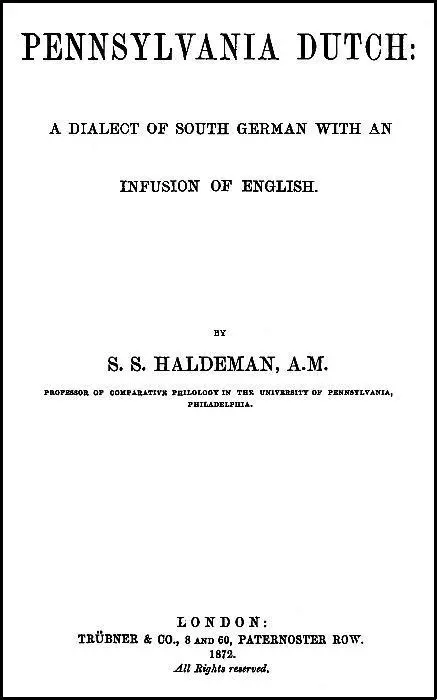
"Pennsylvania Dutch: A Dialect of South German With an Infusion of English" by S. S. Haldeman is a scientific publication written in the late 19th century. The book explores the unique linguistic characteristics of Pennsylvania Dutch, a dialect formed by German-speaking immigrants to Pennsylvania, highlighting its blend of South German roots and English influences. The text delves into various aspects of the dialect, including its phonology, vocabulary, and syntax, making it a valuable resource for those interested in comparative philology and language evolution. The opening of the work introduces the rationale behind studying this dialect, emphasizing its formation over a century within a linguistically diverse community. It describes the historical context of German immigration to Pennsylvania and how various dialects from regions like Rhenish Bavaria and Alsace contributed to the development of Pennsylvania Dutch. The author outlines the influences of limited interactions among the largely agricultural immigrant populations, which led to distinct linguistic changes, thus setting the stage for a detailed examination of phonology, vocabulary, and syntax in subsequent chapters.
Introduction adapted from the source catalogue; source summaries may be automatically generated.
Free to read · English · 27,823 words · No account needed
MAKE TIME FOR A GOOD BOOK
On by default. Untick to stop anonymous reading totals. Each page counts after 10 seconds in view. How this works.
Anonymous counting is on unless you have switched it off.
§ 1. German Words introduced.
If the Germans of Pennsylvania adopted many words from English, the English speaking population applied the appellation of German or Dutch to unfamiliar varieties of objects, such as a Dutch cheese, a German lock; or they adopted the original names, as in calling a form of curds smearcase (G. schmierkäse) in the markets and prices current. German forms of food have furnished the vicinal English with sourcrout, mush, shtreisslers, bretsels, fawstnachts,[70] tseegercase, knep (G. Knöpfe, the k usually pronounced), bower-knep, noodles; and in some of the interior markets, endive must be asked for under the name of 'æntiifi,' even when speaking English. Dutch gives crullers, but stoop (of a house) is hardly known. In English conversation one may hear expressions like "He belongs to the freindschaft" (he is a kinsman or relation); "It makes me greisslich to see an animal killed" (makes me shudder and revolt with disgust--turns my stomach). A strong word without an English equivalent.
The German idiom of using einmal (once) as an expletive, is common, as in "Bring me a chair once," and when a person whose vernacular is English says, "I am through another" (I am confused), he is using a translation of the German durch einander, PG. 'dárich ǝnánnǝr.' Of such introduced words, the following deserve mention.
=Metsel-soup=, originally pudding broth, the butcher's perquisite, but subsequently applied to a gratuity from the animals he has slaughtered.
=Shinner=, G. schinder (a knacker,[71]) an objurgatory epithet
applied by butchers to farmers who compete with them in the
market.
=Speck=, the flitch of salt bacon, particularly when boiled with sourcrout, hence, 'speck and sourcrout.'
=Tsitterly=, calf's-foot jelly.
=Hartley=, a hurdle for drying fruit.
=Snits=, a =snit= (G. schnitz, a cut), a longitudinal section of fruit, particularly apples, and when dried for the kitchen. The term is in use in districts where German is unknown.[72]
=Hootsle=, PG. hutsl, G. hotzel, a dried fruit; Bavar. and Suab. hutzel, a dried pear. In Pennsylvania, a peach dried without removing the stone.
=Dumb= (G. dumm) is much used for stupid.
=Fockle= (G. fackel), a fisherman's torch.
=Mother= (PG. from G. mutter-weh, not parturition, but) a hysterical rising in the throat. The word occurs in old and provincial English.[73]
=Chipmunk=, a ground-squirrel (Tamias); chip probably from its cry, and Swiss munk, a marmot.
=Spook= (G. Spuk), a spectre; and the verb, as--"It spooks there," "The grave-yard spooks."
=Crĭstkintly= (PG. Krischtkintli, G. Chrĭst Kindlein), the Christ Child who is supposed to load the chrĭstmas trees and bring presents at Christmas. Perverted in the Philadelphia newspapers to Kriss Kringle, Kriss Kingle, and Kriss Kinkle.
Your reading position is saved on this browser. Take it to another device with a library code. Reading pages adapt to text, rather than matching a printed edition.
BEHIND THE BOOK
This eBook is for the use of anyone anywhere in the United States and most other parts of the world at no cost and with almost no restrictions whatsoever. You may copy it, give it away or re-use it under the terms of the Project Gutenberg License included with this eBook or online at www.gutenberg.org. If you are not located in the United States, you will have to check the laws of the country where you are located before using this eBook. Read the source licence.
The original source file, including credits and licence, is retained by this library. Request an original-format copy at no charge. Please include the book title and Project Gutenberg identifier #48417.
KEEP YOUR CURIOSITY GOING
Cécile Tormay

Moritz Busch
John L. Ransom
Frances Wright
Cécile Tormay

Mabel Potter Daggett