THE CLASSIC COLLECTION✦An outlaw’s diary: the CommuneCLASSIC FREE BOOKS
An outlaw’s diary: the Commune
Cécile Tormay
THE CLASSIC COLLECTION · 1872
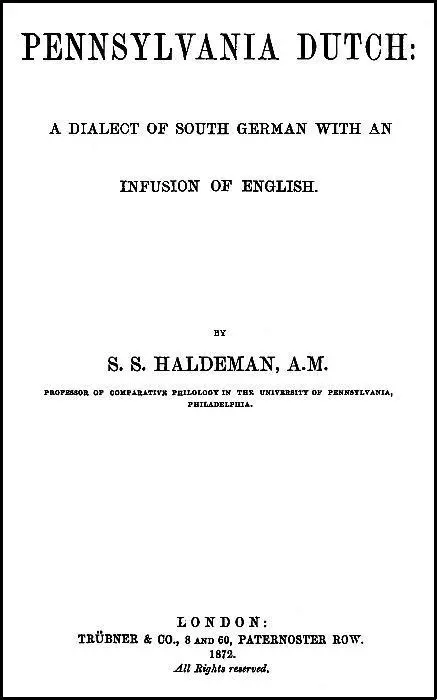
"Pennsylvania Dutch: A Dialect of South German With an Infusion of English" by S. S. Haldeman is a scientific publication written in the late 19th century. The book explores the unique linguistic characteristics of Pennsylvania Dutch, a dialect formed by German-speaking immigrants to Pennsylvania, highlighting its blend of South German roots and English influences. The text delves into various aspects of the dialect, including its phonology, vocabulary, and syntax, making it a valuable resource for those interested in comparative philology and language evolution. The opening of the work introduces the rationale behind studying this dialect, emphasizing its formation over a century within a linguistically diverse community. It describes the historical context of German immigration to Pennsylvania and how various dialects from regions like Rhenish Bavaria and Alsace contributed to the development of Pennsylvania Dutch. The author outlines the influences of limited interactions among the largely agricultural immigrant populations, which led to distinct linguistic changes, thus setting the stage for a detailed examination of phonology, vocabulary, and syntax in subsequent chapters.
Introduction adapted from the source catalogue; source summaries may be automatically generated.
Free to read · English · 27,823 words · No account needed
MAKE TIME FOR A GOOD BOOK
On by default. Untick to stop anonymous reading totals. Each page counts after 10 seconds in view. How this works.
Anonymous counting is on unless you have switched it off.
=Schpel= (a pin), SG. die spelle (a better word than G. stecknadel); Dutch speld (with d educed from l); Lat. SPIcuLa.
=Botsǝr= (masc. a tail-less hen), Holstein, buttars. Provincial G.
butzig (stumpy).
=Mallikǝp= (i.e. thick-headed, a tadpole). Swiss mollig, molli (stout, blunt); Suabian mollig (fleshy). Alsatian muurkrǝntl (tadpole) from muur, G. moder, Eng. mud. The PG. of western New York has taken the New England word polliwog.
=Blech= (tin, a tin cup); dim. 'blechli.' Blechiche Bool (a tin bowl, i.e. a dipper, a convenient word which seems not to have been introduced). In Pennsylvanian English, a tin cup is a tin.
In old English, 'than' represented than and then, and PG. has 'dann' for both G. dann (then) and denn (for); and also 'wann' for wann (when) and wenn (if), as in Rachel Bahn's lines--
"Doch guckt 's ah recht huebsch un' Doch gukt 's aa recht hipsch un nice 'neis' Wann all die Baehm sin so foll ice--" Wan al dii beem sin so fǝl eis--
Yet it looks (auch) also right fair and 'nice' WHEN all the trees are so full of ice.
"Forn bild der reinheit is 's doh, F'r 'n bild dǝr reinheit[1] iss ǝs doo, In fact, mer kenne sehne noh, 'in fækt,' m'r kennǝ seenǝ noo, Dass unser Hertz'[22] so rein muss dass unser hærts so rein[21] muss seih, sei˛, Wann in des Reich mer welle neih." wann in des reich m'r wellǝ nei˛.
For a picture of purity is it (da) here, 'in fact' (wir können sehen darnach) we can perceive therefrom, that our heart must be as pure, (wenn in das reich wir wollen hinein) IF we would enter into the kingdom.
=Baschtǝ= (to husk maize), from 'bascht,' G. bast (soft inner bark, E. bast), applied in PG. to the husk of Indian corn.--Rachel Bahn (1869) thus uses it--
"Die leut sie hocke 's welshcorn ab, Dii leit sii hackǝ 's welschkarn ap, 'S is 'n rechte guhte crop, 's iss 'n rechte guute 'crap,' (fem.) Un' wann's daer genunk werd sei, un wan 's dærr genunk wært sei˛, Noh bashte sies un' fahres eih." noo baschtǝ sii 's un faarǝ 's ei˛.
The people they (ab-hacken) chop off ('s, das) the maize, (es ist) it is a right good 'crop,' and when (es) it becomes (dürr genug) dry enough, they (darnach) afterwards husk it and (fahren) haul it in.
=Greisslich= (to be disagreeably affected). SG. grüselig, G. gräszlich (horrible), E. grisly.
=Noo=, =danoo'=, =danoot'=, =nord=, G. darnach (then, subsequently).
=Bendl= (a string), schuubendl (shoe-string). Swiss bändel.
Your reading position is saved on this browser. Take it to another device with a library code. Reading pages adapt to text, rather than matching a printed edition.
BEHIND THE BOOK
This eBook is for the use of anyone anywhere in the United States and most other parts of the world at no cost and with almost no restrictions whatsoever. You may copy it, give it away or re-use it under the terms of the Project Gutenberg License included with this eBook or online at www.gutenberg.org. If you are not located in the United States, you will have to check the laws of the country where you are located before using this eBook. Read the source licence.
The original source file, including credits and licence, is retained by this library. Request an original-format copy at no charge. Please include the book title and Project Gutenberg identifier #48417.
KEEP YOUR CURIOSITY GOING
Cécile Tormay

Moritz Busch
John L. Ransom
Frances Wright
Cécile Tormay

Mabel Potter Daggett