THE CLASSIC COLLECTION✦An outlaw’s diary: the CommuneCLASSIC FREE BOOKS
An outlaw’s diary: the Commune
Cécile Tormay
THE CLASSIC COLLECTION · 1872
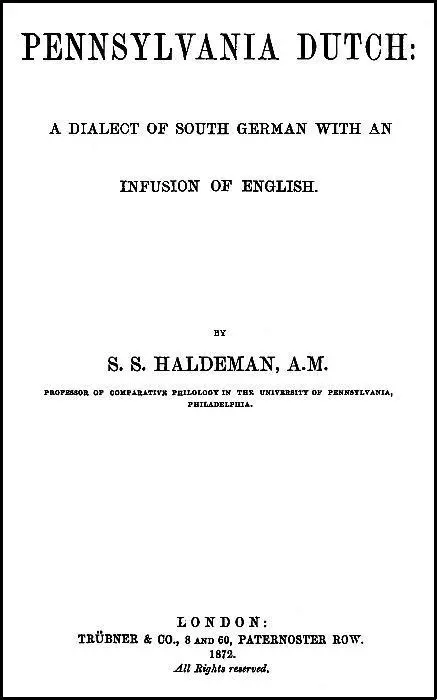
"Pennsylvania Dutch: A Dialect of South German With an Infusion of English" by S. S. Haldeman is a scientific publication written in the late 19th century. The book explores the unique linguistic characteristics of Pennsylvania Dutch, a dialect formed by German-speaking immigrants to Pennsylvania, highlighting its blend of South German roots and English influences. The text delves into various aspects of the dialect, including its phonology, vocabulary, and syntax, making it a valuable resource for those interested in comparative philology and language evolution. The opening of the work introduces the rationale behind studying this dialect, emphasizing its formation over a century within a linguistically diverse community. It describes the historical context of German immigration to Pennsylvania and how various dialects from regions like Rhenish Bavaria and Alsace contributed to the development of Pennsylvania Dutch. The author outlines the influences of limited interactions among the largely agricultural immigrant populations, which led to distinct linguistic changes, thus setting the stage for a detailed examination of phonology, vocabulary, and syntax in subsequent chapters.
Introduction adapted from the source catalogue; source summaries may be automatically generated.
Free to read · English · 27,823 words · No account needed
MAKE TIME FOR A GOOD BOOK
On by default. Untick to stop anonymous reading totals. Each page counts after 10 seconds in view. How this works.
Anonymous counting is on unless you have switched it off.
Wii m'r donaus glǝffǝ sin, bin ich hinnich iin nooch glǝffǝ. As we walked out, I walked behind him.
For 'hinnich,' Alsatian has hing-ǝ, as in 'M'r geen hing-ǝ [nach den] noo dǝ goortǝ noo'--We go along behind the garden.
=Uumǝt=, =oomǝt=, Austr. omad, Swiss amet, G. das grummet (aftermath). Suab. ämt, emt, ömd, aumad; Bavar. âmad.
=Arik=, =arrig= (much, very), Swiss arig, G. arg (bad, cunning).
PG. Ich hab net gwist [Suab. gwest] dass es so arrik reeghǝrt. I did not suppose it to be raining so hard.
=Artlich= (tolerably) is the Swiss artlich and artig.
=Ewwǝ=, G. adv. ēben (really, even, just), but it is PG. 'eewǝ' when it is the adj. even.
Ich hab ewwǝ net gwist for sure eb ær ǝ fraa hǝt ǝdǝr
net. (Rauch.) I did not even know 'for sure' if he has a wife
or not.
=ámanat=, adv. metathesised and adapted from G. an einem Orte (at a place), a dative for an accusative an einen Ort (in a place) as used here. In the example, 'anǝ' is G. an inflected, and zŭ of zu schícken is omitted, as sometimes done in PG.
... wan als ǝ briif kummt f'r ámanat anǝ schikǝ ...
(Rauch.) When ever a letter comes for to send on--to be sent
on.
=Henkweidǝ= (weeping willow). G. Hängebirke, is hanging birch.
=Tappǝr= (quickly), as in Schpring tappǝr run quick! be in a hurry--thus used in Westerwald, and as very in Silesia. G. tapfer (brave, bravely), E. dapper.
=Meenǝr= (more), =Meenscht= (most), for G. mehr, meist, are réferable to mancher and a hypothetic mannigste. 'Mee' and 'mee˛' (more), Swiss--"Was wett i meh?" What would I more. "Nimme meh," never more. PG. 'Was wet ich mee? Nimmi mee.' (See Ellis, Early English Pronunciation, p. 663, note 39.)
=Schtrublich=, =schtruwlich=. G. struppig (bristly, rough), Swiss strublig, PG. 'schtruwlich' (disordered, uncombed, as hair). English of the locality stroobly.
=Neewich=; SG. nebensich, Wetterau (upper Hessia) nêbig, G.
neben (beside).
"Naevvich der mommy ruht er now [Eng. now] In sellem Gottes-acker[19] dort, Shraegs[20] fun der Kreutz Creek Kerrich nuf, [hinauf.] Uft denk ich doch an seller ort!"--Rachel Bahn.
=Hensching=, G. handschue (gloves, Sw. händschen) becomes a new word with 'hen' for hände (hands), the ä umlaut being used to pluralise, but the word is singular also, and, to particularise, a glove proper is 'fing-er hensching' and a mitten 'fauscht-hensching.' This termination is given to 'pærsching' a peach.
=Sidder= (since), Swiss sider, sitter; Suabian and Silesian sider; Scotch, etc., sithens.
Your reading position is saved on this browser. Take it to another device with a library code. Reading pages adapt to text, rather than matching a printed edition.
BEHIND THE BOOK
This eBook is for the use of anyone anywhere in the United States and most other parts of the world at no cost and with almost no restrictions whatsoever. You may copy it, give it away or re-use it under the terms of the Project Gutenberg License included with this eBook or online at www.gutenberg.org. If you are not located in the United States, you will have to check the laws of the country where you are located before using this eBook. Read the source licence.
The original source file, including credits and licence, is retained by this library. Request an original-format copy at no charge. Please include the book title and Project Gutenberg identifier #48417.
KEEP YOUR CURIOSITY GOING
Cécile Tormay

Moritz Busch
John L. Ransom
Frances Wright
Cécile Tormay

Mabel Potter Daggett