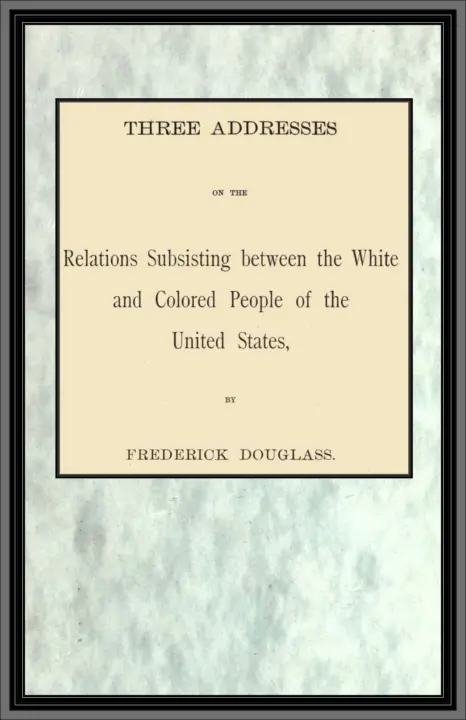
Three addresses on the relations subsisting between the white and colored people of the United States
Frederick Douglass
THE CLASSIC COLLECTION · 1881
"Life and Times of Frederick Douglass: His Early Life as a Slave, His Escape..." by Frederick Douglass is an autobiography published in 1881 and revised in 1892. This third and final autobiography reveals details about Douglass's enslavement and escape that were too dangerous to share earlier. It chronicles his entire life, from childhood memories with his grandparents through his experiences during and after the Civil War, including encounters with Presidents Lincoln and Garfield, and his service as U.S. Marshall of the District of Columbia.
Introduction adapted from the source catalogue; source summaries may be automatically generated.
Free to read · English · 192,936 words · No account needed
MAKE TIME FOR A GOOD BOOK
On by default. Untick to stop anonymous reading totals. Each page counts after 10 seconds in view. How this works.
Anonymous counting is on unless you have switched it off.
“You know the 54th. To you, more than to any one man belongs the credit of raising that regiment. Think of its noble and brave officers literally hacked to pieces, while many of its rank and file have been sold into slavery worse than death, and pardon me, if I hesitate about assisting in raising a fourth regiment until the President shall give the same protection to them as to white soldiers.
With warm and sincere regards, FREDERICK DOUGLAS.”
“Since writing the foregoing letter, which we have now put upon record, we have received assurances from Major Stearns that the government of the United States is already taking measures which will secure the captured colored soldiers at Charleston and elsewhere the same protection against slavery and cruelty extended to white soldiers. What ought to have been done at the beginning, comes late, but it comes. The poor colored soldiers have purchased interference dearly. It really seems that nothing of justice, liberty, or humanity can come to us except through tears and blood.”
My efforts to secure just and fair treatment for the colored soldiers did not stop at letters and speeches. At the suggestion of my friend, Major Stearns, to whom the foregoing letter was addressed, I was induced to go to Washington and lay the complaints of my people before President Lincoln and the secretary of war; and to urge upon them such action as should secure to the colored troops then fighting for the country, a reasonable degree of fair play. I need not say that at the time I undertook this mission it required much more nerve than a similar one would require now. The distance then between the black man and the white American citizen, was immeasurable. I was an ex-slave, identified with a despised race; and yet I was to meet the most exalted person in this great republic. It was altogether an unwelcome duty, and one from which I would gladly have been excused. I could not know what kind of a reception would be accorded me. I might be told to go home and mind my business, and leave such questions as I had come to discuss to be managed by the men wisely chosen by the American people to deal with them. Or I might be refused an interview altogether. Nevertheless, I felt bound to go; and my acquaintance with Senators Charles Sumner, Henry Wilson, Samuel Pomeroy, Secretary Salmon P. Chase, Secretary William H. Seward, and Assistant Secretary of War Charles A. Dana, encouraged me to hope at least for a civil reception. My confidence was fully justified in the result. I shall never forget my first interview with this great man. I was accompanied to the executive mansion and introduced to President Lincoln by Senator Pomeroy. The room in which he received visitors was the one now used by the president’s secretaries. I entered it with a moderate estimate of my own consequence, and yet there I was to talk with, and even to advise, the head man of a great nation. Happily for me, there was no vain pomp and ceremony about him. I was never more quickly or more completely put at ease in the presence of a great man, than in that of Abraham Lincoln. He was seated, when I entered, in a low arm chair, with his feet extended on the floor, surrounded by a large number of documents, and several busy secretaries. The room bore the marks of business, and the persons in it, the president included, appeared to be much over-worked and tired. Long lines of care were already deeply written on Mr. Lincoln’s brow, and his strong face, full of earnestness, lighted up as soon as my name was mentioned. As I approached and was introduced to him, he rose and extended his hand, and bade me welcome. I at once felt myself in the presence of an honest man--one whom I could love, honor, and trust without reserve or doubt. Proceeding to tell him who I was, and what I was doing, he promptly, but kindly, stopped me, saying, “I know who you are, Mr. Douglass; Mr. Seward has told me all about you. Sit down. I am glad to see you.” I then told him the object of my visit: that I was assisting to raise colored troops; that several months before I had been very successful in getting men to enlist, but that now it was not easy to induce the colored men to enter the service, because there was a feeling among them that the government did not deal fairly with them in several respects. Mr. Lincoln asked me to state particulars. I replied that there were three particulars which I wished to bring to his attention. First, that colored soldiers ought to receive the same wages as those paid to white soldiers. Second, that colored soldiers ought to receive the same protection when taken prisoners, and be exchanged as readily, and on the same terms, as any other prisoners, and if Jefferson Davis should shoot or hang colored soldiers in cold blood, the United States government should retaliate in kind and degree without delay upon Confederate prisoners in its hands. Third, when colored soldiers, seeking the “bauble-reputation at the cannon’s mouth,” performed great and uncommon service on the battle-field, they should be rewarded by distinction and promotion, precisely as white soldiers are rewarded for like services.
Your reading position is saved on this browser. Take it to another device with a library code. Reading pages adapt to text, rather than matching a printed edition.
Frederick Douglass
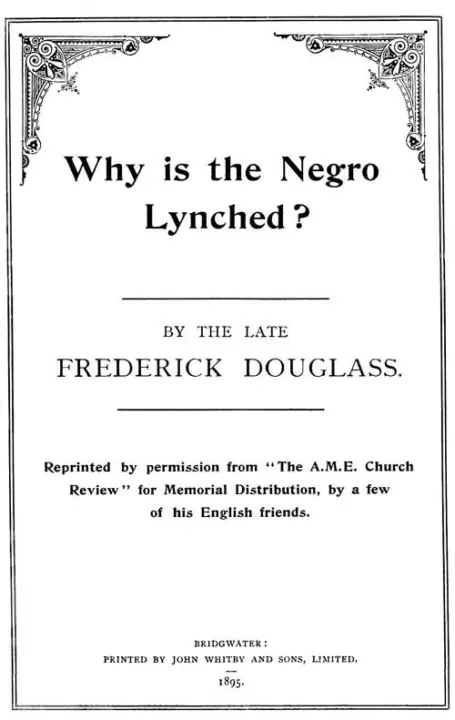
Frederick Douglass
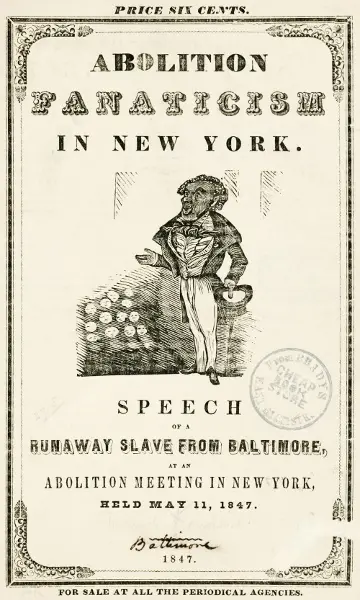
Frederick Douglass
Frederick Douglass
BEHIND THE BOOK
This eBook is for the use of anyone anywhere in the United States and most other parts of the world at no cost and with almost no restrictions whatsoever. You may copy it, give it away or re-use it under the terms of the Project Gutenberg License included with this eBook or online at www.gutenberg.org. If you are not located in the United States, you will have to check the laws of the country where you are located before using this eBook. Read the source licence.
The original source file, including credits and licence, is retained by this library. Request an original-format copy at no charge. Please include the book title and Project Gutenberg identifier #71893.
KEEP YOUR CURIOSITY GOING
Cécile Tormay

Moritz Busch
John L. Ransom
Frances Wright
Cécile Tormay

Mabel Potter Daggett