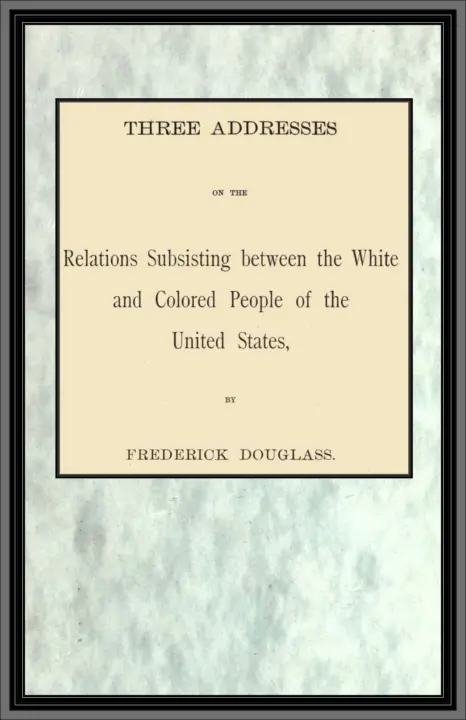
Three addresses on the relations subsisting between the white and colored people of the United States
Frederick Douglass
THE CLASSIC COLLECTION · 1881
"Life and Times of Frederick Douglass: His Early Life as a Slave, His Escape..." by Frederick Douglass is an autobiography published in 1881 and revised in 1892. This third and final autobiography reveals details about Douglass's enslavement and escape that were too dangerous to share earlier. It chronicles his entire life, from childhood memories with his grandparents through his experiences during and after the Civil War, including encounters with Presidents Lincoln and Garfield, and his service as U.S. Marshall of the District of Columbia.
Introduction adapted from the source catalogue; source summaries may be automatically generated.
Free to read · English · 192,936 words · No account needed
MAKE TIME FOR A GOOD BOOK
On by default. Untick to stop anonymous reading totals. Each page counts after 10 seconds in view. How this works.
Anonymous counting is on unless you have switched it off.
Proclamation of emancipation--Its reception in Boston--Objections brought against it--Its effect on the country--Interview with President Lincoln--New York riots--Re-election of Mr. Lincoln--His inauguration, and inaugural--Vice-President Johnson--Presidential reception--The fall of Richmond--Fanueil Hall--The assassination-- Condolence.
The first of January, 1863, was a memorable day in the progress of American liberty and civilization. It was the turning-point in the conflict between freedom and slavery. A death blow was then given to the slaveholding rebellion. Until then the federal arm had been more than tolerant to that relict of barbarism. It had defended it inside the slave States; it had countermanded the emancipation policy of John C. Fremont in Missouri; it had returned slaves to their so-called owners; and had threatened that any attempt on the part of the slaves to gain their freedom by insurrection, or otherwise, would be put down with an iron hand; it had even refused to allow the Hutchinson family to sing their anti-slavery songs in the camps of the Army of the Potomac; it had surrounded the houses of slaveholders with bayonets for their protection; and through its secretary of war, William H. Seward, had given notice to the world that, “however the war for the Union might terminate, no change would be made in the relation of master and slave.” Upon this pro-slavery platform the war against the rebellion had been waged during more than two years. It had not been a war of conquest, but rather a war of conciliation. McClellan, in command of the army, had been trying, apparently, to put down the rebellion without hurting the rebels, certainly without hurting slavery, and the government had seemed to coöperate with him in both respects. Charles Sumner, William Lloyd Garrison, Wendell Phillips, Gerrit Smith, and the whole anti-slavery phalanx at the North, had denounced this policy, and had besought Mr. Lincoln to adopt an opposite one, but in vain. Generals, in the field, and councils in the Cabinet, had persisted in advancing this policy through defeats and disasters, even to the verge of ruin. We fought the rebellion, but not its cause. The key to the situation was the four million of slaves; yet the slave who loved us, was hated, and the slaveholder who hated us, was loved. We kissed the hand that smote us, and spurned the hand that helped us. When the means of victory were before us,--within our grasp,-- we went in search of the means of defeat. And now, on this day of January 1st, 1863, the formal and solemn announcement was made that thereafter the government would be found on the side of emancipation. This proclamation changed everything. It gave a new direction to the councils of the Cabinet, and to the conduct of the national arms. I shall leave to the statesman, the philosopher, and historian, the more comprehensive discussion of this document, and only tell how it touched me, and those in like condition with me at the time. I was in Boston, and its reception there may indicate the importance attached to it elsewhere. An immense assembly convened in Tremont Temple to await the first flash of the electric wires announcing the “new departure.” Two years of war prosecuted in the interests of slavery, had made free speech possible in Boston, and we were now met together to receive and celebrate the first utterance of the long-hoped-for proclamation, if it came, and, if it did not come, to speak our minds freely; for, in view of the past, it was by no means certain that it would come. The occasion, therefore, was one of both hope and fear. Our ship was on the open sea, tossed by a terrible storm; wave after wave was passing over us, and every hour was fraught with increasing peril. Whether we should survive or perish, depended in large measure upon the coming of this proclamation. At least so we felt. Although the conditions on which Mr. Lincoln had promised to withhold it, had not been complied with, yet, from many considerations, there was room to doubt and fear. Mr. Lincoln was known to be a man of tender heart, and boundless patience: no man could tell to what length he might go, or might refrain from going in the direction of peace and reconciliation. Hitherto, he had not shown himself a man of heroic measures, and, properly enough, this step belonged to that class. It must be the end of all compromises with slavery--a declaration that thereafter the war was to be conducted on a new principle, with a new aim. It would be a full and fair assertion that the government would neither trifle, or be trifled with any longer. But would it come? On the side of doubt, it was said that Mr. Lincoln’s kindly nature might cause him to relent at the last moment; that Mrs. Lincoln, coming from an old slaveholding family, would influence him to delay, and give the slaveholders one other chance.[C] Every moment of waiting chilled our hopes, and strengthened our fears. A line of messengers was established between the telegraph office and the platform of Tremont Temple, and the time was occupied with brief speeches from Hon. Thomas Russell of Plymouth, Miss Anna E. Dickinson (a lady of marvelous eloquence), Rev. Mr. Grimes, J. Sella Martin, William Wells Brown, and myself. But speaking or listening to speeches was not the thing for which the people had come together. The time for argument was passed. It was not logic, but the trump of jubilee, which everybody wanted to hear. We were waiting and listening as for a bolt from the sky, which should rend the fetters of four million of slaves; we were watching, as it were, by the dim light of the stars, for the dawn of a new day; we were longing for the answer to the agonizing prayers of centuries. Remembering those in bonds as bound with them, we wanted to join in the shout for freedom, and in the anthem of the redeemed.
Your reading position is saved on this browser. Take it to another device with a library code. Reading pages adapt to text, rather than matching a printed edition.
Frederick Douglass
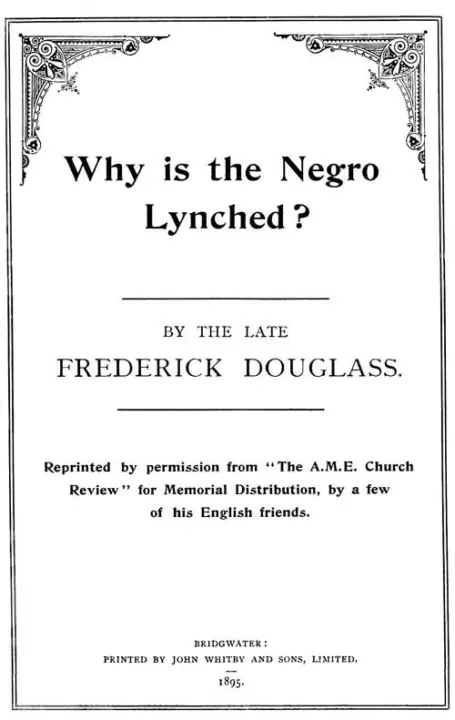
Frederick Douglass
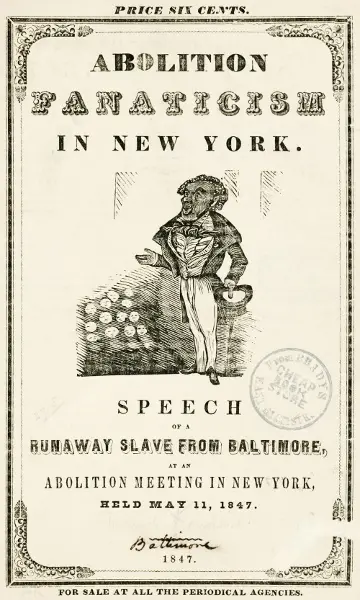
Frederick Douglass
Frederick Douglass
BEHIND THE BOOK
This eBook is for the use of anyone anywhere in the United States and most other parts of the world at no cost and with almost no restrictions whatsoever. You may copy it, give it away or re-use it under the terms of the Project Gutenberg License included with this eBook or online at www.gutenberg.org. If you are not located in the United States, you will have to check the laws of the country where you are located before using this eBook. Read the source licence.
The original source file, including credits and licence, is retained by this library. Request an original-format copy at no charge. Please include the book title and Project Gutenberg identifier #71893.
KEEP YOUR CURIOSITY GOING
Cécile Tormay

Moritz Busch
John L. Ransom
Frances Wright
Cécile Tormay

Mabel Potter Daggett