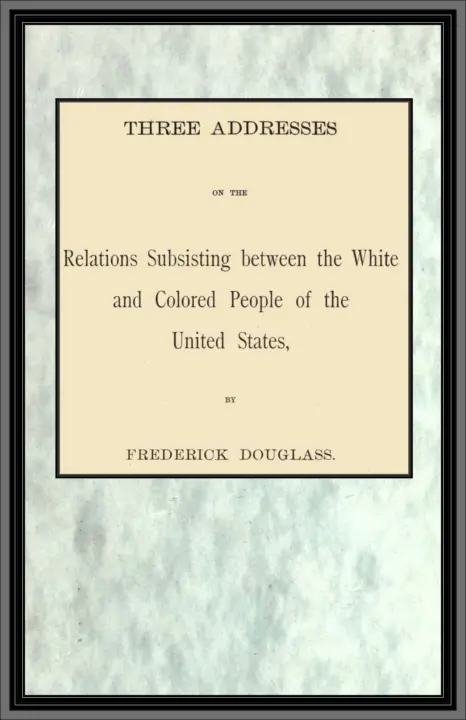
Three addresses on the relations subsisting between the white and colored people of the United States
Frederick Douglass
THE CLASSIC COLLECTION · 1881
"Life and Times of Frederick Douglass: His Early Life as a Slave, His Escape..." by Frederick Douglass is an autobiography published in 1881 and revised in 1892. This third and final autobiography reveals details about Douglass's enslavement and escape that were too dangerous to share earlier. It chronicles his entire life, from childhood memories with his grandparents through his experiences during and after the Civil War, including encounters with Presidents Lincoln and Garfield, and his service as U.S. Marshall of the District of Columbia.
Introduction adapted from the source catalogue; source summaries may be automatically generated.
Free to read · English · 192,936 words · No account needed
MAKE TIME FOR A GOOD BOOK
On by default. Untick to stop anonymous reading totals. Each page counts after 10 seconds in view. How this works.
Anonymous counting is on unless you have switched it off.
“ROCHESTER, August 1st, 1863.
“My Dear Sir--Having declined to attend the meeting to promote enlistments, appointed for me at Pittsburgh, in present circumstances, I owe you a word of explanation. I have hitherto deemed it a duty, as it certainly has been a pleasure, to coöperate with you in the work of raising colored troops in the free States to fight the battles of the Republic against slaveholding rebels and traitors. Upon the first call you gave me to this work I responded with alacrity. I saw, or thought I saw a ray of light, brightening the future of my whole race as well as that of our war-troubled country, in arousing colored men to fight for the nation’s life. I continue to believe in the black man’s arm, and still have some hope in the integrity of our rulers. Nevertheless I must for the present leave to others the work of persuading colored men to join the Union army. I owe it to my long-abused people, and especially to those already in the army, to expose their wrongs and plead their cause. I cannot do that in connection with recruiting. When I plead for recruits I want to do it with all my heart, without qualification. I cannot do that now. The impression settles upon me that colored men have much over-rated the enlightenment, justice, and generosity of our rulers at Washington. In my humble way I have contributed somewhat to that false estimate. You know that when the idea of raising colored troops was first suggested, the special duty to be assigned them, was the garrisoning of forts and arsenals in certain warm, unhealthy, and miasmatic localities in the South. They were thought to be better adapted to that service than white troops. White troops trained to war, brave, and daring, were to take fortifications, and the blacks were to hold them from falling again into the hands of the rebels. Three advantages were to arise out of this wise division of labor: 1st, the spirit and pride of white troops was not to waste itself in dull monotonous inactivity in fort life; their arms were to be kept bright by constant use. 2d, The health of white troops was to be preserved. 3d, Black troops were to have the advantage of sound military training and to be otherwise useful, at the same time that they should be tolerably secure from capture by the rebels, who early avowed their determination to enslave and slaughter them in defiance of the laws of war. Two out of the three advantages were to accrue to the white troops. Thus far, however, I believe that no such duty as holding fortifications has been committed to colored troops. They have done far other and more important work than holding fortifications. I have no special complaint to make at this point, and I simply mention it to strengthen the statement, that from the beginning of this business it was the confident belief among both the colored and white friends of colored enlistments that President Lincoln as commander-in-chief of the army and navy, would certainly see to it that his colored troops should be so handled and disposed of as to be but little exposed to capture by the rebels, and that, if so exposed, as they have repeatedly been from the first, the President possessed both the disposition and the means for compelling the rebels to respect the rights of such as might fall into their hands. The piratical proclamation of Jefferson Davis, announcing slavery and assassination to colored prisoners was before the country and the world. But men had faith in Mr. Lincoln and his advisers. He was silent to be sure, but charity suggested that being a man of action rather than words he only waited for a case in which he should be required to act. This faith in the man enabled us to speak with warmth and effect in urging enlistments among colored men. That faith, my dear sir, is now nearly gone. Various occasions have arisen during the last six months for the exercise of his power in behalf of the colored men in his service. But no word comes to us from the war department, sternly assuring the rebel chief that inquisition shall yet be made for innocent blood. No word of retaliation when a black man is slain by a rebel in cold blood. No word was said when free men from Massachusetts were caught and sold into slavery in Texas. No word is said when brave black men who, according to the testimony of both friend and foe, fought like heroes to plant the star-spangled banner on the blazing parapets of Fort Wagner, and in doing so were captured, some mutilated and killed, and others sold into slavery. The same crushing silence reigns over this scandalous outrage as over that of the slaughtered teamsters at Murfreesboro; the same as over that at Milliken’s Bend and Vicksburg. I am free to say, my dear sir, that the case looks as if the confiding colored soldiers had been betrayed into bloody hands by the very government in whose defence they were heroically fighting. I know what you will say to this; you will say ‘wait a little longer, and after all the best way to have justice done to your people is to get them into the army as fast as you can.’ You may be right in this; my argument has been the same, but have we not already waited, and have we not already shown the highest qualities of soldiers, and on this account deserve the protection of the government for which we are fighting? Can any case stronger than that before Charleston ever arise! If the President is ever to demand justice and humanity, for black soldiers, is not this the time for him to do it? How many 54th’s must be cut to pieces, its mutilated prisoners killed, and its living sold into slavery, to be tortured to death by inches, before Mr. Lincoln shall say, ‘Hold, enough!’
Your reading position is saved on this browser. Take it to another device with a library code. Reading pages adapt to text, rather than matching a printed edition.
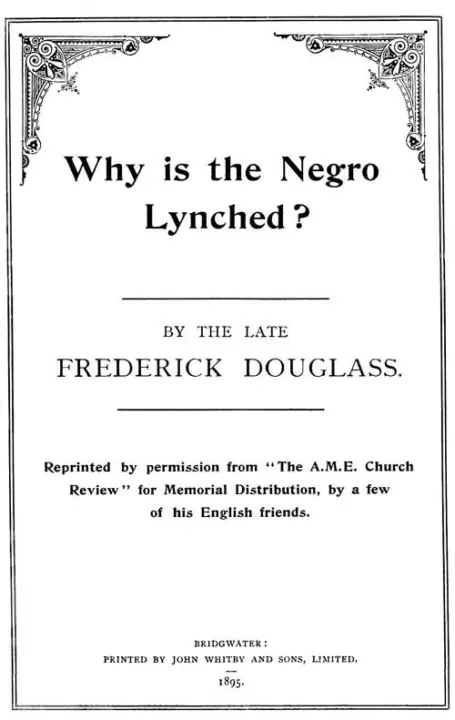
Frederick Douglass
Frederick Douglass
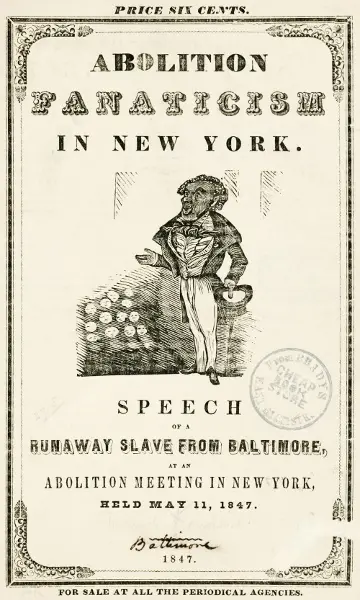
Frederick Douglass
Frederick Douglass
BEHIND THE BOOK
This eBook is for the use of anyone anywhere in the United States and most other parts of the world at no cost and with almost no restrictions whatsoever. You may copy it, give it away or re-use it under the terms of the Project Gutenberg License included with this eBook or online at www.gutenberg.org. If you are not located in the United States, you will have to check the laws of the country where you are located before using this eBook. Read the source licence.
The original source file, including credits and licence, is retained by this library. Request an original-format copy at no charge. Please include the book title and Project Gutenberg identifier #71893.
KEEP YOUR CURIOSITY GOING
Cécile Tormay

Moritz Busch
John L. Ransom
Frances Wright
Cécile Tormay

Mabel Potter Daggett