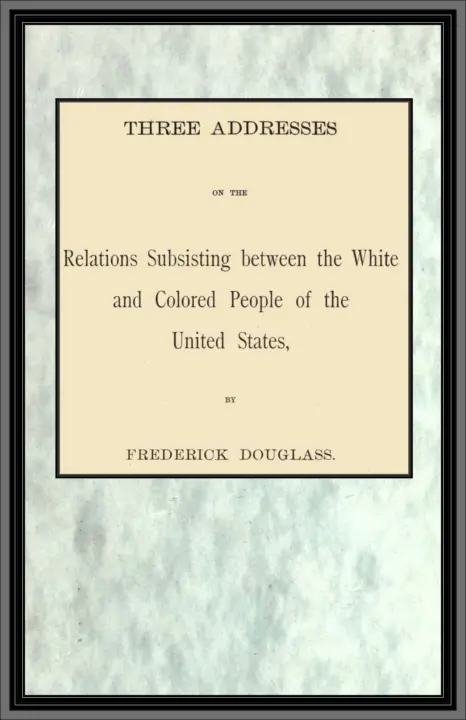
Three addresses on the relations subsisting between the white and colored people of the United States
Frederick Douglass
THE CLASSIC COLLECTION · 1881
"Life and Times of Frederick Douglass: His Early Life as a Slave, His Escape..." by Frederick Douglass is an autobiography published in 1881 and revised in 1892. This third and final autobiography reveals details about Douglass's enslavement and escape that were too dangerous to share earlier. It chronicles his entire life, from childhood memories with his grandparents through his experiences during and after the Civil War, including encounters with Presidents Lincoln and Garfield, and his service as U.S. Marshall of the District of Columbia.
Introduction adapted from the source catalogue; source summaries may be automatically generated.
Free to read · English · 192,936 words · No account needed
MAKE TIME FOR A GOOD BOOK
On by default. Untick to stop anonymous reading totals. Each page counts after 10 seconds in view. How this works.
Anonymous counting is on unless you have switched it off.
Anti-slavery conventions held in parts of New England, and in some of the Middle and Western States--Mobs--Incidents, etc.
The year 1843 was one of remarkable anti-slavery activity. The New England Anti-Slavery Society at its annual meeting, held in the spring of that year, resolved, under the auspices of Mr. Garrison and his friends, to hold a series of one hundred conventions. The territory embraced in this plan for creating anti-slavery sentiment included New Hampshire, Vermont, New York, Ohio, Indiana, and Pennsylvania. I had the honor to be chosen one of the agents to assist in these proposed conventions, and I never entered upon any work with more heart and hope. All that the American people needed, I thought, was light. Could they know slavery as I knew it, they would hasten to the work of its extinction. The corps of speakers who were to be associated with me in carrying on these conventions were Messrs. George Bradburn, John A. Collins, James Monroe, William A. White, Charles L. Remond, and Sydney Howard Gay. They were all masters of the subject, and some of them able and eloquent orators. It was a piece of great good fortune to me, only a few years from slavery as I was, to be brought into contact with such men. It was a real campaign, and required nearly six months for its accomplishment.
Those who only know the State of Vermont as it is to-day, can hardly understand, and must wonder that there was need for anti-slavery effort within its borders forty years ago. Our first convention was held in Middlebury, its chief seat of learning, and the home of William Slade, who was for years the co-worker with John Quincy Adams in Congress; and yet in this town the opposition to our anti-slavery convention was intensely bitter and violent. The only man of note in the town whom I now remember as giving us sympathy or welcome was Mr. Edward Barber, who was a man of courage as well as ability, and did his best to make our convention a success. In advance of our arrival, the college students had very industriously and mischievously placarded the town with violent aspersions of our characters, and the grossest misrepresentations of our principles, measures, and objects. I was described as an escaped convict from the State Prison, and the other speakers were assailed not less slanderously. Few people attended our meeting, and apparently little was accomplished by it. In the neighboring town of Ferrisburgh the case was different and more favorable. The way had been prepared for us by such stalwart anti-slavery workers as Orson S. Murray, Charles C. Burleigh, Rowland T. Robinson, and others. Upon the whole, however, the several towns visited showed that Vermont was surprisingly under the influence of the slave power. Her proud boast that no slave had ever been delivered up to his master within her borders did not hinder her hatred to anti-slavery. What was true of the Green Mountain State in this respect, was most discouragingly true of New York, the State next visited. All along the Erie canal, from Albany to Buffalo, there was apathy, indifference, aversion, and sometimes mobocratic spirit evinced. Even Syracuse, afterwards the home of the humane Samuel J. May, and the scene of the “Jerry rescue,” where Gerrit Smith, Beriah Greene, William Goodell, Alvin Stewart, and other able men since taught their noblest lessons, would not at that time furnish us with church, market, house, or hall in which to hold our meetings. Discovering this state of things, some of our number were disposed to turn our backs upon the town, and shake its dust from our feet, but of these, I am glad to say, I was not one. I had somewhere read of a command to go into the hedges and highways and compel men to come in. Mr. Stephen Smith, under whose hospitable roof we were made at home, thought as I did. It would be easy to silence anti-slavery agitation if refusing its agents the use of halls and churches could effect that result. The house of our friend Smith stood on the southwest corner of the park, which was well covered with young trees, too small to furnish shade or shelter, but better than none. Taking my stand under a small tree, in the southeast corner of this park, I began to speak in the morning to an audience of five persons, and before the close of my afternoon meeting I had before me not less than five hundred. In the evening I was waited upon by officers of the Congregational church, and tendered the use of an old wooden building, which they had deserted for a better, but still owned; and here our convention was continued during three days. I believe there has been no trouble to find places in Syracuse in which to hold anti-slavery meetings since. I never go there without endeavoring to see that tree, which, like the cause it sheltered, has grown large and strong and imposing.
Your reading position is saved on this browser. Take it to another device with a library code. Reading pages adapt to text, rather than matching a printed edition.
Frederick Douglass
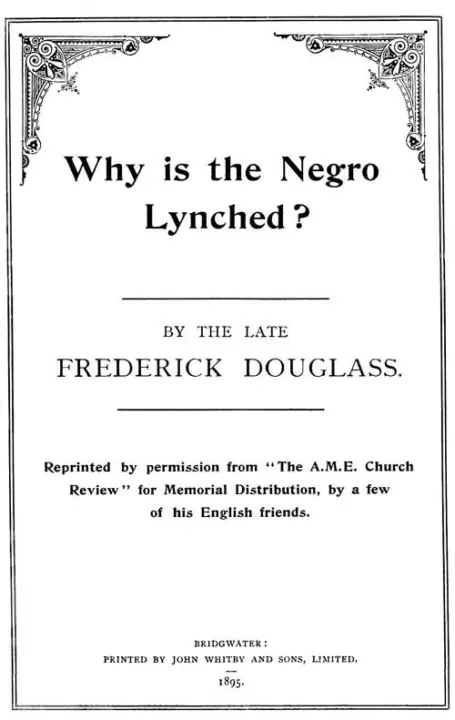
Frederick Douglass
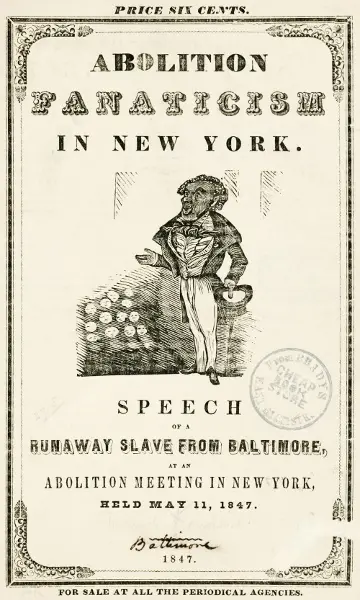
Frederick Douglass
Frederick Douglass
BEHIND THE BOOK
This eBook is for the use of anyone anywhere in the United States and most other parts of the world at no cost and with almost no restrictions whatsoever. You may copy it, give it away or re-use it under the terms of the Project Gutenberg License included with this eBook or online at www.gutenberg.org. If you are not located in the United States, you will have to check the laws of the country where you are located before using this eBook. Read the source licence.
The original source file, including credits and licence, is retained by this library. Request an original-format copy at no charge. Please include the book title and Project Gutenberg identifier #71893.
KEEP YOUR CURIOSITY GOING
Cécile Tormay

Moritz Busch
John L. Ransom
Frances Wright
Cécile Tormay

Mabel Potter Daggett