
Three addresses on the relations subsisting between the white and colored people of the United States
Frederick Douglass
THE CLASSIC COLLECTION · 1881
"Life and Times of Frederick Douglass: His Early Life as a Slave, His Escape..." by Frederick Douglass is an autobiography published in 1881 and revised in 1892. This third and final autobiography reveals details about Douglass's enslavement and escape that were too dangerous to share earlier. It chronicles his entire life, from childhood memories with his grandparents through his experiences during and after the Civil War, including encounters with Presidents Lincoln and Garfield, and his service as U.S. Marshall of the District of Columbia.
Introduction adapted from the source catalogue; source summaries may be automatically generated.
Free to read · English · 192,936 words · No account needed
MAKE TIME FOR A GOOD BOOK
On by default. Untick to stop anonymous reading totals. Each page counts after 10 seconds in view. How this works.
Anonymous counting is on unless you have switched it off.
City annoyances--Plantation regrets--My mistress--Her history-- Her kindness--My master--His sourness--My comforts--Increased sensitiveness--My occupation--Learning to read--Baneful effects of slaveholding on my dear, good mistress--Mr. Hugh forbids Mrs. Sophia to teach me further--Clouds gather on my bright prospects-- Master Auld’s exposition of the Philosophy of Slavery--City slaves-- Country slaves--Contrasts--Exceptions--Mr. Hamilton’s two slaves-- Mrs. Hamilton’s cruel treatment of them--Piteous aspect presented by them--No power to come between the slave and slaveholder.
Established in my new home in Baltimore, I was not very long in perceiving that in picturing to myself what was to be my life there, my imagination had painted only the bright side; and that the reality had its dark shades as well as its light ones. The open country which had been so much to me, was all shut out. Walled in on every side by towering brick buildings, the heat of the summer was intolerable to me, and the hard brick pavements almost blistered my feet. If I ventured out on to the streets, new and strange objects glared upon me at every step, and startling sounds greeted my ears from all directions. My country eyes and ears were confused and bewildered. Troops of hostile boys pounced upon me at every corner. They chased me, and called me “Eastern-Shore man,” till really I almost wished myself back on the Eastern Shore. My new mistress happily proved to be all she had seemed, and in her presence I easily forgot all outside annoyances. Mrs. Sophia was naturally of an excellent disposition--kind, gentle, and cheerful. The supercilious contempt for the rights and feelings of others, and the petulence and bad humor which generally characterized slaveholding ladies, were all quite absent from her manner and bearing toward me. She had never been a slaveholder--a thing then quite unusual at the South--but had depended almost entirely upon her own industry for a living. To this fact the dear lady no doubt owed the excellent preservation of her natural goodness of heart, for slavery could change a saint into a sinner, and an angel into a demon. I hardly knew how to behave towards “Miss Sopha,” as I used to call Mrs. Hugh Auld. I could not approach her even as I had formerly approached Mrs. Thomas Auld. Why should I hang down my head, and speak with bated breath, when there was no pride to scorn me, no coldness to repel me, and no hatred to inspire me with fear? I therefore soon came to regard her as something more akin to a mother than a slaveholding mistress. So far from deeming it impudent in a slave to look her straight in the face, she seemed ever to say, “look up, child; don’t be afraid.” The sailors belonging to the sloop esteemed it a great privilege to be the bearers of parcels or messages to her, for whenever they came, they were sure of a most kind and pleasant reception. If little Thomas was her son, and her most dearly loved child, she made me something like his half-brother in her affections. If dear Tommy was exalted to a place on his mother’s knee, “Feddy” was honored by a place at the mother’s side. Nor did the slave-boy lack the caressing strokes of her gentle hand, soothing him into the consciousness that, though motherless, he was not friendless. Mrs. Auld was not only kind-hearted, but remarkably pious; frequent in her attendance of public worship, much given to reading the Bible, and to chanting hymns of praise when alone. Mr. Hugh was altogether a different character. He cared very little about religion; knew more of the world and was more a part of the world, than his wife. He set out doubtless to be, as the world goes, a respectable man, and to get on by becoming a successful ship-builder, in that city of ship-building. This was his ambition, and it fully occupied him. I was of course of very little consequence to him, and when he smiled upon me, as he sometimes did, the smile was borrowed from his lovely wife, and like all borrowed light, was transient, and vanished with the source whence it was derived. Though I must in truth characterize Master Hugh as a sour man of forbidding appearance, it is due to him to acknowledge that he was never cruel to me, according to the notion of cruelty in Maryland. During the first year or two, he left me almost exclusively to the management of his wife. She was my law-giver. In hands so tender as hers, and in the absence of the cruelties of the plantation, I became both physically and mentally much more sensitive, and a frown from my mistress caused me far more suffering than had Aunt Katy’s hardest cuffs. Instead of the cold, damp floor of my old master’s kitchen, I was on carpets; for the corn bag in winter, I had a good straw bed, well furnished with covers; for the coarse corn meal in the morning, I had good bread and mush occasionally; for my old tow-linen shirt, I had good clean clothes. I was really well off. My employment was to run of errands, and to take care of Tommy; to prevent his getting in the way of carriages, and to keep him out of harm’s way generally. So for a time everything went well. I say for a time, because the fatal poison of irresponsible power, and the natural influence of slave customs, were not very long in making their impression on the gentle and loving disposition of my excellent mistress. She regarded me at first as a child, like any other. This was the natural and spontaneous thought; afterwards, when she came to consider me as property, our relations to each other were changed, but a nature so noble as hers could not instantly become perverted, and it took several years before the sweetness of her temper was wholly lost.
Your reading position is saved on this browser. Take it to another device with a library code. Reading pages adapt to text, rather than matching a printed edition.
Frederick Douglass
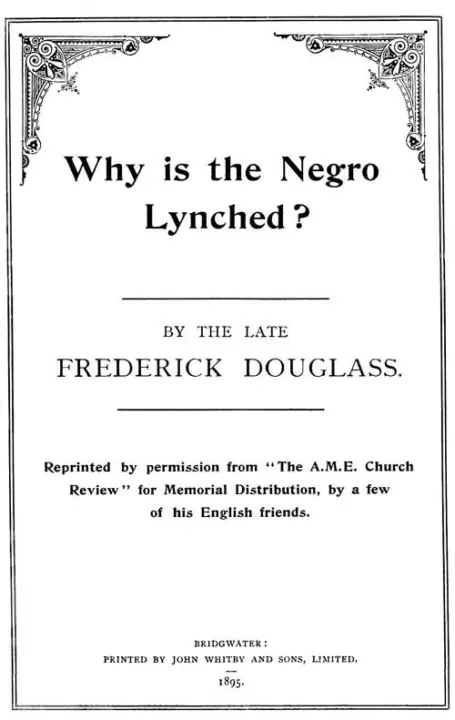
Frederick Douglass
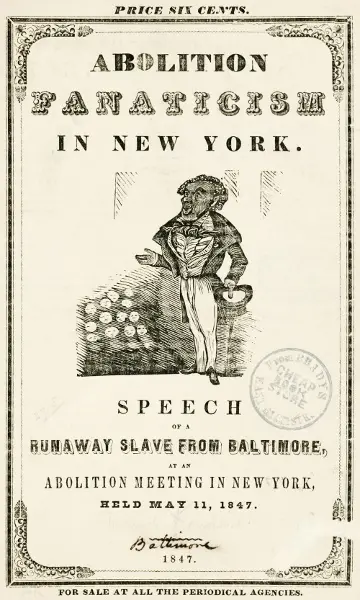
Frederick Douglass
Frederick Douglass
BEHIND THE BOOK
This eBook is for the use of anyone anywhere in the United States and most other parts of the world at no cost and with almost no restrictions whatsoever. You may copy it, give it away or re-use it under the terms of the Project Gutenberg License included with this eBook or online at www.gutenberg.org. If you are not located in the United States, you will have to check the laws of the country where you are located before using this eBook. Read the source licence.
The original source file, including credits and licence, is retained by this library. Request an original-format copy at no charge. Please include the book title and Project Gutenberg identifier #71893.
KEEP YOUR CURIOSITY GOING
Cécile Tormay

Moritz Busch
John L. Ransom
Frances Wright
Cécile Tormay

Mabel Potter Daggett