
Three addresses on the relations subsisting between the white and colored people of the United States
Frederick Douglass
THE CLASSIC COLLECTION · 1881
"Life and Times of Frederick Douglass: His Early Life as a Slave, His Escape..." by Frederick Douglass is an autobiography published in 1881 and revised in 1892. This third and final autobiography reveals details about Douglass's enslavement and escape that were too dangerous to share earlier. It chronicles his entire life, from childhood memories with his grandparents through his experiences during and after the Civil War, including encounters with Presidents Lincoln and Garfield, and his service as U.S. Marshall of the District of Columbia.
Introduction adapted from the source catalogue; source summaries may be automatically generated.
Free to read · English · 192,936 words · No account needed
MAKE TIME FOR A GOOD BOOK
On by default. Untick to stop anonymous reading totals. Each page counts after 10 seconds in view. How this works.
Anonymous counting is on unless you have switched it off.
My mistress--Her slaveholding duties--Their effects on her originally noble nature--The conflict in her mind--She opposes my learning to read--Too late--She had given me the “inch,” I was resolved to take the “ell”--How I pursued my study to read--My tutors--What progress I made--Slavery--What I heard said about it--Thirteen years old--Columbian orator--Dialogue--Speeches--Sheridan-- Pitt--Lords Chatham and Fox--Knowledge increasing--Liberty-- Singing--Sadness--Unhappiness of Mrs. Sophia--My hatred of slavery--One Upas tree overshadows us all.
I lived in the family of Mr. Auld, at Baltimore, seven years, during which time, as the almanac makers say of the weather, my condition was variable. The most interesting feature of my history here, was my learning to read and write under somewhat marked disadvantages. In attaining this knowledge I was compelled to resort to indirections by no means congenial to my nature, and which were really humiliating to my sense of candor and uprightness. My mistress, checked in her benevolent designs toward me, not only ceased instructing me herself, but set her face as a flint against my learning to read by any means. It is due to her to say, however, that she did not adopt this course in all its stringency at first. She either thought it unnecessary, or she lacked the depravity needed to make herself forget at once my human nature. She was, as I have said, naturally a kind and tender-hearted woman, and in the humanity of her heart and the simplicity of her mind, she set out, when I first went to live with her, to treat me as she supposed one human being ought to treat another.
Nature never intended that men and women should be either slaves or slaveholders, and nothing but rigid training long persisted in, can perfect the character of the one or the other. Mrs. Auld was singularly deficient in the qualities of a slaveholder. It was no easy matter for her to think or to feel that the curly-headed boy, who stood by her side, and even leaned on her lap, who was loved by little Tommy, and who loved little Tommy in turn, sustained to her only the relation of a chattel. I was more than that; she felt me to be more than that. I could talk and sing; I could laugh and weep; I could reason and remember; I could love and hate. I was human, and she, dear lady, knew and felt me to be so. How could she then treat me as a brute without a mighty struggle with all the noblest powers of her soul. That struggle came, and the will and power of the husband was victorious. Her noble soul was overcome, and he who wrought the wrong was injured in the fall no less than the rest of the household. When I went into that household, it was the abode of happiness and contentment. The wife and mistress there was a model of affection and tenderness. Her fervent piety and watchful uprightness made it impossible to see her without thinking and feeling “that woman is a Christian.” There was no sorrow nor suffering for which she had not a tear, and there was no innocent joy for which she had not a smile. She had bread for the hungry, clothes for the naked, and comfort for every mourner who came within her reach. But slavery soon proved its ability to divest her of these excellent qualities, and her home of its early happiness. Conscience cannot stand much violence. Once thoroughly injured, who is he who can repair the damage? If it be broken toward the slave on Sunday, it will be toward the master on Monday. It cannot long endure such shocks. It must stand unharmed, or it does not stand at all. As my condition in the family waxed bad, that of the family waxed no better. The first step in the wrong direction was the violence done to nature and to conscience, in arresting the benevolence that would have enlightened my young mind. In ceasing to instruct me, my mistress had to seek to justify herself to herself, and once consenting to take sides in such a debate, she was compelled to hold her position. One needs little knowledge of moral philosophy to see where she inevitably landed. She finally became even more violent in her opposition to my learning to read than was Mr. Auld himself. Nothing now appeared to make her more angry than seeing me, seated in some nook or corner, quietly reading a book or newspaper. She would rush at me with the utmost fury, and snatch the book or paper from my hand, with something of the wrath and consternation which a traitor might be supposed to feel on being discovered in a plot by some dangerous spy. The conviction once thoroughly established in her mind, that education and slavery were incompatible with each other, I was most narrowly watched in all my movements. If I remained in a separate room from the family for any considerable length of time, I was sure to be suspected of having a book, and was at once called to give an account of myself. But this was too late: the first and never-to-be-retraced step had been taken. Teaching me the alphabet had been the “inch” given, I was now waiting only for the opportunity to “take the ell.”
Your reading position is saved on this browser. Take it to another device with a library code. Reading pages adapt to text, rather than matching a printed edition.
Frederick Douglass
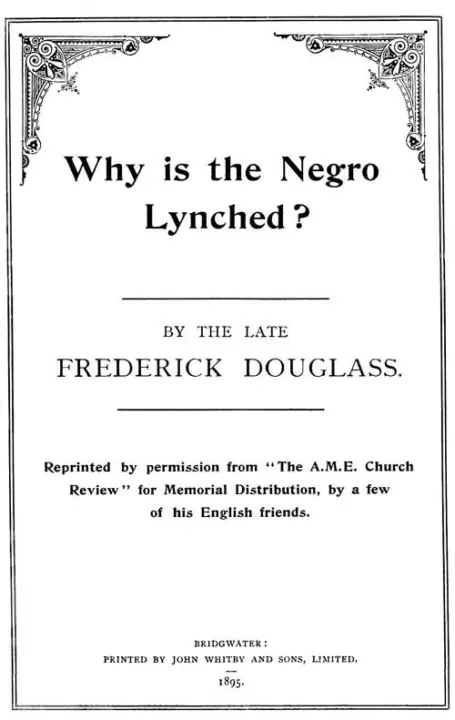
Frederick Douglass
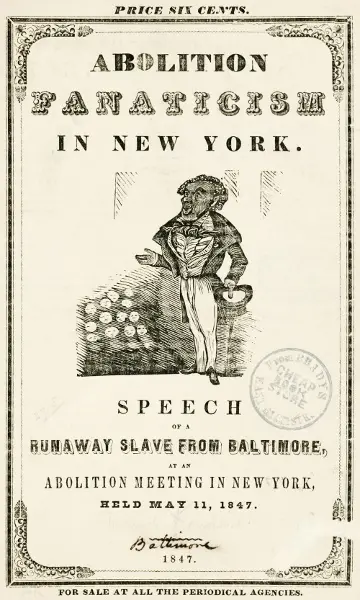
Frederick Douglass
Frederick Douglass
BEHIND THE BOOK
This eBook is for the use of anyone anywhere in the United States and most other parts of the world at no cost and with almost no restrictions whatsoever. You may copy it, give it away or re-use it under the terms of the Project Gutenberg License included with this eBook or online at www.gutenberg.org. If you are not located in the United States, you will have to check the laws of the country where you are located before using this eBook. Read the source licence.
The original source file, including credits and licence, is retained by this library. Request an original-format copy at no charge. Please include the book title and Project Gutenberg identifier #71893.
KEEP YOUR CURIOSITY GOING
Cécile Tormay

Moritz Busch
John L. Ransom
Frances Wright
Cécile Tormay

Mabel Potter Daggett