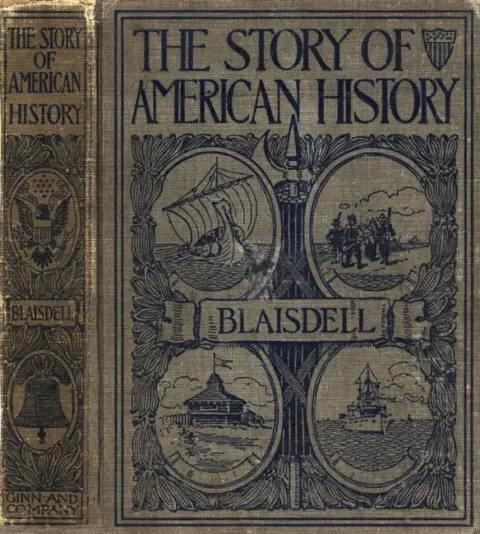
The Story of American History for Elementary Schools
Albert F. (Albert Franklin) Blaisdell
THE CLASSIC COLLECTION · 1903
"Hero Stories from American History" by Albert F. Blaisdell and Francis Kingsley Ball is a collection of historical narratives written in the early 20th century. It serves as an educational reader aimed at students in elementary schools, particularly for those in the sixth and seventh grades. The book focuses on significant figures and events from the first fifty years of American history, presenting them in a way that captures the excitement and drama of these historical moments to engage young readers. The opening of the book introduces the life and adventures of George Rogers Clark, a key figure in the American Revolutionary War. It details his determination and leadership as he navigates the challenges faced by early American settlers in Kentucky, particularly his strategic decision to confront British forces and Indigenous tribes that threatened their safety. The text emphasizes Clark's bravery and innovative military tactics, such as launching surprise attacks on British-held forts, which ultimately contributed to the expansion of American territory. This engaging retelling of history highlights not only the actions of Clark but also the resilience of the early American pioneers.
Introduction adapted from the source catalogue; source summaries may be automatically generated.
Free to read · English · 57,694 words · No account needed
MAKE TIME FOR A GOOD BOOK
On by default. Untick to stop anonymous reading totals. Each page counts after 10 seconds in view. How this works.
Anonymous counting is on unless you have switched it off.
The gist of the whole matter is that our Federal Constitution is based upon three great compromises.
The first compromise was between the small and the large states. In the upper house, or Senate, equal representation was conceded to all the states, but in the lower house of Congress, representation was arranged according to the population.
{149} Thus, as you know, little Rhode Island and Delaware have each two senators, while the great commonwealths of New York and Ohio have no more. In the House of Representatives, on the other hand, New York has forty-three representatives, and Ohio has twenty-two, while Rhode Island has three, and Delaware only one.
The second compromise was between the free and the slave states.
Were the slaves to be counted as persons or as goods?
South Carolina and Georgia maintained that they were persons; the Northern states said they were merely property.
Now indeed there was a clashing over local interest; but it was decided that in counting the population, whether for taxation, or for representation in the lower house, a slave should be considered as three fifths of an individual. And so it stood until the outbreak of the Civil War.
It was a bitter pill for far-sighted men like Washington, Madison, and others, who did not believe in slavery. Without this compromise, however, they believed that nine slave states would never adopt the Constitution, and doubtless they were right.
The slave question was the real bone of contention that resulted in the third compromise. The majority of the delegates, especially those from Virginia, were not in favor of slavery.
{150} "This infernal traffic that brings the judgment of Heaven on a country!" said George Mason of Virginia.
At first, it was proposed to abolish foreign slave trade. South Carolina and Georgia sturdily protested.
"Are we wanted in the Union?" they said.
They declared that it was not a question of morality or of religion, but purely a matter of business.
Rhode Island had refused to send delegates; and those from New York had gone home in anger. The discussions were bitter, and the situation became dangerous.
While the convention "was scarcely held together by the strength of a hair," the question came up for discussion, whether Congress or the individual states should have control over commerce.
The New England states, with their wealth of shipping, said that by all means Congress should have the control, and should make a uniform tariff in all the states. This, it was believed, would put an end to all the wranglings and the unjust acts which were so ruinous to commerce.
Your reading position is saved on this browser. Take it to another device with a library code. Reading pages adapt to text, rather than matching a printed edition.
Albert F. (Albert Franklin) Blaisdell
BEHIND THE BOOK
This eBook is for the use of anyone anywhere in the United States and most other parts of the world at no cost and with almost no restrictions whatsoever. You may copy it, give it away or re-use it under the terms of the Project Gutenberg License included with this eBook or online at www.gutenberg.org. If you are not located in the United States, you will have to check the laws of the country where you are located before using this eBook. Read the source licence.
The original source file, including credits and licence, is retained by this library. Request an original-format copy at no charge. Please include the book title and Project Gutenberg identifier #31092.
KEEP YOUR CURIOSITY GOING
Cécile Tormay

Moritz Busch
John L. Ransom
Frances Wright
Cécile Tormay

Mabel Potter Daggett