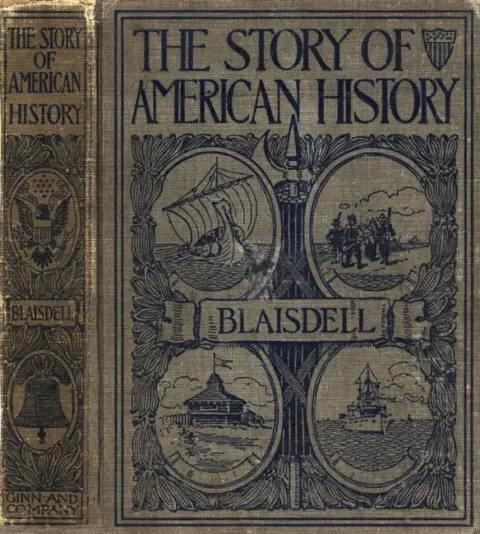
The Story of American History for Elementary Schools
Albert F. (Albert Franklin) Blaisdell
THE CLASSIC COLLECTION · 1903
"Hero Stories from American History" by Albert F. Blaisdell and Francis Kingsley Ball is a collection of historical narratives written in the early 20th century. It serves as an educational reader aimed at students in elementary schools, particularly for those in the sixth and seventh grades. The book focuses on significant figures and events from the first fifty years of American history, presenting them in a way that captures the excitement and drama of these historical moments to engage young readers. The opening of the book introduces the life and adventures of George Rogers Clark, a key figure in the American Revolutionary War. It details his determination and leadership as he navigates the challenges faced by early American settlers in Kentucky, particularly his strategic decision to confront British forces and Indigenous tribes that threatened their safety. The text emphasizes Clark's bravery and innovative military tactics, such as launching surprise attacks on British-held forts, which ultimately contributed to the expansion of American territory. This engaging retelling of history highlights not only the actions of Clark but also the resilience of the early American pioneers.
Introduction adapted from the source catalogue; source summaries may be automatically generated.
Free to read · English · 57,694 words · No account needed
MAKE TIME FOR A GOOD BOOK
On by default. Untick to stop anonymous reading totals. Each page counts after 10 seconds in view. How this works.
Anonymous counting is on unless you have switched it off.
Dale, Commodore, sent to the Mediterranean Sea, 157.
captures a Tripolitan war ship, 158.
Daring exploit, a, 156-168. See Philadelphia, the frigate.
Davie, William, a leader in the South, 91.
Dayton, Jonathan, of New Jersey, at the Philadelphia convention, 146.
Dearborn, Captain, kills his fine dog, 26.
Decatur, Stephen, 158.
chosen to destroy the Philadelphia, 161.
calls for volunteers, 162.
sails for Tripoli, 162.
boards the Philadelphia and sets her on fire, 165, 166.
the promotion of, 168.
how received by Commodore Preble, 173.
Deckhard rifle, the, used in the South, 95.
Declaration of Independence, the, 140, 141, 146, 157.
De Grasse, receives orders to act with Washington, 125.
headed for Chesapeake Bay, 126.
defeats the British fleet and controls Chesapeake Bay, 130.
at the blockade of Yorktown, 134.
Delaware, the representation of, in Congress, 149.
the first to adopt the Constitution, 154.
De Peyster, Colonel, the bravery of, 103.
Detroit, Fort, Hamilton's headquarters, 4, 11. See the map in Chapter
I.
Dickinson, John, at the Philadelphia convention, 147.
Dinwiddie, governor of Virginia, 109.
Doak, Rev. Samuel, invokes a blessing before the march to King's
Mountain, 96.
Dragoons, the defeat of the red, 90-104. See King's Mountain.
Du Loup River, the, Arnold's men cross, 29.
Dunmore, Lord, driven from Virginia, 36.
Ellsworth, Oliver, at the Philadelphia convention, 146.
Enos, Colonel, 22, 23.
deserts Arnold, 24.
Enterprise, the, fights a Tripolitan man-of-war, 157.
Experiment, the, a British man-of-war, 46.
Farragut, Admiral, 41.
Federalist, the, 154.
Federalists, the, 153.
Ferguson, Colonel, character of, 91.
enlists Tories and raids the Carolinas, 92.
threatens the backwoodsmen, 92.
the rally of the backwoodsmen to attack, 94.
retreats before the backwoodsmen, 97.
makes a stand at King's Mountain, 99.
defeated at King's Mountain, 101-103.
the death of, at King's Mountain, 102.
Fish, Nicholas, with Lafayette at Yorktown, 208.
Fiske, John, the historian, 115, 139.
Fort Detroit, Hamilton's headquarters, 4, 11. See the map in Chapter
I.
Fort Pitt, 5. See the map in Chapter I.
Fort Sullivan, the defense of, 36-49.
built of palmetto logs, 38.
the mounting of cannon in, 39.
visited by General Lee, 39.
Lee advises the surrender of, 39, 46.
the British plan of attack on, 41.
the attack on, 41-48.
the repulse of the British attack on, 48.
the moral effect of the defense of, 49.
Fort Sumter, 43.
France, the king of, promises us aid, 201.
Franklin and Holston settlements, now Tennessee, 92.
Franklin, Benjamin, at the Philadelphia convention, 146.
work of, in framing the Constitution, 150, 152.
the witty remark of, about the Constitution, 152.
a quotation from the almanac of, 157.
aids Lafayette, 200.
Frederick the Great of Prussia, friendly to us, 145.
Freeman's Farm, Burgoyne defeated at, 114.
French Canadians, the, help Arnold, 28.
French fleet, the, under De Grasse, 125. See De Grasse.
French villages, the, north of the Ohio River, 3, 11, 15.
Gates, General, the statue of, at Saratoga, 18.
sent to take command in the South, 90.
defeated at Camden, South Carolina, 90.
the character of, 90, 105.
George, King, receives word of Cornwallis's surrender, 137.
Georgia, overrun by the British, 90.
protests against abolishing slavery, 150.
Germantown, Pennsylvania, Wayne at, 82.
Your reading position is saved on this browser. Take it to another device with a library code. Reading pages adapt to text, rather than matching a printed edition.
Albert F. (Albert Franklin) Blaisdell
BEHIND THE BOOK
This eBook is for the use of anyone anywhere in the United States and most other parts of the world at no cost and with almost no restrictions whatsoever. You may copy it, give it away or re-use it under the terms of the Project Gutenberg License included with this eBook or online at www.gutenberg.org. If you are not located in the United States, you will have to check the laws of the country where you are located before using this eBook. Read the source licence.
The original source file, including credits and licence, is retained by this library. Request an original-format copy at no charge. Please include the book title and Project Gutenberg identifier #31092.
KEEP YOUR CURIOSITY GOING
Cécile Tormay

Moritz Busch
John L. Ransom
Frances Wright
Cécile Tormay

Mabel Potter Daggett