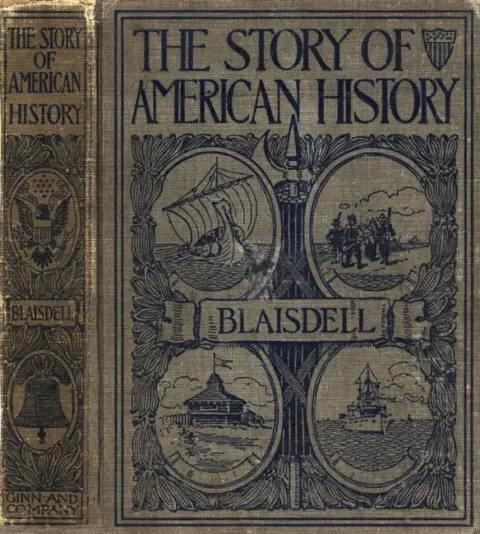
The Story of American History for Elementary Schools
Albert F. (Albert Franklin) Blaisdell
THE CLASSIC COLLECTION · 1903
"Hero Stories from American History" by Albert F. Blaisdell and Francis Kingsley Ball is a collection of historical narratives written in the early 20th century. It serves as an educational reader aimed at students in elementary schools, particularly for those in the sixth and seventh grades. The book focuses on significant figures and events from the first fifty years of American history, presenting them in a way that captures the excitement and drama of these historical moments to engage young readers. The opening of the book introduces the life and adventures of George Rogers Clark, a key figure in the American Revolutionary War. It details his determination and leadership as he navigates the challenges faced by early American settlers in Kentucky, particularly his strategic decision to confront British forces and Indigenous tribes that threatened their safety. The text emphasizes Clark's bravery and innovative military tactics, such as launching surprise attacks on British-held forts, which ultimately contributed to the expansion of American territory. This engaging retelling of history highlights not only the actions of Clark but also the resilience of the early American pioneers.
Introduction adapted from the source catalogue; source summaries may be automatically generated.
Free to read · English · 57,694 words · No account needed
MAKE TIME FOR A GOOD BOOK
On by default. Untick to stop anonymous reading totals. Each page counts after 10 seconds in view. How this works.
Anonymous counting is on unless you have switched it off.
Madeira Islands, the, "Old Ironsides" fights a great battle near,
182.
Madison, James, of Virginia, 146.
"Father of the Constitution," 148.
hated slavery, 149.
defends the Constitution, 154.
President of the United States, a man of peace, 186.
Maltese sailors, Decatur's sailors dressed like, 161, 164.
Manhattan Island, the patriots retire from, 51.
Map, a, showing the line of Clark's march, 7.
of Arnold's route to Quebec, 23.
of the military operations in the Carolinas, 99.
Marion, Francis, a leader in the South, 91.
Marseillaise, The, the national hymn of France, 189.
Marshall, John, defends the Constitution, 154.
Martha's Vineyard, 78.
Maryland called on for volunteers, 112.
Mason, George, of Virginia, opposed to slavery, 150.
McDaniel, an anecdote of, 47.
McDonough, Thomas, with Decatur, 166.
McDowell, leads the refugees, 94.
McLane, Captain, one of Wayne's pickets, 81.
Meigs, Major, a commander under Arnold, 22.
Midnight surprise, a, 77-89. See Stony Point.
Midwinter campaign, a, 18-35. See Arnold.
Minutemen, the, of the Old North State, 36.
Mississippi River, the, Lafayette ascends, 206.
Monmouth, New Jersey, the battle of, 200.
Wayne at, 82.
the cowardice of Charles Lee at, 105.
Monroe, President, instructed to invite Lafayette as the nation's
guest, 202.
receives Lafayette at the White House, 204.
Montgomery, General, 20.
joined by Arnold, 30.
demands the surrender of Quebec, 31.
despairs of the expedition, 31.
leads the attack on Quebec, 32.
the death of, 33.
Monticello, the home of Thomas Jefferson, near Charlottesville,
Virginia, 124, 214.
Montreal, captured by Montgomery, 30.
Sir Guy Carleton leaves, 31.
Monument, the, at Saratoga, 18, 122.
at Yorktown, 137.
the statues of Schuyler, Gates, and Morgan on, at Saratoga, 18.
Arnold forfeits his place on, at Saratoga, 18.
Morgan, Daniel, the life of, 105-122.
the statue of, at Saratoga, New York, 18, 122.
the statue of, at Spartanburg, South Carolina, 122.
joins Arnold's expedition, 21.
leads the advance in Arnold's expedition, 22.
forced to surrender at Quebec, 34.
the early life of, 106.
enlists in the Virginia troops and serves as a teamster, 106.
takes pride in his company and shows his skill as a boxer, 107.
enlists as a teamster in Washington's regiment, 107.
receives one hundred lashes, 108.
makes his mark as a private, 108.
drives no more army wagons, 108.
receives the commission of an ensign, 109.
severely wounded, 109.
returns to his farm, 110.
the marriage of, 110.
marches to Cambridge, 112.
at the siege of Quebec, 113.
made a colonel, 113.
at Freeman's Farm and at Saratoga, 114.
leaves the army for a time, 115.
rejoins the army in the South, under Gates, 115.
made a brigadier general, 115.
makes his plan for a battle with Tarleton, 116.
makes his stand at Cowpens, 116.
victorious at Cowpens, 119.
marches to join General Greene, 121.
retires from the army again, 121.
takes part in the Virginia campaign of 1780, 121.
the after life of, 122.
the valor of, commemorated at Saratoga, New York, and at
Spartanburg, South Carolina, 122.
Morocco, 156, 158.
Morris, Gouverneur, originator of our decimal system of money, attends the Philadelphia convention, 146.
Morris, Lieutenant, with Captain Hull on "Old Ironsides," 174, 177.
Your reading position is saved on this browser. Take it to another device with a library code. Reading pages adapt to text, rather than matching a printed edition.
Albert F. (Albert Franklin) Blaisdell
BEHIND THE BOOK
This eBook is for the use of anyone anywhere in the United States and most other parts of the world at no cost and with almost no restrictions whatsoever. You may copy it, give it away or re-use it under the terms of the Project Gutenberg License included with this eBook or online at www.gutenberg.org. If you are not located in the United States, you will have to check the laws of the country where you are located before using this eBook. Read the source licence.
The original source file, including credits and licence, is retained by this library. Request an original-format copy at no charge. Please include the book title and Project Gutenberg identifier #31092.
KEEP YOUR CURIOSITY GOING
Cécile Tormay

Moritz Busch
John L. Ransom
Frances Wright
Cécile Tormay

Mabel Potter Daggett