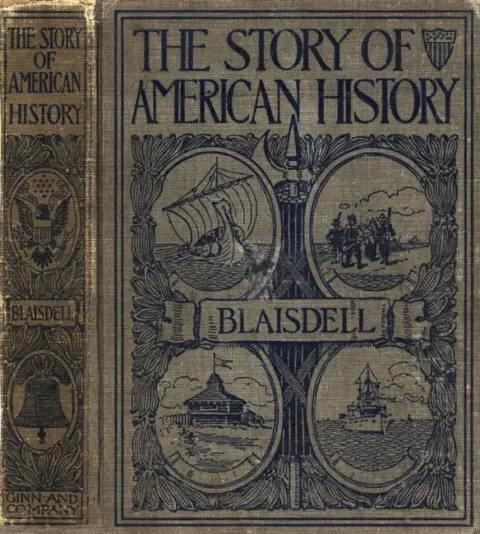
The Story of American History for Elementary Schools
Albert F. (Albert Franklin) Blaisdell
THE CLASSIC COLLECTION · 1903
"Hero Stories from American History" by Albert F. Blaisdell and Francis Kingsley Ball is a collection of historical narratives written in the early 20th century. It serves as an educational reader aimed at students in elementary schools, particularly for those in the sixth and seventh grades. The book focuses on significant figures and events from the first fifty years of American history, presenting them in a way that captures the excitement and drama of these historical moments to engage young readers. The opening of the book introduces the life and adventures of George Rogers Clark, a key figure in the American Revolutionary War. It details his determination and leadership as he navigates the challenges faced by early American settlers in Kentucky, particularly his strategic decision to confront British forces and Indigenous tribes that threatened their safety. The text emphasizes Clark's bravery and innovative military tactics, such as launching surprise attacks on British-held forts, which ultimately contributed to the expansion of American territory. This engaging retelling of history highlights not only the actions of Clark but also the resilience of the early American pioneers.
Introduction adapted from the source catalogue; source summaries may be automatically generated.
Free to read · English · 57,694 words · No account needed
MAKE TIME FOR A GOOD BOOK
On by default. Untick to stop anonymous reading totals. Each page counts after 10 seconds in view. How this works.
Anonymous counting is on unless you have switched it off.
Valley Forge, Pennsylvania, Lafayette at, 200.
the patriots suffer greatly at, 200.
Vernon, Mount, Washington's home, 68.
the slaves at, 70.
the hospitality at, 71, 76.
Washington retires to, 138.
Lafayette's visits to, 202, 211.
Verplanck's Point, on the Hudson River, the British fortify, 78.
Victory, the final, 123-137. See Yorktown campaign.
Ville de Paris, the flagship of De Grasse, 129.
Villere, Major, informs Jackson of the approach of the British, 188.
Vincennes, the hero of, 1-17. See Clark.
Virginia, in the struggle with Great Britain, 2, 5.
aids Clark, 3, 5.
called on for volunteers, 112.
takes the lead in sending delegates to Philadelphia, 145.
the University of, Lafayette visits, 214.
Vulture, the, a British war ship at Stony Point, 87.
Wabash River, the Little, Clark crosses, 12.
Wabash River, the, Clark crosses, 13.
Wagoner, the old, 105-122. See Morgan.
Warner, James, and his wife with Arnold's expedition to Quebec, 22,
26.
Washington, Lafayette received by President Monroe at, 204. Lafayette's farewell dinner at, 215.
Washington, George, in the Revolution, 2.
takes command of the patriots at Cambridge, Massachusetts, 19.
meets Benedict Arnold, 19.
confers with his officers at the Murray mansion, 50.
gives Hale his orders, 53.
informed of Hale's execution, 61.
our greatest patriot, 62-76.
the personal appearance of, 63.
the strength of, 64.
likes dancing, 65.
eats simple food, 66.
fond of fine clothes, 66.
a fine horseman, 67.
methodical in business, 68.
owns much land, 69, 70.
dislikes slaves, 70.
the generosity of, 71.
attends the meeting at Newburgh, New York, 72.
the appearance of, on his first visit to Congress, described by an
eyewitness, 73.
the formal receptions of, 74.
the state dinners of, 75.
the greatness of, 76.
a hard nut to crack, says General Clinton, 77.
plans an attack on Stony Point, 79, 81.
visits Stony Point, 88.
famous men gathered about, in the siege of Boston, 105.
meets Daniel Morgan, 112.
in the Yorktown campaign, 123-136.
bids farewell to his generals, 138.
retires to Mount Vernon, 138.
the "legacy" of, to the American people, 140.
works at the problem of our national existence, 143.
attends the Philadelphia convention, 145.
made president of the Philadelphia convention, 147.
holds the Philadelphia convention to its duty, 148.
signs the Constitution, 152.
the first President of the United States, 155.
Lafayette serves under, 200.
Lafayette visits, at Mount Vernon, 202.
tomb of, at Mount Vernon, 211.
Washington, William, at the battle of Cowpens, 117-119.
in a hand to hand fight with Tarleton, 120.
"knows how to make his mark," 120.
Wayne, Anthony, the personal appearance of, 80.
chosen to attack Stony Point, 80.
at Germantown and at Monmouth, 82.
the march of, to Stony Point, 82.
reads his order of battle at Stony Point, 83.
writes to a friend at Philadelphia, 83.
leads the attack on Stony Point, 85.
wounded in the head, 86.
captures the fort, 87.
writes a letter to Washington, 88.
in the Yorktown campaign, 121, 124.
Webster, Daniel, speaks at the dedication of the Bunker Hill
Monument, 214.
Wellington, the Duke of, a British general, 186.
called the "Iron Duke," 187.
West Point, the Americans at, 78, 125.
Washington's headquarters at, 127.
Your reading position is saved on this browser. Take it to another device with a library code. Reading pages adapt to text, rather than matching a printed edition.
Albert F. (Albert Franklin) Blaisdell
BEHIND THE BOOK
This eBook is for the use of anyone anywhere in the United States and most other parts of the world at no cost and with almost no restrictions whatsoever. You may copy it, give it away or re-use it under the terms of the Project Gutenberg License included with this eBook or online at www.gutenberg.org. If you are not located in the United States, you will have to check the laws of the country where you are located before using this eBook. Read the source licence.
The original source file, including credits and licence, is retained by this library. Request an original-format copy at no charge. Please include the book title and Project Gutenberg identifier #31092.
KEEP YOUR CURIOSITY GOING
Cécile Tormay

Moritz Busch
John L. Ransom
Frances Wright
Cécile Tormay

Mabel Potter Daggett