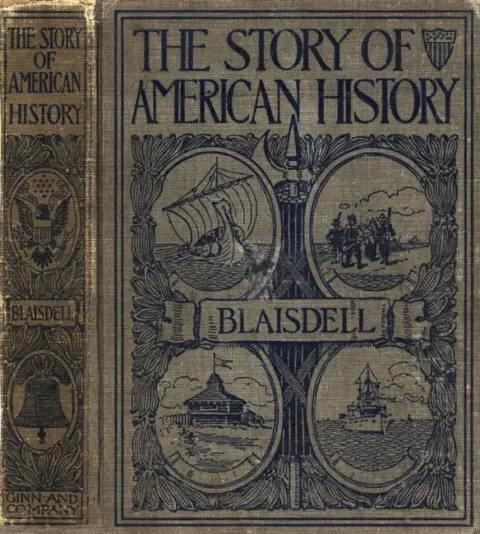
The Story of American History for Elementary Schools
Albert F. (Albert Franklin) Blaisdell
THE CLASSIC COLLECTION · 1903
"Hero Stories from American History" by Albert F. Blaisdell and Francis Kingsley Ball is a collection of historical narratives written in the early 20th century. It serves as an educational reader aimed at students in elementary schools, particularly for those in the sixth and seventh grades. The book focuses on significant figures and events from the first fifty years of American history, presenting them in a way that captures the excitement and drama of these historical moments to engage young readers. The opening of the book introduces the life and adventures of George Rogers Clark, a key figure in the American Revolutionary War. It details his determination and leadership as he navigates the challenges faced by early American settlers in Kentucky, particularly his strategic decision to confront British forces and Indigenous tribes that threatened their safety. The text emphasizes Clark's bravery and innovative military tactics, such as launching surprise attacks on British-held forts, which ultimately contributed to the expansion of American territory. This engaging retelling of history highlights not only the actions of Clark but also the resilience of the early American pioneers.
Introduction adapted from the source catalogue; source summaries may be automatically generated.
Free to read · English · 57,694 words · No account needed
MAKE TIME FOR A GOOD BOOK
On by default. Untick to stop anonymous reading totals. Each page counts after 10 seconds in view. How this works.
Anonymous counting is on unless you have switched it off.
Ville de Paris, vill de (e as in her) pah-ree'.
Villere, vil-ray'.
Vincennes, vin-senz'.
Wabash, waw'bash.
Watauga, wa-taw'ga.
Wayne, wain.
Worcester, woos'ter (oo as in foot).
This book is designed to be used either before the formal text-book on American history is begun, or to be read in connection with it. It is also intended to serve as a convenient basis for more extended work on the part of both teacher and pupils. Hence, to the reading of the preceding chapters should be added a systematic course in supplementary reading.
The following plan is suggested, which may be readily modified to meet the needs of any particular class of pupils:
Two books are of special value to teachers. These are Channing and Hart's Guide to American History (Ginn & Company, $2.00), and Gordy and Twitchell's Pathfinder in American History (Lee & Shepard, $1.20. In separate parts, Part I, 60 cents; Part II, 90 cents).
These two works are replete with suggestions, hints, and helps on collateral study, with numerous references, detailed lists of topics, and a wide range of other subjects which make them indispensable to the teacher of American history.
NOTE.--The subject of reference books on American history is treated thoroughly in Montgomery's American History (see "Short List of Books," page xxxiii in Appendix), and Fiske's History of the United States (see Appendix D, page 530, Appendix E, page 539, and Appendix F, page 542).
For original materials pertaining to the colonial period and the Revolution, admirably edited for school use, consult Hart's "Source-Readers in American History": No. 1, Colonial Children; No. 2, Camps and Firesides of the Revolution; No. 3, How our Grandfathers Lived.
In searching libraries for books on the Revolution, the teacher will
find Winsor's Reader's Handbook of the American Revolution very
useful.
Pupils should have easy access, by means of the school library or otherwise, to a few of the formal school text-books on American history. In connection with this book, Montgomery's Leading Facts of American History, Fiske's History of the United States, Eggleston's History of the United States, and Steele's Brief History of the United States (usually known as "Barnes's History") are especially valuable.
If less difficult and much smaller works are thought desirable, the following five books are recommended: Montgomery's Beginner's American History, McMaster's Primary History of the United States, Tappan's Our Country's Story, Thorpe's Junior History of the United States, and Eggleston's First Book in American History.
These books are useful for additional topics, for dates, maps, illustrations, reference tables, and for filling in subjects which do not come within the scope of this book.
Your reading position is saved on this browser. Take it to another device with a library code. Reading pages adapt to text, rather than matching a printed edition.
Albert F. (Albert Franklin) Blaisdell
BEHIND THE BOOK
This eBook is for the use of anyone anywhere in the United States and most other parts of the world at no cost and with almost no restrictions whatsoever. You may copy it, give it away or re-use it under the terms of the Project Gutenberg License included with this eBook or online at www.gutenberg.org. If you are not located in the United States, you will have to check the laws of the country where you are located before using this eBook. Read the source licence.
The original source file, including credits and licence, is retained by this library. Request an original-format copy at no charge. Please include the book title and Project Gutenberg identifier #31092.
KEEP YOUR CURIOSITY GOING
Cécile Tormay

Moritz Busch
John L. Ransom
Frances Wright
Cécile Tormay

Mabel Potter Daggett