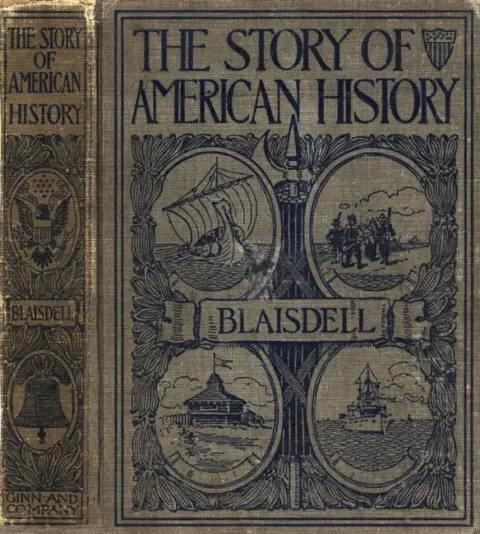
The Story of American History for Elementary Schools
Albert F. (Albert Franklin) Blaisdell
THE CLASSIC COLLECTION · 1903
"Hero Stories from American History" by Albert F. Blaisdell and Francis Kingsley Ball is a collection of historical narratives written in the early 20th century. It serves as an educational reader aimed at students in elementary schools, particularly for those in the sixth and seventh grades. The book focuses on significant figures and events from the first fifty years of American history, presenting them in a way that captures the excitement and drama of these historical moments to engage young readers. The opening of the book introduces the life and adventures of George Rogers Clark, a key figure in the American Revolutionary War. It details his determination and leadership as he navigates the challenges faced by early American settlers in Kentucky, particularly his strategic decision to confront British forces and Indigenous tribes that threatened their safety. The text emphasizes Clark's bravery and innovative military tactics, such as launching surprise attacks on British-held forts, which ultimately contributed to the expansion of American territory. This engaging retelling of history highlights not only the actions of Clark but also the resilience of the early American pioneers.
Introduction adapted from the source catalogue; source summaries may be automatically generated.
Free to read · English · 57,694 words · No account needed
MAKE TIME FOR A GOOD BOOK
On by default. Untick to stop anonymous reading totals. Each page counts after 10 seconds in view. How this works.
Anonymous counting is on unless you have switched it off.
Cahokia, a Creole village in the country of the Illinois Indians, 8.
Calhoun, John C., favors making war on Great Britain, 186.
Cambridge, Massachusetts, Arnold's expedition leaves, 21.
Washington's headquarters at, in the Craigie house, 105.
Morgan marches to, 112.
Camden, defeat of Gates at, 90.
Campbell, Lord, royal governor of South Carolina, 37. injured in the attack on Fort Sullivan, 46.
Campbell, William, rallies the backwoodsmen, 94.
leads the advance at King's Mountain, 101.
Canada, extending to the Ohio and Mississippi rivers, 3. See the map
in Chapter I.
the "back door," 19.
the winters of, 22, 29.
Cape Fear River, the, Clinton sails for, 36.
Carleton, Sir Guy, 19.
leaves Montreal and slips into Quebec, 31.
fortifies Quebec, 31.
Carolina, the, throws shells into the British camp, 190.
Carroll, Colonel, with his riflemen arrives from Nashville, 189. in the battle of New Orleans, 194.
Carrying places, work at the, 22.
Catalano, the Sicilian pilot, used by Decatur, 162, 164.
Cedars, The, Hale passes a night at, 57.
Champlain, Lake, Lafayette visits, 206.
Charleston, attack on, planned by the British, 37. the patriots prepare for the defense of, 38.
Charleston Harbor, Sullivan's Island near, 38.
Charlestown, a part of Boston, "Old Ironsides" lies in the navy yard
at, 169, 183, 184.
Charlotte, North Carolina, Gates flees to, 90.
Chaudiere River, the, an army to enter Canada by, 20.
Arnold's army scattered along, 25.
the perils of, 28.
Chesapeake Bay, De Grasse headed for, 126.
De Grasse reaches, 129.
the patriot armies march to, 129.
Clinton sends a fleet to, 130.
Admiral Graves forced to withdraw from, 130.
De Grasse gets control of, 130.
Lafayette returns to France by, 216.
Chick, Mother, the tavern of, 57.
Clark, Captain, at Bunker Hill, 213.
Clark, George Rogers, 1.
starts for Kentucky, 1.
tramps back to Virginia, 2, 5.
receives help from Virginia, 3.
plans great deeds, 4.
sends out spies, 4.
appointed colonel, 5.
helped by Jefferson and Madison, 5.
starts down the Ohio, 6.
begins his march to Kaskaskia, 7.
interrupts the dance, 8.
captures Kaskaskia, 8.
makes friends of the Creoles, 8.
shows the kind of man he is, 9.
visited by Indians, 9.
shows his contempt for the Indians, 9.
an incident showing the boldness of, 10.
decides to recapture Vincennes, 11.
starts for Vincennes, 12.
shows brave leadership, 13.
makes a speech to his men, 13.
captures an Indian canoe, 14.
captures a Creole hunter, 14.
reaches Vincennes, 15.
punishes some Indians, 16.
captures Vincennes, 16.
Clay, Henry, favors making war on Great Britain, 186.
Cleveland, Colonel, rallies the backwoodsmen, 94. given the supreme command at King's Mountain, 97. leads the left wing at King's Mountain, 101.
Clinton, Sir Henry, 18.
sails for the Cape Fear River, 36.
at the attack on Fort Sullivan, 44.
receives orders to bring "Mr. Washington" to a decisive action, 77.
makes raids along the coast, 78.
hears of the capture of Stony Point, 87.
at Charleston, 90.
hoodwinked by Washington, 127.
sails for Yorktown, 133, 135.
Coffee, Colonel, and his mounted riflemen at New Orleans, 190.
Commerce controlled by Congress, 151.
Common Sense, a pamphlet by Thomas Paine, 138.
Compromises, the three, in framing the Constitution, 148-151.
Your reading position is saved on this browser. Take it to another device with a library code. Reading pages adapt to text, rather than matching a printed edition.
Albert F. (Albert Franklin) Blaisdell
BEHIND THE BOOK
This eBook is for the use of anyone anywhere in the United States and most other parts of the world at no cost and with almost no restrictions whatsoever. You may copy it, give it away or re-use it under the terms of the Project Gutenberg License included with this eBook or online at www.gutenberg.org. If you are not located in the United States, you will have to check the laws of the country where you are located before using this eBook. Read the source licence.
The original source file, including credits and licence, is retained by this library. Request an original-format copy at no charge. Please include the book title and Project Gutenberg identifier #31092.
KEEP YOUR CURIOSITY GOING
Cécile Tormay

Moritz Busch
John L. Ransom
Frances Wright
Cécile Tormay

Mabel Potter Daggett