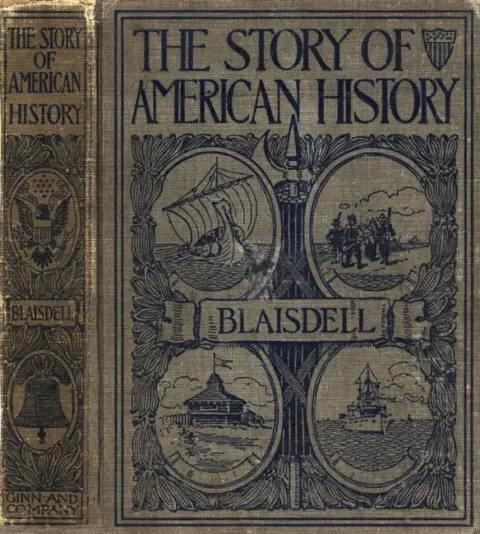
The Story of American History for Elementary Schools
Albert F. (Albert Franklin) Blaisdell
THE CLASSIC COLLECTION · 1903
"Hero Stories from American History" by Albert F. Blaisdell and Francis Kingsley Ball is a collection of historical narratives written in the early 20th century. It serves as an educational reader aimed at students in elementary schools, particularly for those in the sixth and seventh grades. The book focuses on significant figures and events from the first fifty years of American history, presenting them in a way that captures the excitement and drama of these historical moments to engage young readers. The opening of the book introduces the life and adventures of George Rogers Clark, a key figure in the American Revolutionary War. It details his determination and leadership as he navigates the challenges faced by early American settlers in Kentucky, particularly his strategic decision to confront British forces and Indigenous tribes that threatened their safety. The text emphasizes Clark's bravery and innovative military tactics, such as launching surprise attacks on British-held forts, which ultimately contributed to the expansion of American territory. This engaging retelling of history highlights not only the actions of Clark but also the resilience of the early American pioneers.
Introduction adapted from the source catalogue; source summaries may be automatically generated.
Free to read · English · 57,694 words · No account needed
MAKE TIME FOR A GOOD BOOK
On by default. Untick to stop anonymous reading totals. Each page counts after 10 seconds in view. How this works.
Anonymous counting is on unless you have switched it off.
Head and shoulders above all others towered George Washington. The man most widely known, except Washington, was Benjamin Franklin, eighty-one years old; the youngest delegate was Mr. Dayton of New Jersey, who was only twenty-six.
Here also were two of the ablest statesmen of their time, Alexander Hamilton of New York, and James Madison of Virginia.
Connecticut sent two of her great men, Oliver Ellsworth, afterwards chief justice of the United States, and Roger Sherman, the learned shoemaker.
Near Robert Morris, the great financier, sat his namesake, Gouverneur Morris, who originated our decimal system of money, and James Wilson, one of the most learned lawyers of his day.
The two brilliant Pinckneys and John Rutledge, the silver-tongued orator, were there to represent South Carolina.
{147} Then there were Elbridge Gerry and Rufus King of Massachusetts, John Langdon of New Hampshire, John Dickinson of Delaware, and the great orator, Edmund Randolph of Virginia.
Thomas Jefferson and John Adams would no doubt have been delegates, had they not been abroad in the service of their country. Patrick Henry and Samuel Adams remained at home; for they did not approve of the convention.
How Rhode Island must have missed her most eminent citizen, Nathanael Greene, who had just died of sunstroke, in the prime of manhood!
Washington was elected president of the convention. The doors were locked, and, every member being pledged to secrecy, they settled down to work.
Just what was said and done during those four months was for more than fifty years kept a profound secret. After the death of James Madison, often called the {148} "Father of the Constitution," his journal was published, giving a complete account of the proceedings.
When the delegates began their work, they soon realized what a problem it was to frame a government for the whole country. As might have been expected, some of these men had a fit of moral cowardice. They began to cut and to trim, and tried to avoid any measure of thorough reform.
Washington was equal to the occasion. He was not a brilliant orator, and his speech was very brief; but the solemn words of this majestic man, as his tall figure drawn up to its full height rose from the president's chair, carried conviction to every delegate.
"If, to please the people," he said, "we offer what we ourselves disapprove, how can we afterward defend our work? Let us raise a standard to which the wise and the honest can repair; the event is in the hand of God."
The details of what this convention did would be dull reading; but some day we shall want to study in our school work the noble Constitution which these men framed.
Your reading position is saved on this browser. Take it to another device with a library code. Reading pages adapt to text, rather than matching a printed edition.
Albert F. (Albert Franklin) Blaisdell
BEHIND THE BOOK
This eBook is for the use of anyone anywhere in the United States and most other parts of the world at no cost and with almost no restrictions whatsoever. You may copy it, give it away or re-use it under the terms of the Project Gutenberg License included with this eBook or online at www.gutenberg.org. If you are not located in the United States, you will have to check the laws of the country where you are located before using this eBook. Read the source licence.
The original source file, including credits and licence, is retained by this library. Request an original-format copy at no charge. Please include the book title and Project Gutenberg identifier #31092.
KEEP YOUR CURIOSITY GOING
Cécile Tormay

Moritz Busch
John L. Ransom
Frances Wright
Cécile Tormay

Mabel Potter Daggett