
Life of Edwin Forrest, the American Tragedian. Volume 2 (of 2)
William Rounseville Alger & Horatio, Jr. Alger
THE CLASSIC COLLECTION · 1895
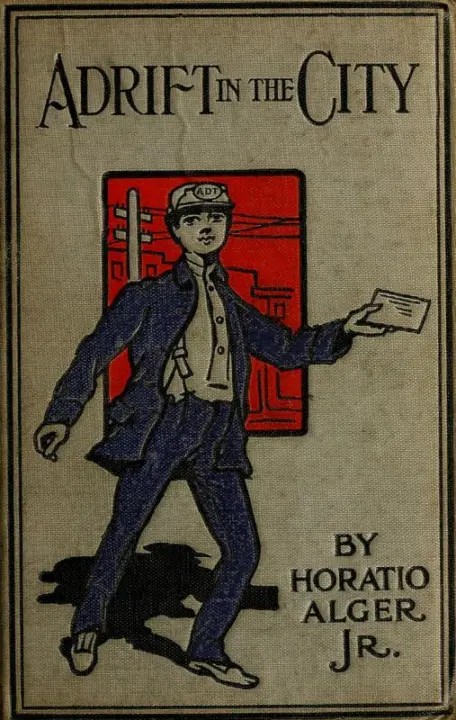
"Adrift in the City; or, Oliver Conrad's Plucky Fight" by Horatio Alger, Jr. is a novel written in the late 19th century. This coming-of-age story centers on young Oliver Conrad, who faces a challenging relationship with his step-brother Roland Kenyon and his cruel step-father, Mr. Kenyon. The narrative explores themes of resilience and the struggle for independence amidst familial tensions, as Oliver learns to assert himself against the bullying he experiences. The opening of the book introduces a confrontation between Oliver and Roland, establishing their antagonistic relationship marked by class and privilege disparities. Roland, feeling entitled, commands Oliver to fetch a ball, leading to a physical altercation that exemplifies the underlying tension between them. After defending himself successfully, Oliver is summoned before Mr. Kenyon, who unjustly accuses him of assaulting Roland. As Oliver stands firm in his principles and self-defense, the stage is set for a deeper exploration of his plight, hinting at future conflicts and Oliver's quest for autonomy against the backdrop of his step-father's deceitful motives.
Introduction adapted from the source catalogue; source summaries may be automatically generated.
Free to read · English · 51,164 words · No account needed
MAKE TIME FOR A GOOD BOOK
On by default. Untick to stop anonymous reading totals. Each page counts after 10 seconds in view. How this works.
Anonymous counting is on unless you have switched it off.
Mrs. Kenyon thought it best to put two hundred miles between herself and Dr. Fox. She left the cars the next morning at a town of about three thousand inhabitants, which we will call Crawford.
"Is there a hotel here?" she enquired of the depot-master.
"Yes, ma'am."
"Is it far off?"
"About three-quarters of a mile up in the village."
"Can I get a carriage to convey me there?"
"Certainly, ma'am," answered the depot-master briskly. My son drives the depot carriage. There it is, near the platform.
"Peter!" he called. "Here's a lady to go to the hotel. Have you a check
for your trunk, ma'am?"
Mrs. Kenyon was rather embarrassed. She had no luggage except a small bundle which she carried in her hand, and this, she feared, might look suspicious. She had a trunk of clothing at the asylum, but of course it was out of the question to send for this.
"My luggage has been delayed," she said; "it will be sent me."
"Very well, ma'am."
Mrs. Kenyon got into the carriage and was soon landed at the hotel. It might be called rather a boarding-house than a hotel, as it could hardly accommodate more than a dozen guests. It was by no means stylish, but looked tolerably comfortable. In Mrs. Kenyon's state of mind she was not likely to care much for luxury, and she said to herself wearily:
"This will do as well as any other place."
She enquired the terms of board, and found them very reasonable. This was a relief, for she had but two hundred dollars with her, and a part of this must be expended for the replenishing of her wardrobe. This she attended to at once, and, though she studied economy, it consumed about one-half of her scanty supply.
Four weeks passed. Mrs. Kenyon found time hanging heavily upon her hands. She appeared to have no object left in life. Her boy was dead, or at least she supposed so. She had a husband, but he had proved himself her bitterest foe. She had abstained from making acquaintances, because acquaintances are apt to be curious, and she did not wish to talk of the past.
There was one exception, however. One afternoon when out walking, a pretty little girl, perhaps four years of age, ran up to her, crying:
"Take me to mamma. I'm so frightened!"
She was always fond of children, and her heart opened to the little
girl.
"What is the matter, my dear?" she asked soothingly.
"I've lost my mamma," sobbed the little girl.
"How did it happen, my child?"
"I went out with nurse, and I can't find her."
Your reading position is saved on this browser. Take it to another device with a library code. Reading pages adapt to text, rather than matching a printed edition.
William Rounseville Alger & Horatio, Jr. Alger

William Rounseville Alger & Horatio, Jr. Alger

Horatio, Jr. Alger

Horatio, Jr. Alger
BEHIND THE BOOK
This eBook is for the use of anyone anywhere in the United States and most other parts of the world at no cost and with almost no restrictions whatsoever. You may copy it, give it away or re-use it under the terms of the Project Gutenberg License included with this eBook or online at www.gutenberg.org. If you are not located in the United States, you will have to check the laws of the country where you are located before using this eBook. Read the source licence.
The original source file, including credits and licence, is retained by this library. Request an original-format copy at no charge. Please include the book title and Project Gutenberg identifier #56973.
KEEP YOUR CURIOSITY GOING
Coulson Kernahan

Maurice Baring
Frances Wright
Cécile Tormay

Frederic Jesup Stimson

W. H. P. (William Henry Pope) Jarvis