
Life of Edwin Forrest, the American Tragedian. Volume 2 (of 2)
William Rounseville Alger & Horatio, Jr. Alger
THE CLASSIC COLLECTION · 1895
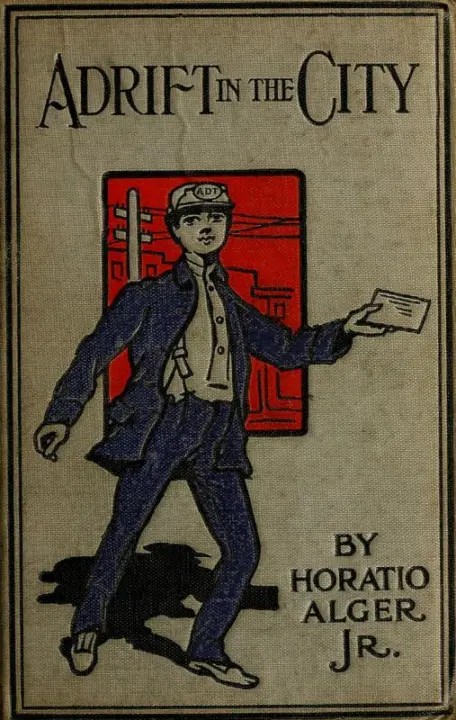
"Adrift in the City; or, Oliver Conrad's Plucky Fight" by Horatio Alger, Jr. is a novel written in the late 19th century. This coming-of-age story centers on young Oliver Conrad, who faces a challenging relationship with his step-brother Roland Kenyon and his cruel step-father, Mr. Kenyon. The narrative explores themes of resilience and the struggle for independence amidst familial tensions, as Oliver learns to assert himself against the bullying he experiences. The opening of the book introduces a confrontation between Oliver and Roland, establishing their antagonistic relationship marked by class and privilege disparities. Roland, feeling entitled, commands Oliver to fetch a ball, leading to a physical altercation that exemplifies the underlying tension between them. After defending himself successfully, Oliver is summoned before Mr. Kenyon, who unjustly accuses him of assaulting Roland. As Oliver stands firm in his principles and self-defense, the stage is set for a deeper exploration of his plight, hinting at future conflicts and Oliver's quest for autonomy against the backdrop of his step-father's deceitful motives.
Introduction adapted from the source catalogue; source summaries may be automatically generated.
Free to read · English · 51,164 words · No account needed
MAKE TIME FOR A GOOD BOOK
On by default. Untick to stop anonymous reading totals. Each page counts after 10 seconds in view. How this works.
Anonymous counting is on unless you have switched it off.
The store was crowded with a miscellaneous collection of cheap articles. That such a business should yield such large profits struck Oliver with surprise, but he reflected that it was possible, and that he was not qualified to judge of the extent of trade in a city store.
A tall man, pock-marked, and with reddish hair, stood behind the counter, and, with the exception of a young clerk of nineteen, appeared to be the only salesman. This was Ezekiel Bond.
"How are you, Ezekiel?" said Mr. Kenyon affably, advancing to the
counter.
"Pretty well, thank you, uncle," said the other, twisting his features into the semblance of a smile. "When did you come into town?"
"This morning only."
"That isn't Roland, is it?"
"Oh, no; it is my step-son, Oliver Conrad. Oliver, this is my nephew,
Ezekiel Bond."
"Glad to see you, Mr. Conrad," said Ezekiel, putting out his hand as if he were a pump-handle. "Do you like New York?"
"I haven't seen much of it yet. I think I shall."
"Ezekiel," said Mr. Kenyon, "can I see you a few minutes in private?"
"Oh, certainly. We'll go into the back room. Will Mr. Conrad come, too?"
"No; he can remain with your clerk while we converse."
"John, take care of Mr. Conrad," said Ezekiel.
"All right, sir."
John Meadows was a Bowery boy, and better adapted for the store he was in than for one in a more fashionable thoroughfare.
"The boss wants me to entertain you," he remarked, when they were
alone. "How shall I do it?"
"Don't trouble yourself," said Oliver, smiling.
"I'd offer you a cigarette, only the boss don't allow smoking in the
store."
"I don't smoke," said Oliver.
"You don't! Where was you brung up?" asked John.
"In the country."
"Oh, that accounts for it. Mean ter say you've never puffed a weed?"
"I never have."
"Then you don't know what 'tis to enjoy yourself. Who's that man you
came in with?"
"My step-father."
"I've seen him here before. He's related to my boss. I don't think any
more of him for that."
"Why not?" asked Oliver, rather amused. "Don't you like Mr. Bond?"
"Come here," said John.
Oliver approached the counter, and leaning over, John whispered
mysteriously:
"He's a file!"
"A what?"
"A file, and an awful rasping one at that. He's as mean as dirt."
"I am sorry to hear that, for Mr. Kenyon wants me to begin business in
this store."
John whistled.
"That's a go," he said. "Are you going to do it?"
"I suppose I shall try it. If I don't like it I can give it up at any
time."
Your reading position is saved on this browser. Take it to another device with a library code. Reading pages adapt to text, rather than matching a printed edition.
William Rounseville Alger & Horatio, Jr. Alger

William Rounseville Alger & Horatio, Jr. Alger

Horatio, Jr. Alger

Horatio, Jr. Alger
BEHIND THE BOOK
This eBook is for the use of anyone anywhere in the United States and most other parts of the world at no cost and with almost no restrictions whatsoever. You may copy it, give it away or re-use it under the terms of the Project Gutenberg License included with this eBook or online at www.gutenberg.org. If you are not located in the United States, you will have to check the laws of the country where you are located before using this eBook. Read the source licence.
The original source file, including credits and licence, is retained by this library. Request an original-format copy at no charge. Please include the book title and Project Gutenberg identifier #56973.
KEEP YOUR CURIOSITY GOING
Coulson Kernahan

Maurice Baring
Frances Wright
Cécile Tormay

Frederic Jesup Stimson

W. H. P. (William Henry Pope) Jarvis