
Life of Edwin Forrest, the American Tragedian. Volume 2 (of 2)
William Rounseville Alger & Horatio, Jr. Alger
THE CLASSIC COLLECTION · 1895
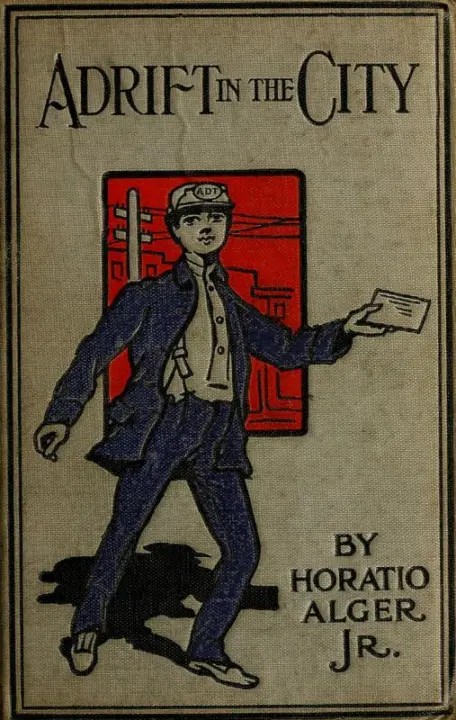
"Adrift in the City; or, Oliver Conrad's Plucky Fight" by Horatio Alger, Jr. is a novel written in the late 19th century. This coming-of-age story centers on young Oliver Conrad, who faces a challenging relationship with his step-brother Roland Kenyon and his cruel step-father, Mr. Kenyon. The narrative explores themes of resilience and the struggle for independence amidst familial tensions, as Oliver learns to assert himself against the bullying he experiences. The opening of the book introduces a confrontation between Oliver and Roland, establishing their antagonistic relationship marked by class and privilege disparities. Roland, feeling entitled, commands Oliver to fetch a ball, leading to a physical altercation that exemplifies the underlying tension between them. After defending himself successfully, Oliver is summoned before Mr. Kenyon, who unjustly accuses him of assaulting Roland. As Oliver stands firm in his principles and self-defense, the stage is set for a deeper exploration of his plight, hinting at future conflicts and Oliver's quest for autonomy against the backdrop of his step-father's deceitful motives.
Introduction adapted from the source catalogue; source summaries may be automatically generated.
Free to read · English · 51,164 words · No account needed
MAKE TIME FOR A GOOD BOOK
On by default. Untick to stop anonymous reading totals. Each page counts after 10 seconds in view. How this works.
Anonymous counting is on unless you have switched it off.
When Denton, to his infinite disgust, saw his scheme foiled by the return of Oliver and Bundy to the inn at Kelso, he was strongly tempted to go back also. But prudence withheld him. It was by no means certain that he had been recognized. Very probably Bundy really went back on account of some slight matter which he had forgotten.
Denton was of opinion that his visit to Kelso was not connected with the interest of his employer. Therefore he decided to return to Chicago and await the reappearance of Oliver and Bundy. Undoubtedly they would return to the same hotel where they had been stopping.
By the time he took his seat in the car he was in quite a philosophical frame of mind, and reconciled to the turn that events had taken.
It would have been well for Mr. Denton if he had become involved in no new adventures, but his lucky star was not in the ascendant.
He took a seat beside a stout, red-haired, coarse-featured man, with a mottled complexion, who might have been a butcher or a returned miner, but would hardly be taken for a "gentleman and a scholar." Yet there was something about this man that charmed and fascinated Denton. Not to keep the reader in suspense, it was an enormous diamond breastpin which he wore conspicuously in his shirt-front. Denton knew something about diamonds, and to his practised eyes it seemed that the pin was worth at least five thousand dollars. He only ventured to glance furtively at it, lest he should excite suspicion.
The stout man proved to be sociable.
"Fine mornin'," he remarked.
"It is, indeed," said Denton, who had no objection to cultivating the acquaintance of the possessor of such a gem. "Pleasant for travelling."
"Yes, so 'tis. Speakin' of travelling I've travelled some in my time."
"Indeed," commented Denton.
"Yes, I've just come from Californy."
"Been at the mines?"
"Well, not exactly. When I fust went out I mined a little, but it didn't pay; so I set up a liquor saloon in the minin' deestrict, an' that paid."
"I suppose it did."
"Of course it did. You see, them fellers got dry mighty easy, and they'd pay anything for a drink. When they hadn't silver, I took gold-dust, an' that way I got paid better."
"You must have made money," said Denton, getting more and more
interested.
"You bet I did. Why, they used to call me the Rich Red-head. Hallo! why, you're a red-head, too!"
Denton was about to disclaim the imputation, when he chanced to think of his red wig, and answered, with a smile:
"Queer, isn't it, that two red-heads should come together?"
Your reading position is saved on this browser. Take it to another device with a library code. Reading pages adapt to text, rather than matching a printed edition.
William Rounseville Alger & Horatio, Jr. Alger

William Rounseville Alger & Horatio, Jr. Alger

Horatio, Jr. Alger

Horatio, Jr. Alger
BEHIND THE BOOK
This eBook is for the use of anyone anywhere in the United States and most other parts of the world at no cost and with almost no restrictions whatsoever. You may copy it, give it away or re-use it under the terms of the Project Gutenberg License included with this eBook or online at www.gutenberg.org. If you are not located in the United States, you will have to check the laws of the country where you are located before using this eBook. Read the source licence.
The original source file, including credits and licence, is retained by this library. Request an original-format copy at no charge. Please include the book title and Project Gutenberg identifier #56973.
KEEP YOUR CURIOSITY GOING
Coulson Kernahan

Maurice Baring
Frances Wright
Cécile Tormay

Frederic Jesup Stimson

W. H. P. (William Henry Pope) Jarvis