
Life of Edwin Forrest, the American Tragedian. Volume 2 (of 2)
William Rounseville Alger & Horatio, Jr. Alger
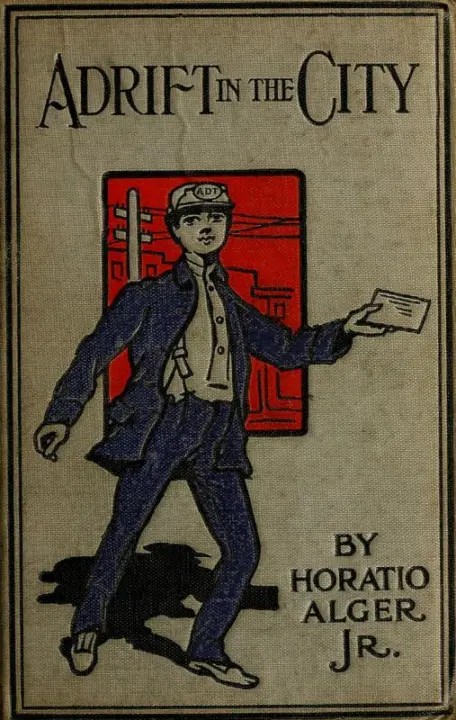
THE CLASSIC COLLECTION · 1895
"Adrift in the City; or, Oliver Conrad's Plucky Fight" by Horatio Alger, Jr. is a novel written in the late 19th century. This coming-of-age story centers on young Oliver Conrad, who faces a challenging relationship with his step-brother Roland Kenyon and his cruel step-father, Mr. Kenyon. The narrative explores themes of resilience and the struggle for independence amidst familial tensions, as Oliver learns to assert himself against the bullying he experiences. The opening of the book introduces a confrontation between Oliver and Roland, establishing their antagonistic relationship marked by class and privilege disparities. Roland, feeling entitled, commands Oliver to fetch a ball, leading to a physical altercation that exemplifies the underlying tension between them. After defending himself successfully, Oliver is summoned before Mr. Kenyon, who unjustly accuses him of assaulting Roland. As Oliver stands firm in his principles and self-defense, the stage is set for a deeper exploration of his plight, hinting at future conflicts and Oliver's quest for autonomy against the backdrop of his step-father's deceitful motives.
Introduction adapted from the source catalogue; source summaries may be automatically generated.
Free to read · English · 51,164 words · No account needed
MAKE TIME FOR A GOOD BOOK
On by default. Untick to stop anonymous reading totals. Each page counts after 10 seconds in view. How this works.
Anonymous counting is on unless you have switched it off.
"Oh, we can manage without it. Can't we, Florette?"
"Let us yide in the horse-cars," said the little girl. "I like to yide in the cars better than in mamma's carriage."
"It shall be as you like, Florette," said Mrs. Conrad.
Florette clapped her little hands. Accustomed to ride in the carriage, it was a change and variety to her to ride in the more democratic conveyance, the people's carriage.
Mrs. Conrad, intent on amusing her little charge, decided to take her to Lincoln Park, in the northern division of the city. This is a beautiful pleasure-ground, comprising over two hundred acres, with fine trees, miniature lakes and streams, and is a favorite resort for children and their guardians, especially on Saturday afternoons, when there are open-air concerts. It was a bright, sunny day, and even Mrs. Conrad felt her spirits enlivened as she descended from the cars, and, entering the park, mingled with the gay throngs who were giving themselves up to enjoyment.
Little Florette wanted to go to the lake, and her companion yielded to
her request.
It was early autumn. The trees had lost none of their full, rich foliage, and the lawns were covered with soft verdure. Little Florette laughed and clapped her hands with childish hilarity. Mrs. Conrad sat down on the grass, while Florette ran hither and thither as caprice dictated.
"Don't go far away, Florette," said Mrs. Conrad.
"No, I won't," said the child.
But a child's promises are soon forgotten. She ran to the lake, and while standing on the brink managed to tumble in. It was not deep, yet for a little child there was danger. Florette screamed, and Mrs. Conrad, hearing her cry, sprang to her feet in dismay.
But Florette found a helper.
Oliver had strayed out to Lincoln Park like the rest in search of enjoyment, and was standing close at hand when the little girl fell into the lake.
It was the work of an instant to plunge in and rescue the little girl. Then he looked about to find out to whom he should yield her up.
His eyes fell upon Mrs. Conrad hastening to her young charge. As yet she had not noticed Oliver. She only saw Florette.
Oliver's heart gave a great bound. Could it be his mother--his mother whom he believed dead--or was it only a wonderful resemblance?
"Mother!" he exclaimed, almost involuntarily.
At that word Mrs. Conrad turned her eyes upon him. She, too, was amazed, and something of awe crept over her as she looked upon one whom she thought a tenant of the tomb.
"Oliver!" she said wistfully, and in an instant he was folded in her
arms.
Your reading position is saved on this browser. Take it to another device with a library code. Reading pages adapt to text, rather than matching a printed edition.
William Rounseville Alger & Horatio, Jr. Alger

William Rounseville Alger & Horatio, Jr. Alger

Horatio, Jr. Alger

Horatio, Jr. Alger
BEHIND THE BOOK
This eBook is for the use of anyone anywhere in the United States and most other parts of the world at no cost and with almost no restrictions whatsoever. You may copy it, give it away or re-use it under the terms of the Project Gutenberg License included with this eBook or online at www.gutenberg.org. If you are not located in the United States, you will have to check the laws of the country where you are located before using this eBook. Read the source licence.
The original source file, including credits and licence, is retained by this library. Request an original-format copy at no charge. Please include the book title and Project Gutenberg identifier #56973.
KEEP YOUR CURIOSITY GOING
Coulson Kernahan

Maurice Baring
Frances Wright
Cécile Tormay

Frederic Jesup Stimson

W. H. P. (William Henry Pope) Jarvis