
Life of Edwin Forrest, the American Tragedian. Volume 2 (of 2)
William Rounseville Alger & Horatio, Jr. Alger
THE CLASSIC COLLECTION · 1895
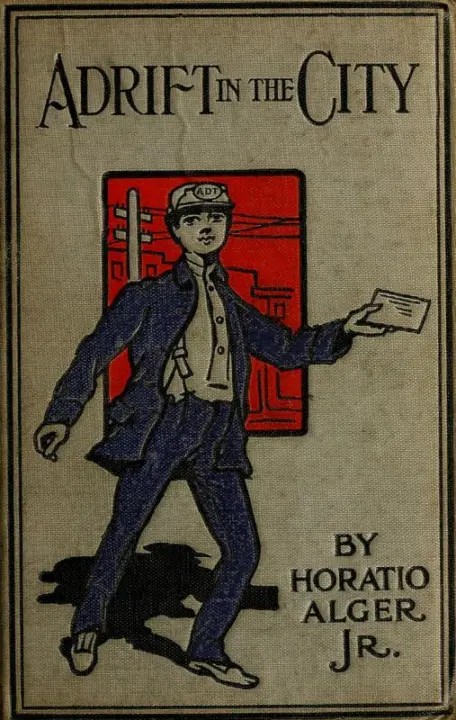
"Adrift in the City; or, Oliver Conrad's Plucky Fight" by Horatio Alger, Jr. is a novel written in the late 19th century. This coming-of-age story centers on young Oliver Conrad, who faces a challenging relationship with his step-brother Roland Kenyon and his cruel step-father, Mr. Kenyon. The narrative explores themes of resilience and the struggle for independence amidst familial tensions, as Oliver learns to assert himself against the bullying he experiences. The opening of the book introduces a confrontation between Oliver and Roland, establishing their antagonistic relationship marked by class and privilege disparities. Roland, feeling entitled, commands Oliver to fetch a ball, leading to a physical altercation that exemplifies the underlying tension between them. After defending himself successfully, Oliver is summoned before Mr. Kenyon, who unjustly accuses him of assaulting Roland. As Oliver stands firm in his principles and self-defense, the stage is set for a deeper exploration of his plight, hinting at future conflicts and Oliver's quest for autonomy against the backdrop of his step-father's deceitful motives.
Introduction adapted from the source catalogue; source summaries may be automatically generated.
Free to read · English · 51,164 words · No account needed
MAKE TIME FOR A GOOD BOOK
On by default. Untick to stop anonymous reading totals. Each page counts after 10 seconds in view. How this works.
Anonymous counting is on unless you have switched it off.
"I am very much pleased to think that she cares for me," said Mrs. Conrad, looking the pleasure she felt. "Do you really like me, then, Florette?"
The answer was a caress, which was very grateful to the lonely woman.
"It does me good," she said to Mrs. Graham. "I am quite alone in the world, and treasure more than you can imagine your little girl's affection."
"I am sure she has suffered," thought Mrs. Graham, who was of a kindly, sympathetic nature. "How unhappy I should be if I, too, were alone in the world!"
Mr. Graham was a merchant in Chicago, where business detained him and prevented his joining his wife. She was only to stay a few weeks, and the time had nearly expired when little Florette was taken sick with a contagious disease. The mercenary nurse fled. Mrs. Graham's relations, also concerned for their safety, left the sorrow-stricken mother alone in the house, going to a neighboring town to remain till the danger was over. Human nature was unlovely in some of its phases, as Mrs. Graham was to find out.
But she was not without a friend in the hour of her need.
Mrs. Conrad presented herself, and said:
"I have heard of Florette's sickness, and I have come to help you."
"But do you know the danger?" asked the poor mother. "Do you know that her disease is contagious, and that you run the risk of taking it?"
"I know all, but life is not very precious to me. I love your little daughter, and I am willing to risk my life for her."
Mrs. Graham made no further opposition. In truth, she was glad and encouraged to find a friend who was willing to help her--more especially one whom the little girl loved nearly as much as herself.
So these two faithful women watched by day and by night at the bedside of little Florette, relieving each other when nature's demand for rest became imperative, and the result was that Florette was saved. The crisis was safely past, and neither contracted the disease.
When Florette was well enough, Mrs. Graham prepared to set out for her
Northern home.
"How lonely I shall feel without you," exclaimed Mrs. Conrad, with a
sigh.
"Then come with us," said Mrs. Graham. "Florette loves you, and after what has passed I look upon you as a sister. I have a pleasant home in Chicago, and wish you to share it."
"But I am a stranger to you, Mrs. Graham. How do you know that I am
worthy?"
"The woman who has nursed my child back from death is worthy of all
honor in my household."
Your reading position is saved on this browser. Take it to another device with a library code. Reading pages adapt to text, rather than matching a printed edition.
William Rounseville Alger & Horatio, Jr. Alger

William Rounseville Alger & Horatio, Jr. Alger

Horatio, Jr. Alger

Horatio, Jr. Alger
BEHIND THE BOOK
This eBook is for the use of anyone anywhere in the United States and most other parts of the world at no cost and with almost no restrictions whatsoever. You may copy it, give it away or re-use it under the terms of the Project Gutenberg License included with this eBook or online at www.gutenberg.org. If you are not located in the United States, you will have to check the laws of the country where you are located before using this eBook. Read the source licence.
The original source file, including credits and licence, is retained by this library. Request an original-format copy at no charge. Please include the book title and Project Gutenberg identifier #56973.
KEEP YOUR CURIOSITY GOING
Coulson Kernahan

Maurice Baring
Frances Wright
Cécile Tormay

Frederic Jesup Stimson

W. H. P. (William Henry Pope) Jarvis