THE CLASSIC COLLECTION✦Lost DiariesCLASSIC FREE BOOKS
Lost Diaries
Maurice Baring
THE CLASSIC COLLECTION · 1874
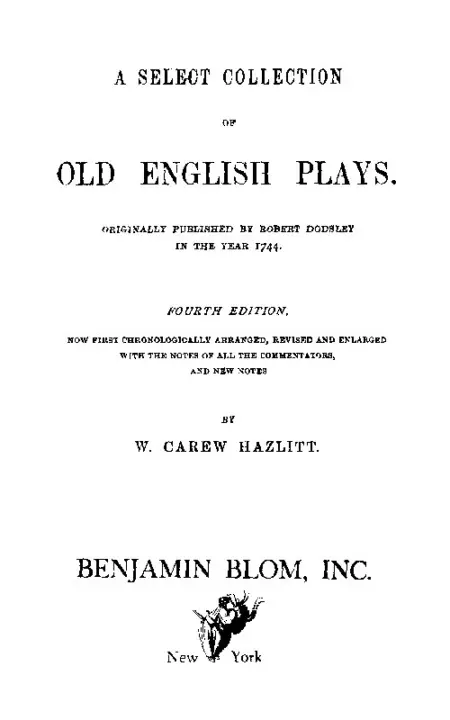
"A Select Collection of Old English Plays, Volume 12" by Robert Dodsley is a compilation of early English dramas, likely assembled in the 18th century. This volume includes works that reflect the theatrical traditions of that period, particularly focusing on themes of love, avarice, and social critique. Readers can expect the plays collected within to showcase a variety of characters and scenarios typical of old English comedy. The opening portion introduces "The Old Couple," a comedy by Thomas May, featuring prominent characters like Eugeny, humanity's tragic figure, and Theodore, the virtuous son of the miserly Earthworm. The narrative centers around the secret meeting of Eugeny and Artemia, highlighting themes of forbidden love and societal constraints. The dialogue reveals the emotional turmoil faced by Eugeny due to his past deeds, setting a tone for the complexities of the relationships that unfold within the comedic framework. Through witty exchanges and poignant reflections, the play promises a blend of humor and introspection that is characteristic of its time.
Introduction adapted from the source catalogue; source summaries may be automatically generated.
Free to read · English · 148,252 words · No account needed
MAKE TIME FOR A GOOD BOOK
On by default. Untick to stop anonymous reading totals. Each page counts after 10 seconds in view. How this works.
Anonymous counting is on unless you have switched it off.
EUPH. It comes into my head
What old Sir Argent Scrape told to his lady.
His kinsman Eugeny lurk'd hereabouts:
He was her sweetheart once, and may be still;
I think she's constant, though she keep it close.
This Theodore and he were fam'd for friendship.
[Aside.
I have collected, cousin, and have at you?
ART. Let's hear it, pray.
EUPH. You shall. This Theodore
I do confess a most deserving man;
And so perchance your lover Eugeny
Has told you, cousin. Ha! do you begin
To blush already? I am sure those two
Were most entirely friends; and I am sorry
To hear what I have heard to-day, concerning
Young Eugeny.
ART. What, prythee, cousin? Tell me.
EUPH. Now you are mov'd; but I may err, you know.
ART. Good cousin, tell me what.
EUPH. Nay, I believe
I shall worse startle you, though you would make
Such fools as I believe he is in France.
Yes, yes, it may be so; and then, you know,
He's safe enough.
ART. O cousin, I'll confess
What you would have me do; but tell me this.
EUPH. Nay, now I will not thank you; I have found it: And though you dealt in riddles so with me, I'll plainly tell you all, and teach you how You may perchance prevent your lover's danger.
ART. O, I shall ever love you.
EUPH. Well, come in;
I'll tell you all, and by what means I knew it.
[15] I suppose he means a bumper, a cup filled till the wine rises above the top of it. Such a character as Dotterel is hardly made to allude to the pocula coronata of the Romans.--Steevens.
A crowned cup was not an unusual expression for a bumper: thus, in "All Fools," Fortunio says--
"True, and to welcome Dariotto's lateness
He shall (unpledg'd) carouse one crowned cup
To all these ladies' health."
Dotterel might therefore very properly employ words in ordinary use, without supposing him acquainted with "the pocula coronata of the Romans."--Collier.
[16] [Compare vol. iv. p. 68.]
[17] So Pope--
"Who sees pale Mammon pine amidst his store, Sees but a backward steward for the poor; This year a reservoir to keep and spare; The next, a fountain, spouting through his heir, In lavish streams to quench a country's thirst, And men and dogs shall drink him till they burst."
--"Moral Essays," Ep. iii. l. 170.
Your reading position is saved on this browser. Take it to another device with a library code. Reading pages adapt to text, rather than matching a printed edition.
BEHIND THE BOOK
This eBook is for the use of anyone anywhere in the United States and most other parts of the world at no cost and with almost no restrictions whatsoever. You may copy it, give it away or re-use it under the terms of the Project Gutenberg License included with this eBook or online at www.gutenberg.org. If you are not located in the United States, you will have to check the laws of the country where you are located before using this eBook. Read the source licence.
The original source file, including credits and licence, is retained by this library. Request an original-format copy at no charge. Please include the book title and Project Gutenberg identifier #46791.
KEEP YOUR CURIOSITY GOING
Maurice Baring
W. B. (William Butler) Yeats
Edward Martyn

John Brougham & Charlotte Brontë
Marguerite Merington
Leonid Andreyev