THE CLASSIC COLLECTION✦Lost DiariesCLASSIC FREE BOOKS
Lost Diaries
Maurice Baring
THE CLASSIC COLLECTION · 1874
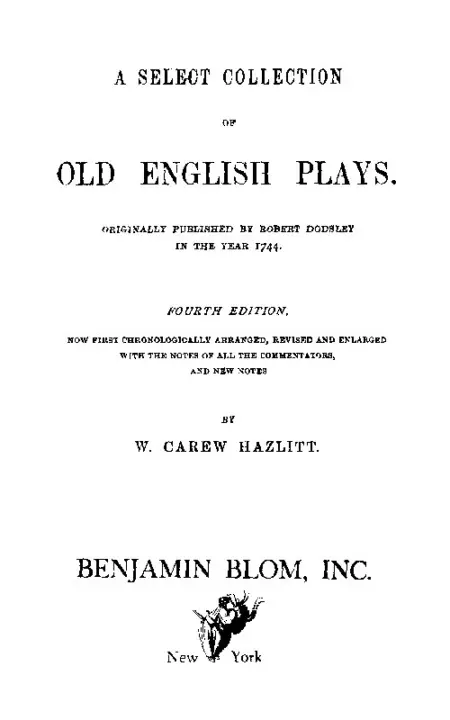
"A Select Collection of Old English Plays, Volume 12" by Robert Dodsley is a compilation of early English dramas, likely assembled in the 18th century. This volume includes works that reflect the theatrical traditions of that period, particularly focusing on themes of love, avarice, and social critique. Readers can expect the plays collected within to showcase a variety of characters and scenarios typical of old English comedy. The opening portion introduces "The Old Couple," a comedy by Thomas May, featuring prominent characters like Eugeny, humanity's tragic figure, and Theodore, the virtuous son of the miserly Earthworm. The narrative centers around the secret meeting of Eugeny and Artemia, highlighting themes of forbidden love and societal constraints. The dialogue reveals the emotional turmoil faced by Eugeny due to his past deeds, setting a tone for the complexities of the relationships that unfold within the comedic framework. Through witty exchanges and poignant reflections, the play promises a blend of humor and introspection that is characteristic of its time.
Introduction adapted from the source catalogue; source summaries may be automatically generated.
Free to read · English · 148,252 words · No account needed
MAKE TIME FOR A GOOD BOOK
On by default. Untick to stop anonymous reading totals. Each page counts after 10 seconds in view. How this works.
Anonymous counting is on unless you have switched it off.
HEAR. We're made, my boys, we're made! methinks I am Growing into a thing that will be worshipp'd.
SLICER. I shall sleep one day in my chain and scarlet
At Spital-sermon.
SHAPE. Were not my wit such,
I'd put out moneys of being Mayor.
But, O this brain of mine! that's it that will
Bar me the city honour.
HEAR. We're cri'd up
O' th' sudden for the sole tutors of the age.
SHAPE. Esteem'd discreet, sage trainers up of youth.
HEAR. Our house becomes a place of visit now.
SLICER. In my poor judgment, 'tis as good my lady
Should venture to commit her eldest son
To us as to the Inns-of-Court: He'll be
Undone here, only with less ceremony.
HEAR. Speak for our credit, my brave man of war.
What, Meanwell, why so lumpish?
MEAN. Pray you, be quiet.
HEAR. Thou look'st as if thou plott'st the calling in O' th' Declaration, or the abolishing[116] O' th' common prayers. Cheer up; say something for us.
MEAN. Pray, vex me not.
SLICER. These foolish, puling sighs
Are good for nothing, but to endanger buttons.
Take heart of grace, man.[117]
MEAN. Fie, y' are troublesome!
HEAR. Nay, fare you well then, sir. [Exeunt HEARSAY, SLICER, SHAPE.
MEAN. My father still
Runs in my mind, meets all my thoughts, and doth
Mingle himself in all my cogitations.
Thus to see eager villains drag along
Him unto whom they crouch'd! to see him hal'd,
That ne'er knew what compulsion was, but when
His virtues did incite him to good deeds,
And keep my sword dry! O unequal nature!
Why was I made so patient as to view,
And not so strong as to redeem? Why should I
Dare to behold, and yet not dare to rescue?
Had I been destitute of weapons, yet
Arm'd with the only name of son, I might
Have outdone wonder. Naked piety
Dares more than fury well-appointed[118]; blood
Being never better sacrificed, than when
It flows to him that gave it. But, alas!
The envy of my fortune did allow
That only which she could not take away--
Compassion, that which was not in those savage
And knowing beasts, those engines of the law
That even killed as uncontroll'd as that.
How do I grieve when I consider from
What hands he suffer'd! Hands that do excuse
Th' indulgent prison, shackles being here
A kind of rescue. Young man, 'tis not well
To see thy aged father thus confin'd.
Good, good old man! alas! thou'rt dead to me,
Dead to the world, and only living to
That which is more than death, thy misery!
The grave could be a comfort: and shall I--
O, would this soul of mine--But death's the wish
Of him that fears; he's lazy that would die.
I'll live and see that thing of wealth, that worm
Bred out of splendid muck, that citizen,
Like his own sullied wares thrown by into
Some unregarded corner; and my piety
Shall be as famous as his avarice.
His son, whom we have in our tuition,
Shall be the subject of my good revenge:
I'll count myself no child, till I have done
Something that's worth that name. My brain shall be
Busy in his undoing; and I will
Plot ruin with religion: his disgrace
Shall be my zeal's contrivement; and when this
Shall style me son again, I hope 'twill be
Counted not wrong, but duty. When that time
Shall give my actions growth, I will cast off
This brood of vipers, and will show that I
Do hate the poison which I meant t' apply. [Exit.
Your reading position is saved on this browser. Take it to another device with a library code. Reading pages adapt to text, rather than matching a printed edition.
BEHIND THE BOOK
This eBook is for the use of anyone anywhere in the United States and most other parts of the world at no cost and with almost no restrictions whatsoever. You may copy it, give it away or re-use it under the terms of the Project Gutenberg License included with this eBook or online at www.gutenberg.org. If you are not located in the United States, you will have to check the laws of the country where you are located before using this eBook. Read the source licence.
The original source file, including credits and licence, is retained by this library. Request an original-format copy at no charge. Please include the book title and Project Gutenberg identifier #46791.
KEEP YOUR CURIOSITY GOING
Maurice Baring
W. B. (William Butler) Yeats
Edward Martyn

John Brougham & Charlotte Brontë
Marguerite Merington
Leonid Andreyev