THE CLASSIC COLLECTION✦Lost DiariesCLASSIC FREE BOOKS
Lost Diaries
Maurice Baring
THE CLASSIC COLLECTION · 1874
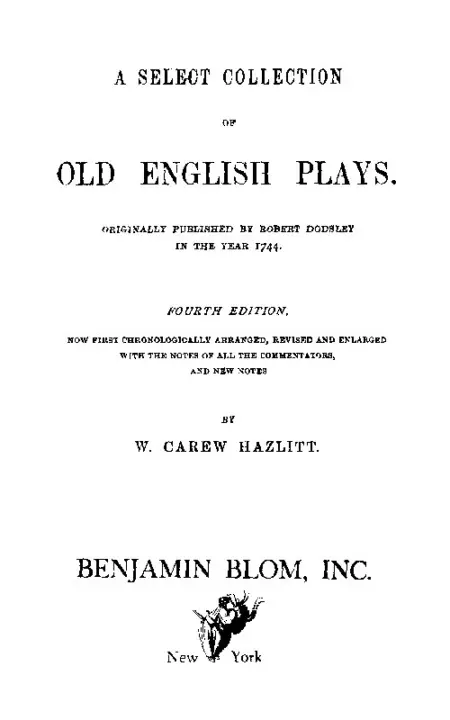
"A Select Collection of Old English Plays, Volume 12" by Robert Dodsley is a compilation of early English dramas, likely assembled in the 18th century. This volume includes works that reflect the theatrical traditions of that period, particularly focusing on themes of love, avarice, and social critique. Readers can expect the plays collected within to showcase a variety of characters and scenarios typical of old English comedy. The opening portion introduces "The Old Couple," a comedy by Thomas May, featuring prominent characters like Eugeny, humanity's tragic figure, and Theodore, the virtuous son of the miserly Earthworm. The narrative centers around the secret meeting of Eugeny and Artemia, highlighting themes of forbidden love and societal constraints. The dialogue reveals the emotional turmoil faced by Eugeny due to his past deeds, setting a tone for the complexities of the relationships that unfold within the comedic framework. Through witty exchanges and poignant reflections, the play promises a blend of humor and introspection that is characteristic of its time.
Introduction adapted from the source catalogue; source summaries may be automatically generated.
Free to read · English · 148,252 words · No account needed
MAKE TIME FOR A GOOD BOOK
On by default. Untick to stop anonymous reading totals. Each page counts after 10 seconds in view. How this works.
Anonymous counting is on unless you have switched it off.
1. At the spring
Birds do sing:
Now with high,
Then low cry.
Flat, acute;
And salute,
The sun, born
Every morn.
ALL. He's no bard that cannot sing
The praises of the flow'ry spring.
2. Flora queen,
All in green,
Doth delight
To paint white,
And to spread
Cruel red
With a blue,
Colour true.
ALL. He's no bard, &c.
3. Woods renew
Hunter's hue.
Shepherd's grey
Crown'd with bay,
With his pipe
Care doth wipe,
Till he dream
By the stream.
ALL. He's no bard, &c.
4. Faithful loves,
Turtle-doves,
Sit and bill
On a hill.
Country swains
On the plains
Run and leap,
Turn and skip.
ALL. He's no bard, &c.
5. Pan doth play
Care away.
Fairies small,
Two foot tall,
With caps red
On their head,
Dance around
On the ground.
ALL. He's no bard, &c.
6. Phillis bright,
Cloth'd in white,
With neck fair,
Yellow hair,
Rocks doth move
With her love,
And make mild
Tigers wild.
ALL. He's no bard that cannot sing
The praises of the flow'ry spring.
2d Song.
Thus spend we time in laughter,
While peace and spring do smile;
But I hear a sound of slaughter
Draw nearer to our isle.
Leave then your wonted prattle,
The oaten reed forbear;
For I hear a sound of battle,
And trumpets tear the air.
Let bagpipes die for want of wind,
Let crowd[276] and harp be dumb:
Let little tabor come behind:
For I hear the dreadful drum.
Let no birds sing, no lambkins dance, No fountains murmuring go: Let shepherd's crook be made a lance. For the martial horns do blow. [Exeunt.
[260] Bring you back. Reduco, Lat.--Steevens.
[261] Dux Nennius. The leaders of armies are on this account styled Dukes by many of our ancient English translators; as Duke Æneas, Duke Hannibal, &c.--Steevens.
[262] [Natives of Gallia Belgica, a province comprising the Duchy of Treves, part of Luxembourg, and the departments of the Meuse, Moselle, Meurthe, and Vosges. Hazlitt's "Classical Gazetteer," 1851, p. 71.]
[263] The same turn of thought occurs in Mr Gray's celebrated ode
called "The Bard"--
"Think'st thou yon sanguine cloud,
Raised by thy breath, has quench'd the orb of day?"
--Steevens.
[264] Imitated from the first speech of Gloster in "King Richard III."
[265] "In bis fuit Ariovistus, qui naviculam deligatam ad ripam nactus ea profugit."--Cæsar "De Bello Gallico," lib. i. s. 53.
[266] See Cæsar "De Bello Gallico," lib, iv., s. 17, for an account of this bridge over the Rhine.
[267] Alexander the Great. Pella was a city of Macedon, where he was
born.
[268] A term in archery.
[269] Erynnis is the common name of the sister Furies, but is frequently used by the poets for mischief in general.--Steevens.
Your reading position is saved on this browser. Take it to another device with a library code. Reading pages adapt to text, rather than matching a printed edition.
BEHIND THE BOOK
This eBook is for the use of anyone anywhere in the United States and most other parts of the world at no cost and with almost no restrictions whatsoever. You may copy it, give it away or re-use it under the terms of the Project Gutenberg License included with this eBook or online at www.gutenberg.org. If you are not located in the United States, you will have to check the laws of the country where you are located before using this eBook. Read the source licence.
The original source file, including credits and licence, is retained by this library. Request an original-format copy at no charge. Please include the book title and Project Gutenberg identifier #46791.
KEEP YOUR CURIOSITY GOING
Maurice Baring
W. B. (William Butler) Yeats
Edward Martyn

John Brougham & Charlotte Brontë
Marguerite Merington
Leonid Andreyev