THE CLASSIC COLLECTION✦Lost DiariesCLASSIC FREE BOOKS
Lost Diaries
Maurice Baring
THE CLASSIC COLLECTION · 1874
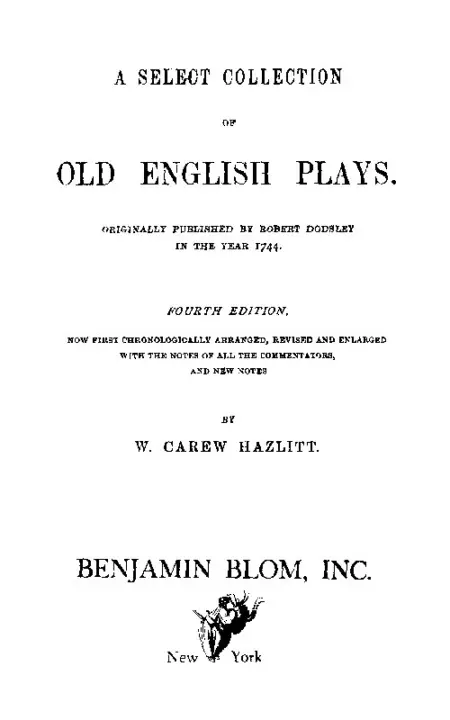
"A Select Collection of Old English Plays, Volume 12" by Robert Dodsley is a compilation of early English dramas, likely assembled in the 18th century. This volume includes works that reflect the theatrical traditions of that period, particularly focusing on themes of love, avarice, and social critique. Readers can expect the plays collected within to showcase a variety of characters and scenarios typical of old English comedy. The opening portion introduces "The Old Couple," a comedy by Thomas May, featuring prominent characters like Eugeny, humanity's tragic figure, and Theodore, the virtuous son of the miserly Earthworm. The narrative centers around the secret meeting of Eugeny and Artemia, highlighting themes of forbidden love and societal constraints. The dialogue reveals the emotional turmoil faced by Eugeny due to his past deeds, setting a tone for the complexities of the relationships that unfold within the comedic framework. Through witty exchanges and poignant reflections, the play promises a blend of humor and introspection that is characteristic of its time.
Introduction adapted from the source catalogue; source summaries may be automatically generated.
Free to read · English · 148,252 words · No account needed
MAKE TIME FOR A GOOD BOOK
On by default. Untick to stop anonymous reading totals. Each page counts after 10 seconds in view. How this works.
Anonymous counting is on unless you have switched it off.
ART. All happiness attend you, worthy sir.
[Exit THEODORE.
Would I myself might go as well as send,
And see that seeming solitary place,
That place of woe. Sure, it would be to me
No desert wood, while Eugeny were there,
But a delightful palace. Here at home,
The more that company comes in, the more
I am alone, methinks. Wanting that object
On which my heart is fix'd, I cannot be
Possess'd of anything. Nothing can be
My comfort but a hope that these sad clouds
Of our misfortunes will at last blow over.
But mischief's like a cockatrice's eyes--
Sees first and kills, or is seen first and dies.
Enter EUPHUES.
EUPH. How dost thou, coz? I wrote a letter for thee
To Earthworm's son: has the young ten-i'-th'-hundred
Been here?
ART. I thank you, cousin; the gentleman
Was with me, and but newly parted hence.
EUPH. H' has got a title then by coming hither:
But he may be a gentleman; his wealth
Will make it good.
ART. His virtues make it good:
Believe it, cousin, there's a wealthy mind
Within that plain outside.
EUPH. How's this?
Have your quick eyes found out his worth already?
ART. They must be blind that cannot, when they know him.
Well, cousin, you may laugh at me.
EUPH. By no means;
I know your judgment's good.
ART. As good as 'tis,
It must content a woman. When you know him,
You'll find a man that may deserve your friendship,
And far above all slighting.
EUPH. I am sorry
I came not soon enough: but prythee, cousin,
What are the ways have taken thee so soon?
ART. What taking do you mean? You promis'd me
You would not ask the cause I sent for him,
Though you shall know hereafter. But I hope
You do not think I am in love with him?
EUPH. I'll look upon the man, and then resolve you.
ART. Well, do; perhaps you'll know him better, then:
He knows you well.
EUPH. Me! Has he told you how?
ART. Did you ne'er meet one Theodore at Venice?
EUPH. Can this be he?
ART. Yes, very well; although
He be old Earthworm's son, and make no shew
At home.
EUPH. And have you found out so much worth
In him already?
ART. How do you esteem him?
We women well may err.
EUPH. I smell a rat;
And, if my brain fail not, have found out all
Your drifts, though ne'er so politicly carri'd.
ART. I know your brain, cousin, is very good;
But it may fail.
Your reading position is saved on this browser. Take it to another device with a library code. Reading pages adapt to text, rather than matching a printed edition.
BEHIND THE BOOK
This eBook is for the use of anyone anywhere in the United States and most other parts of the world at no cost and with almost no restrictions whatsoever. You may copy it, give it away or re-use it under the terms of the Project Gutenberg License included with this eBook or online at www.gutenberg.org. If you are not located in the United States, you will have to check the laws of the country where you are located before using this eBook. Read the source licence.
The original source file, including credits and licence, is retained by this library. Request an original-format copy at no charge. Please include the book title and Project Gutenberg identifier #46791.
KEEP YOUR CURIOSITY GOING
Maurice Baring
W. B. (William Butler) Yeats
Edward Martyn

John Brougham & Charlotte Brontë
Marguerite Merington
Leonid Andreyev