THE CLASSIC COLLECTION✦Lost DiariesCLASSIC FREE BOOKS
Lost Diaries
Maurice Baring
THE CLASSIC COLLECTION · 1874
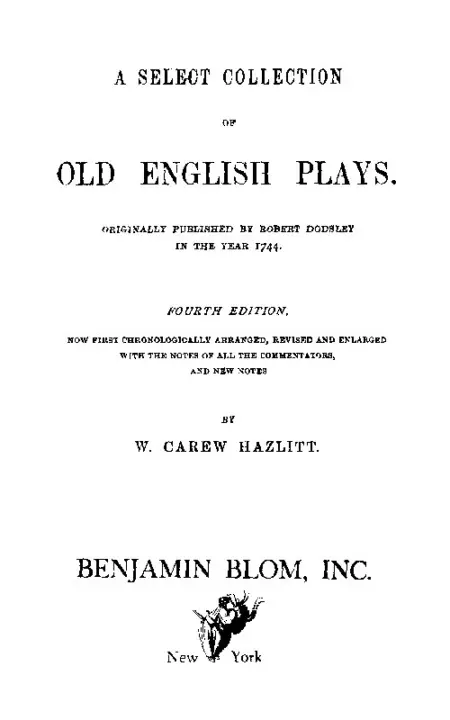
"A Select Collection of Old English Plays, Volume 12" by Robert Dodsley is a compilation of early English dramas, likely assembled in the 18th century. This volume includes works that reflect the theatrical traditions of that period, particularly focusing on themes of love, avarice, and social critique. Readers can expect the plays collected within to showcase a variety of characters and scenarios typical of old English comedy. The opening portion introduces "The Old Couple," a comedy by Thomas May, featuring prominent characters like Eugeny, humanity's tragic figure, and Theodore, the virtuous son of the miserly Earthworm. The narrative centers around the secret meeting of Eugeny and Artemia, highlighting themes of forbidden love and societal constraints. The dialogue reveals the emotional turmoil faced by Eugeny due to his past deeds, setting a tone for the complexities of the relationships that unfold within the comedic framework. Through witty exchanges and poignant reflections, the play promises a blend of humor and introspection that is characteristic of its time.
Introduction adapted from the source catalogue; source summaries may be automatically generated.
Free to read · English · 148,252 words · No account needed
MAKE TIME FOR A GOOD BOOK
On by default. Untick to stop anonymous reading totals. Each page counts after 10 seconds in view. How this works.
Anonymous counting is on unless you have switched it off.
Chorus.
1st Song.
Rejoice, O Britain!
Britain, O, rejoice!
The stormy cloud pass'd o'er,
And only made a noise.
A clattering sound was heard,
And still we felt no wound:
Rejoice, rejoice,
Thou happy Britons' ground.
O that sweet Plenides,
Eloquent Orone,
Were now to chant our victories
With a melodious tone;
And rousing echo from the dales,
With Harmony to sound:
Rejoice, rejoice,
Thou happy Britons' ground.
2d Song
Gang, ye lads and lasses,
Sa wimble and sa wight:
Fewl mickle teen betide ye,
If ye ligg in this plight.
Be bonny, buxom, jolly,
Trip haydegues[325] belive;
And gif night gars the welkin merk,
Tom piper do you blive.
Hidder, eke and shidder,
With spic'd sew ycram'd;
Sa that unneath thilke borrels
May well ne yede, ne stand:
As leefe as life do weete it,
When timbarins giu sound;
Fore harvest gil prankt up in lathe,
To loute it low around.[326]
[301] [An allusion to a belief which is mentioned in many of our early plays. See Dyce's Middleton, iv. 495.]
[302] Helmet.
[303] i.e., The roofs of the temples. "De tholis pendent laqueata
circum Arma."
[304] Pallas being feigned by the poets to have been bred in Jupiter's
brain.
[305] i.e., The Romans, who owed their founders, Romulus and Remus, to the care of Faustulus, who was shepherd to the tyrant Amulius.--Steevens.
[306] The goddess of the morning.--Steevens.
[307] The goddess of revenge. Baxter, in his "Glossary," says she is corruptly so called, and that her true name should be Andrasta.
[308] A mace [here seems to mean a sceptre, but properly stands for a
club.]
[309] Geoffrey of Monmouth says, "His (Nennius's) funeral exequies were performed with regal pomp, and Cæsar's sword put into the tomb with him, which he kept possession of when struck into his shield in the combat. The name of the sword was Crocea Mors, Yellow Death, as being mortal to everybody that was wounded with it."--Bk. iv. c. 4, Thompson's translation, 1718, p. 102.
[310] By Geoffrey of Monmouth said to be the great grandson of Æneas. After being banished from Italy, on account of accidentally killing his father, he arrived at Britain, to which he gave his own name. He built Trinovantum, or London, and dying, left the government of the nation to his sons.
[311] Dunwallo Molmutius, son of Cloton, King of Cornwall. After a reign of 40 years he died, and was buried at Trinovantum, near the Temple of Concord.--"Geoffrey of Monmouth," bk. ii. c. 17. [Compare p. 484.]
[312] So in "King Henry IV., Part. II."--
"And darkness be the burier of the dead."
--Steevens.
[313] Frankincense.--Steevens.
[314] One of the horses of the Sun.--Steevens.
[315] Perhaps Pylius, i.e., Nestor--
Your reading position is saved on this browser. Take it to another device with a library code. Reading pages adapt to text, rather than matching a printed edition.
BEHIND THE BOOK
This eBook is for the use of anyone anywhere in the United States and most other parts of the world at no cost and with almost no restrictions whatsoever. You may copy it, give it away or re-use it under the terms of the Project Gutenberg License included with this eBook or online at www.gutenberg.org. If you are not located in the United States, you will have to check the laws of the country where you are located before using this eBook. Read the source licence.
The original source file, including credits and licence, is retained by this library. Request an original-format copy at no charge. Please include the book title and Project Gutenberg identifier #46791.
KEEP YOUR CURIOSITY GOING
Maurice Baring
W. B. (William Butler) Yeats
Edward Martyn

John Brougham & Charlotte Brontë
Marguerite Merington
Leonid Andreyev