THE CLASSIC COLLECTION✦Lost DiariesCLASSIC FREE BOOKS
Lost Diaries
Maurice Baring
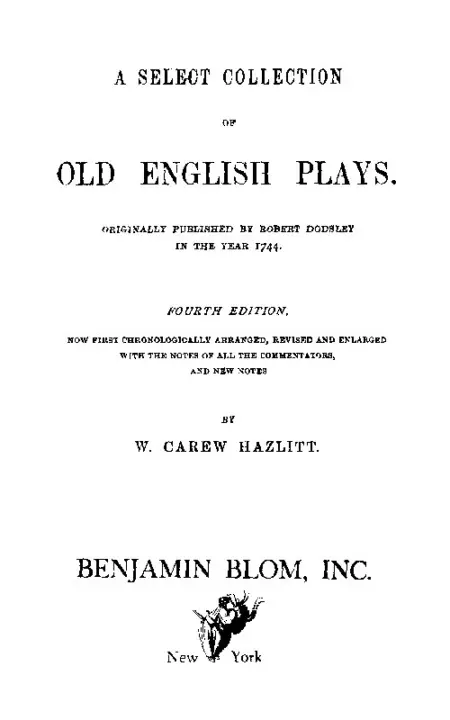
THE CLASSIC COLLECTION · 1874
"A Select Collection of Old English Plays, Volume 12" by Robert Dodsley is a compilation of early English dramas, likely assembled in the 18th century. This volume includes works that reflect the theatrical traditions of that period, particularly focusing on themes of love, avarice, and social critique. Readers can expect the plays collected within to showcase a variety of characters and scenarios typical of old English comedy. The opening portion introduces "The Old Couple," a comedy by Thomas May, featuring prominent characters like Eugeny, humanity's tragic figure, and Theodore, the virtuous son of the miserly Earthworm. The narrative centers around the secret meeting of Eugeny and Artemia, highlighting themes of forbidden love and societal constraints. The dialogue reveals the emotional turmoil faced by Eugeny due to his past deeds, setting a tone for the complexities of the relationships that unfold within the comedic framework. Through witty exchanges and poignant reflections, the play promises a blend of humor and introspection that is characteristic of its time.
Introduction adapted from the source catalogue; source summaries may be automatically generated.
Free to read · English · 148,252 words · No account needed
MAKE TIME FOR A GOOD BOOK
On by default. Untick to stop anonymous reading totals. Each page counts after 10 seconds in view. How this works.
Anonymous counting is on unless you have switched it off.
MOTH. Harrow,[176] alas! I swelt[177] here as I go;
Brenning[178] in fire of little Cupido.
I no where hoart yfeel but on mine head.
Huh, huh, huh, so; ycapred very wele.
I am thine leek, thou Chaucer eloquent;
Mine head is white, but, O, mine taile is green.
This is the palyes, where mine lady wendeth.
Saint Francis[179] and Saint Benedight,
Blesse this house from wicked wight;
From the night-mare and the goblin,
That is hight Good-fellow Robin;
Keep it from all evil spirits,
Fairies, weazels, rats, and ferrets:
From curfew-time
To the next prime.
Come forth, mine duck, mine bride, mine honeycomb;
Come forth, mine cinnamon.
Enter MISTRESS POTLUCK.
POT. Who is't that calls?
MOTH. A knight most gent.
POT. What is your pleasure, sir?
MOTH. Thou art mine pleasure, by dame Venus brent; So fresh thou art, and therewith so lycand.[180]
POT. Alas! I am not any flickering thing:
I cannot boast of that slight-fading gift
You men call beauty; all my handsomeness
Is my good-breeding and my honesty.
I could plant red where you now yellow see;
But painting shows an harlot.
MOTH. Harlot! so
Called from one Harlotha, concubine
To deignous[181] Wilhelm, hight the Conqueror.
POT. Were he ten Williams and ten conquerors,
I'd have him know't, I scorn to be his harlot.
I never yet did take press-money to
Serve under any one.
MOTH. Then take it now.
Werme kiss! Thine lips ytaste like marrow-milk;
Me-thinketh that fresh butter runneth on them.
I grant well now, I do enduren woe,
As sharp as doth the Tityus in hell,
Whose stomach fowls do tyren[182] ever more,
That highten vultures, as do tellen clerks.
POT. You've spoke my meaning, though I do not know What 'tis you said. Now see the fortune on't; We do know one another's souls already; The other must needs follow. Where's your dwelling?
MOTH. Yclose by Aldersgate there dwelleth one
Wights clepen Robert Moth; now Aldersgate[183]
Is hoten so from one that Aldrich hight;
Or else of elders, that is, ancient men;
Or else of aldern-trees, which growden there;
Or else, as heralds say, from Aluredus:
But whencesoe'er this yate[184] ycalled is,
There dwelleth Robert Moth, thine paramour.
POT. Can you be constant unto me, as I
Can be to you?
MOTH. By Woden, god of Saxons,
From whence comes We'nsday, that is, Woden'sday,
Truth is a thing that ever I will keep,
Unto thylke day in which I creep into
My sepulchre; I'll be as faithful to thee,
As Chaunticleer to Madam Partelot.[185]
POT. Here then I give away my heart to you;
As true a heart as ever widow gave.
Your reading position is saved on this browser. Take it to another device with a library code. Reading pages adapt to text, rather than matching a printed edition.
BEHIND THE BOOK
This eBook is for the use of anyone anywhere in the United States and most other parts of the world at no cost and with almost no restrictions whatsoever. You may copy it, give it away or re-use it under the terms of the Project Gutenberg License included with this eBook or online at www.gutenberg.org. If you are not located in the United States, you will have to check the laws of the country where you are located before using this eBook. Read the source licence.
The original source file, including credits and licence, is retained by this library. Request an original-format copy at no charge. Please include the book title and Project Gutenberg identifier #46791.
KEEP YOUR CURIOSITY GOING
Maurice Baring
W. B. (William Butler) Yeats
Edward Martyn

John Brougham & Charlotte Brontë
Marguerite Merington
Leonid Andreyev