THE CLASSIC COLLECTION✦Lost DiariesCLASSIC FREE BOOKS
Lost Diaries
Maurice Baring
THE CLASSIC COLLECTION · 1874
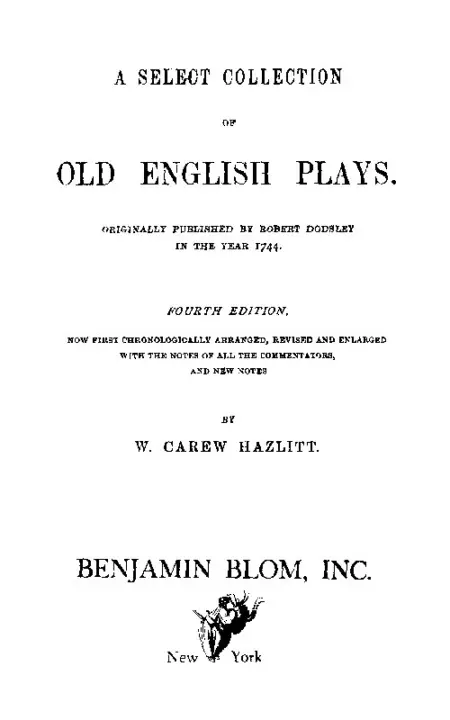
"A Select Collection of Old English Plays, Volume 12" by Robert Dodsley is a compilation of early English dramas, likely assembled in the 18th century. This volume includes works that reflect the theatrical traditions of that period, particularly focusing on themes of love, avarice, and social critique. Readers can expect the plays collected within to showcase a variety of characters and scenarios typical of old English comedy. The opening portion introduces "The Old Couple," a comedy by Thomas May, featuring prominent characters like Eugeny, humanity's tragic figure, and Theodore, the virtuous son of the miserly Earthworm. The narrative centers around the secret meeting of Eugeny and Artemia, highlighting themes of forbidden love and societal constraints. The dialogue reveals the emotional turmoil faced by Eugeny due to his past deeds, setting a tone for the complexities of the relationships that unfold within the comedic framework. Through witty exchanges and poignant reflections, the play promises a blend of humor and introspection that is characteristic of its time.
Introduction adapted from the source catalogue; source summaries may be automatically generated.
Free to read · English · 148,252 words · No account needed
MAKE TIME FOR A GOOD BOOK
On by default. Untick to stop anonymous reading totals. Each page counts after 10 seconds in view. How this works.
Anonymous counting is on unless you have switched it off.
1. Alecto, rising from the lakes
Of nights sad empery,[337]
With knotty bunch of curled snakes
Doth lash fair Brittany.
2. More ghastly monster did not spring
From the Hibernian flood:
With which Morvidus[338] combating,
Of foe became his food.
3. Shall no more shepherds in the shade
Sit whistling without care?
Shall never spear be made a spade,
And sword a ploughing-share?
4. Grant, heaven, at last that music loud
Of bloody Mars be still:
That Britain's virgins in a crowd
With hymns the sky may fill!
2d Song.
Nor is Landora's loss
The least part of our mournful muse:
Jove, Juno for to cross,
This Trojan dame for bride did choose.
Where she doth shine
'Bove Guendoline,[339]
The amazon of her days:
And Mercia wise
Law to devise.
O, sound Landora's praise.
There doth she shine above,
Clear as great Delia's horned bow,
Bright as the queen of love,
To shoot down gentle beams below.
Sabrina, dare
Not to compare
With her most splendent rays:
A ring the sky
A gem her eye.
O, sound Landora's praise.
[325] [A sort of rural dance. See a long note in Nares' "Glossary," 1859, and Halliwell's Dictionary, v. Haydigee.]
[326] [This is the Scottish song which has led to the unfortunate conjecture that the author was a native of Scotland.]
[327] i.e., Octaves, a musical term.
[328] i.e., Low as a cow does. The word frequently occurs in Roman poetry. So in Virgil's third Georgic--
"Et vox assensu nemorum ingeminata remugit."
--Steevens.
[329] Mandubratius, Mr Camden observes, is by Eutropius, Bede, and the more modern writers called Androgeus, which in the British language signifies vir malus, a bad man; a name of infamy fixed on him for having been the first who betrayed his country.--Camden's "Britannia," ii. 327, edit. 1772; Baxter's "Glossary" in voce.
[330] i.e., Spoiled, rendered unserviceable. See Cotgrave in voce
Desbaucher.--Steevens.
[331] Hercules and Alexander.--Steevens.
[332] Hannibal.--Steevens.
[333] Cacus stole the oxen of Hercules, and, that which way they went might not be discovered, drew them backwards into his den.--Steevens.
[334] See Cæsar's "Commentaries," bk. v. s. 20, 21. The Trinobantes were those who inhabited Middlesex and Essex. The Cenimagnians, says Camden, were the same with the Iceni, whose province contained Suffolk, Norfolk, Cambridgeshire, and Huntingdonshire. Segontiaks, he thinks, were originally the Belgæ, and places them in the hundred of Holshot, in Hampshire; the Ancalites he calls those who inhabit the hundred of Henley, in Oxfordshire; the Bybrocks, that of Bray, in Berkshire; and the Cassians the people of Buckinghamshire, Bedfordshire, and Herefordshire, where the name is still preserved in the hundred of Casbow.
"Versis lugeret Græcia fatis."
--Steevens.
[336] Terms of heraldry, signifying green and red.
[337] [Dominion.]
Your reading position is saved on this browser. Take it to another device with a library code. Reading pages adapt to text, rather than matching a printed edition.
BEHIND THE BOOK
This eBook is for the use of anyone anywhere in the United States and most other parts of the world at no cost and with almost no restrictions whatsoever. You may copy it, give it away or re-use it under the terms of the Project Gutenberg License included with this eBook or online at www.gutenberg.org. If you are not located in the United States, you will have to check the laws of the country where you are located before using this eBook. Read the source licence.
The original source file, including credits and licence, is retained by this library. Request an original-format copy at no charge. Please include the book title and Project Gutenberg identifier #46791.
KEEP YOUR CURIOSITY GOING
Maurice Baring
W. B. (William Butler) Yeats
Edward Martyn

John Brougham & Charlotte Brontë
Marguerite Merington
Leonid Andreyev