THE CLASSIC COLLECTION✦A Christmas Carol The original manuscriptCLASSIC FREE BOOKS
A Christmas Carol The original manuscript
Charles Dickens
THE CLASSIC COLLECTION · 1895
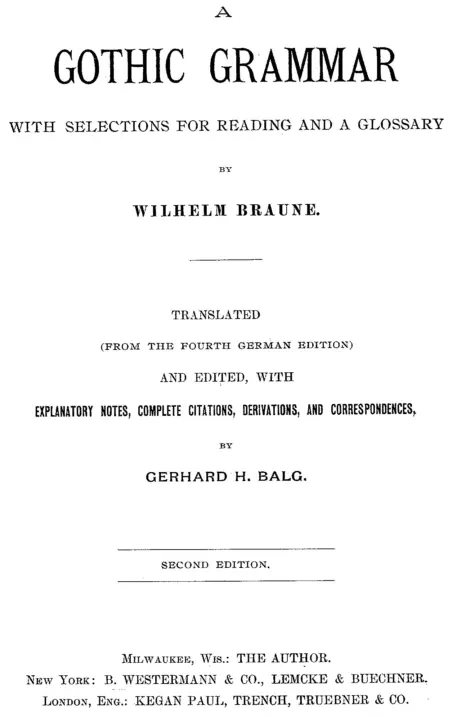
"A Gothic Grammar" by Wilhelm Braune is an academic textbook written in the late 19th century. The work serves as both a comprehensive introduction and an instructional guide for students seeking to learn the Gothic language, emphasizing phonology and inflectional grammar while providing reading selections and a glossary for practical application. The opening of this grammar provides insight into its structure and intended use in an academic context. It first outlines the purpose of the book, which is to aid students in gaining a practical understanding of Gothic, enabling them to follow lectures on historical and comparative grammar. Braune emphasizes that the focus will be on phonology and inflection without relying heavily on comparative grammar. Additionally, it advises beginners on how to approach the chapters, indicating that initial focus should be on phonology before progressing to inflections and reading texts, along with guidance on supplemental resources for deeper study. This sets the stage for a systematic exploration of the intricacies of the Gothic language.
Introduction adapted from the source catalogue; source summaries may be automatically generated.
Free to read · English · 99,757 words · No account needed
MAKE TIME FOR A GOOD BOOK
On by default. Untick to stop anonymous reading totals. Each page counts after 10 seconds in view. How this works.
Anonymous counting is on unless you have switched it off.
Chap. I. 1. =aíwaggêljôns...guþs=; contrary to the Greek text, the art. is omitted before these gens. (S., 68, n. 2). 2. =gamêliþ ist=; for the Grk. perf.--=Êsaïin praúfêtau=; in the Greek text the art. is uzed before both dats. (S., 68, n. 2); for the different forms of =praúfêtus=, s. 'Vocabulary'.--=sai= (Gr., 204, n. 2).--=ik=; the pers. prn. might here be omitted, as it does not seem to be emfasized (S., 59). Probably for this reason sum MSS. do not hav it.--=saei=; rel. prn. (Gr., 157).--=gamanweiþ=; the prs. for the Grk. future (S., 86, (3)).--=þeinana=; after its sbs., because it is not emfatic (S., 10, n. 2). 3. =wôpjandins=; gen. sg. of =wôpjanda=, weak prs. ptc. (Gr., 133).--=manweiþ=; there is no perceptibl difference between this v. and the compound =gamanweiþ= in the second verse. 4. =du aflageinai=; =du= denotes purpose.--=frawaúrhtê=; objectiv gen. (S., 20; and 19) with the verbal noun =aflageinai=. 5. =daupidai wêsun=; imperf. made up of the pp. and the prt. of =wisan= (S., 87, n. a).--=Iaúrdanê= (Grk. dat.); attribute of =aƕai=.--=fram= (w. dat.), by.--=andhaitandans=; w. the dat. of the dir. object (S., 45). 6. =wasuþ-þan=; for =was-uh-þan= (Gr., 62, n. 3).--=taglam=; instr. dat. after =gawasiþs= (S., 52, (2), b).--=gaírda filleina=; subj. of =was= understood.--=haiþiwisk=, wild, lit. 'pertaining to the heath'. 7. =mis=; abl. dat. after =swinþôza= (S., 54, (3)).--=sa afar mis=; =sa= seems to hav been added erroneously, or =afar= should be =ufar= (?).--=ik=; emfatic, as opposed to =swinþôza=, or =sa=.--=andbindan=; the prefix =and-= expresses the contrary of an action (Cp. E. un-in 'unbind').--=is=, his (Gr., 152; S., 60 et seq.).--=ik.....is=; uzed for the sake of emfasis (S., 2). 9. =warþ...qam=; an asyndetic construction.--=Nazaraíþ=; indecl. pr. n.--=Galeilaias=; notice the adj. force of this adnominal gen. (S., 20).--=fram=; by, as in 5, abuv; --=Iôhannê= and =Iaúrdanê= ar Grk. dativs. 10. =uslukanans=; the emendation is wel grounded; see Bernhardt's large edition. 11. =þuzei= (= =þus-ei=; Gr., 78); rel. prn. (Gr., 158; S., 73). 12. =sai, ahma=, not =sa ahma=, because =ahma=, 'Holy Ghost', occurs always without the art. (Bernhardt, note to this passage). 13. =dagê=; partit. gen. with =tiguns= (Gr., 142; S., 21).--=diuzam=; dat. pl. of =dius= (Gr., 78, b; 94).--=imma=; dat. with =andbahtidêdun= (S., 38). 14. =Galeilaia=; (Grk.) dat. after =qam in=; see V, 20. 15. =usfullnôda...atnêƕida=; for the Grk. perfect (S., 87, (2)).--=galaubeiþ in=; with the dat. (for other constructions after =galaubjan=, see S., 41 and note). 16. =faúr=, along, lit. before.--=Galeilaias=; (Grk.) gen. as in verse 9.--=is=, his, i. e. Simon's (S., 62). 17. =hirjats=; dual of =hiri= (Gr., 20, n. 1).--=igqis=; dir. obj.--=nutans=; predicate acc. (S., 18). 18. =seina=; poss. prn. referring to the subj. of the sentence; cp. verse 16. 19. =inngaggands=, going on.--=þana Zaíbaídaiaus=, [that of Zebedee, = the 'Zebedeean' =] the son of Zebedee. Observ the adj. force of the gen. (S., 19 and 21).--=is=; see verses 16 and 18, abuv.--=manwjandans=; weak inflection of the prs. ptc. uzed as sb., and with an obj., =natja= (Gr., 133. Cp. also Gr., 115; and Mt. V, 47). 20. =seinana=; this poss. prn. refers to the subj.; cp. the poss. =is= in v. 19; also v. 16. 21. =sabbatô=; indecl. sb. for the gen. pl.--=synagôgên=; acc. 22. =usfilmans=; this is one of the adjs. that follow the weak infl. only (Gr., 132, n. 2). 23. =synagôgên=; dat.--=in= (the second); denotes a condition: in, with. 24. =ƕa uns jah þus=, what hav we to do with thee, lit. what [is there] to us and to thee (S., 35, n. 1).--=Nazôrênai=; a Grk. ending, or =-ai= is an error for =-au=.--=uns=; is dat. or acc. with =fraqistjan= (S., 46).--=weiha=; weak adj. uzed as sb.--=guþs=; gen. (Gr., 94, n. 3). 25. =ût us þamma=, out of him (lit. this, for the Grk. αὐτός. S., 63).--=unhrainja=; the weak infl. of adjs. in the voc. case is quite common in Gothic. 26. =stibnai mikilai=; instr. dat. (S., 52, (2)). 27. =miþ sis missô=, with one another (S., 59, n.).--=sijai=; prs. opt. in a dir. question implying possibility (S., 91, (3)).--=ƕô=, of what kind; the copula is omitted, as in Grk.--=laiseinô=; gen. pl.; s. Mt. V, 46; also Gr., 159.--=ahmam þaim unhrainjam=; dat. with =anabiudiþ= (S., 37).--=imma=; dat. after =ufhausjand= (S., 38; and 45). 28. =is=, his.--=bisitands=, neighbor (lit. sitting, i. e. dwelling, near; for this kind of nouns, see Gr., 115). 29. =in garda=; =in= with dat. after =qiman=; see Mt. V, 20.--=Iôhannên=; with a Grk. ending. There is no fixt rule for the declension of proper names in Gothic (Gr., 120). 30. =in brinnôn=; in fever, lit. 'in burning'. 31. =im=; dat. pl. of =is=, guvernd by =andbahtida= (S., 38); refers to Jesus and those with him. 32. =andanahtja waúrþanamma=; dat. abs. (S., 119).--=þan=; for δέ, the second =þan= for ὅτε.--=sauil=; this word occurs only twice in Gothic, and without the art. (S. 262), the uzual word for 'sun' being =sunnô=. 34. =missaleikaim saúhtim=; instr. dat. (or 'with-case'. S., 50) of cause: =ubil habandans m. s.=, (having evil =) being sick with divers diseases. 36. =jah galaistans waúrþun imma=; =imma= is instr. dat. of accumpaniment or association, depending on the predicate noun =galaistans= (S., 52, (1), a). 37. =þatei=, conj., that, before a dir. quotation. 38. =bisunjanê=; attributiv adv. preceded by the art. (S., 68, (2)). 40. =þrutsfill habands=, (a person) having leprosy, for λεπρός, a leper.--=kniwam knussjands=; an alliterativ expression, =kniwam= being a superfluous instr. dat. (S., 52, (2)). 41. =imma=; dat. guvernd by =attaítôk= (S., 40).--=wiljau=; the opt. of this vb. discharges the function of the ind. (Gr., 205).--=waírþ=, be thou (for the distinction between the imper. and the hort. opt., see S., 91, n. 1). 42. =þata..þata=; the former is the dem. prn., the latter the art. 43. =imma=; dir. obj. in the dat., guvernd by =gaƕôtjands= (S., 40; cp. verse 41, abuv). 44. =qiþais=; opt. in a final clause (S., 96, a).--=mannhun=; indef. prn. in the dat. (Gr., 163, a).--=ataugjan=; inf. of purpose (without =du=, to) after =gagg= (S., 114).--=fram= (περί), concerning, for.--=þatei=; rel. prn., for =þata-ei= (Gr., 4, n. 1; 157), that which, = =giba þôei= in Mt. VIII, 4. 45. =swaswê=, so that.--=is=, he (= =Iesus=), while the first =is= refers to the heald man.
Your reading position is saved on this browser. Take it to another device with a library code. Reading pages adapt to text, rather than matching a printed edition.
BEHIND THE BOOK
This eBook is for the use of anyone anywhere in the United States and most other parts of the world at no cost and with almost no restrictions whatsoever. You may copy it, give it away or re-use it under the terms of the Project Gutenberg License included with this eBook or online at www.gutenberg.org. If you are not located in the United States, you will have to check the laws of the country where you are located before using this eBook. Read the source licence.
The original source file, including credits and licence, is retained by this library. Request an original-format copy at no charge. Please include the book title and Project Gutenberg identifier #50336.
KEEP YOUR CURIOSITY GOING
Charles Dickens
Violet Hunt
Marjorie Bowen

Edward Lucas White
James Mooney
May Agnes Fleming