THE CLASSIC COLLECTION✦A Christmas Carol The original manuscriptCLASSIC FREE BOOKS
A Christmas Carol The original manuscript
Charles Dickens
THE CLASSIC COLLECTION · 1895
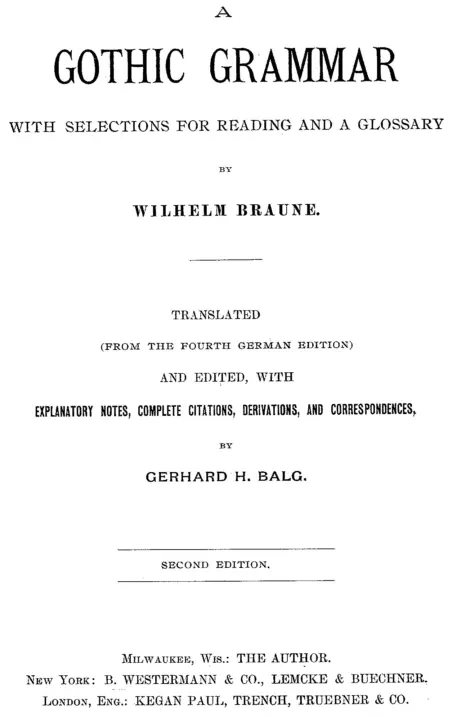
"A Gothic Grammar" by Wilhelm Braune is an academic textbook written in the late 19th century. The work serves as both a comprehensive introduction and an instructional guide for students seeking to learn the Gothic language, emphasizing phonology and inflectional grammar while providing reading selections and a glossary for practical application. The opening of this grammar provides insight into its structure and intended use in an academic context. It first outlines the purpose of the book, which is to aid students in gaining a practical understanding of Gothic, enabling them to follow lectures on historical and comparative grammar. Braune emphasizes that the focus will be on phonology and inflection without relying heavily on comparative grammar. Additionally, it advises beginners on how to approach the chapters, indicating that initial focus should be on phonology before progressing to inflections and reading texts, along with guidance on supplemental resources for deeper study. This sets the stage for a systematic exploration of the intricacies of the Gothic language.
Introduction adapted from the source catalogue; source summaries may be automatically generated.
Free to read · English · 99,757 words · No account needed
MAKE TIME FOR A GOOD BOOK
On by default. Untick to stop anonymous reading totals. Each page counts after 10 seconds in view. How this works.
Anonymous counting is on unless you have switched it off.
§ 219. =ô=, oh! ah!; =wai=, woe!; =sai=, behold!--Interjectional in meaning ar the sg. =hiri=, the du. =hirjats=, and the pl. =hirjiþ=, cum here! (cp. § 20, n. 1; § 187, n. 4).
Cp. Sievers 'Grundr.', I, 407-416 ('Geschichte der got. sprache'); II, 1, 65-70 ('Gotische literatur'); Kögel, Geschichte der deutsch. litteratur, I, 1, 176-195.
(a) The Gothic language is the language of the Gothic peple (=Gut-þiuda=) which, divided into the two great tribes of the East and West Goths, figured in history in the time of the great migration. Together with the fall of the East Gothic kingdom in Italy and of the West Gothic kingdom in Spain the Gothic nation also past away. Only scatterd remains of the Goths and their language remaind until the beginning of the modern era in the Crimea. ('Crimean' or 'Tetraxitic' Goths.)
NOTE 1. The Goth. spelling of the name of the Goths as a peple is =*Gutans= and =*Gutôs=, with =t=, not with =þ= according to J. Grimm's suggestion which is supported by Kremer (Beitr., 8, 447). Concerning the form, inflection, and etymology of the name of the Goths, cp. Zs. fda., 9, 243 et seq.; Grundr., I, 407; Wrede, 'Ostg.', 44 et seq.; Beitr., 17, 178 et seq.; Ax. Erdmann, folknamnen 'Götar' och 'Goter', Stockholm 1891 (cp. Litbl. 1894, 249).
NOTE 2. The current interpretation of the two Lt. names Austro-, Ostrogot(h)æ, -i and Wisigot(h)æ, -i, as East Goths and West Goths, which dates back to Jordanes, might hold good for the former only; the name of the Wisigothæ which ar simply calld also Vesi, Visi, has nothing to do with 'west'. Ep. IF., 4, 300 et seq.
NOTE 3. Concerning the Crimean Goths and the remains of their language, s. Zs. fda., 1, 345-366; W. Tomaschek, 'Die Goten in Taurien', Wien 1881; Beitr., 11, 563 et seq.; F. Braun, 'Die letzten schicksale der Krimgoten'. Program St. Petersburg 1890 (cp. Anz. fda. 17, 167 f.).
(b) It was for the Gothic peple that the group of Germanic tribes to which the Goths belongd has been frequently calld the 'Gothic Group'. For this there has been recently proposed the name 'Vandilians' (according to Pliny, 'nat. hist.', IV, 99). The most important of these Vandilians ar the Goths, the Gepidae, the Vandals, the Burgundi, the Heruli, and the Rugii. At the beginning of the Christian era their abodes wer between the Elbe and the Vistula. The languages of these peples wer closely related. The extant literary remains, however, except in Gothic, ar very few, and these ar almost entirely proper nouns.
NOTE 4. Concerning the Vandilians, cp. F. Wrede, 'Ueber die sprache der Wandalen', Strassburg, 1886 (QF., 59), p. 3 et seq.; F. Dahn, 'Urgeschichte der germ. und rom. völker', vol. I (Berlin 1881), p. 139 et seq.; R. Much, 'Goten und Ingvaeonen. (Beitr., 17, 178-221).
Your reading position is saved on this browser. Take it to another device with a library code. Reading pages adapt to text, rather than matching a printed edition.
BEHIND THE BOOK
This eBook is for the use of anyone anywhere in the United States and most other parts of the world at no cost and with almost no restrictions whatsoever. You may copy it, give it away or re-use it under the terms of the Project Gutenberg License included with this eBook or online at www.gutenberg.org. If you are not located in the United States, you will have to check the laws of the country where you are located before using this eBook. Read the source licence.
The original source file, including credits and licence, is retained by this library. Request an original-format copy at no charge. Please include the book title and Project Gutenberg identifier #50336.
KEEP YOUR CURIOSITY GOING
Charles Dickens
Violet Hunt
Marjorie Bowen
Edward Lucas White
James Mooney
May Agnes Fleming