THE CLASSIC COLLECTION✦A Christmas Carol The original manuscriptCLASSIC FREE BOOKS
A Christmas Carol The original manuscript
Charles Dickens
THE CLASSIC COLLECTION · 1895
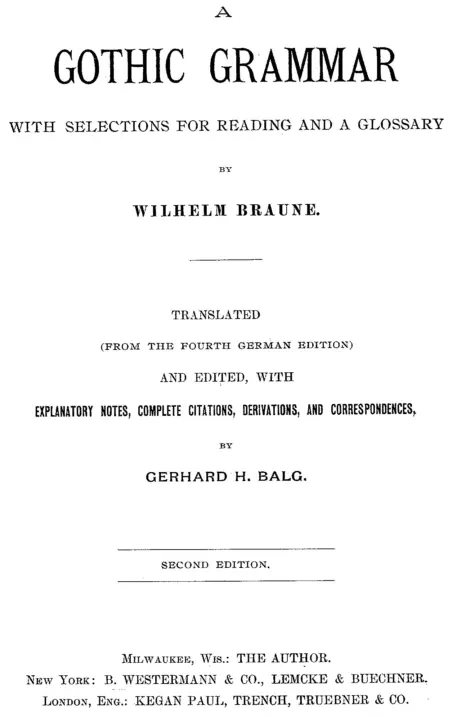
"A Gothic Grammar" by Wilhelm Braune is an academic textbook written in the late 19th century. The work serves as both a comprehensive introduction and an instructional guide for students seeking to learn the Gothic language, emphasizing phonology and inflectional grammar while providing reading selections and a glossary for practical application. The opening of this grammar provides insight into its structure and intended use in an academic context. It first outlines the purpose of the book, which is to aid students in gaining a practical understanding of Gothic, enabling them to follow lectures on historical and comparative grammar. Braune emphasizes that the focus will be on phonology and inflection without relying heavily on comparative grammar. Additionally, it advises beginners on how to approach the chapters, indicating that initial focus should be on phonology before progressing to inflections and reading texts, along with guidance on supplemental resources for deeper study. This sets the stage for a systematic exploration of the intricacies of the Gothic language.
Introduction adapted from the source catalogue; source summaries may be automatically generated.
Free to read · English · 99,757 words · No account needed
MAKE TIME FOR A GOOD BOOK
On by default. Untick to stop anonymous reading totals. Each page counts after 10 seconds in view. How this works.
Anonymous counting is on unless you have switched it off.
Chap. II. 1. =þatei=; conj., that (Gr., 157, n. 2).--=ist= (for ἐστίν); we should rather expect the prt. 2. =swaswê juþan ni gamôstêdun= (prt. of =gamôtan=; Gr., 202) =nih at daúra=, so that they found no room any more, not even at the door.--=im=; dat. of the indir. obj. (S., 37).--=waúrd=; in Gr.: τὸν λόγον. 3. =hafanana= (acc. sg. of =hafans=; Gr., 134), pp. of =hafjan= (Gr., 177, n. 2). 4. =imma=; dat. guvernd by =nêƕa= (=qiman=; cp. =nêƕjan sik=, S., 39).--=faúra= (w. dat.), because of.--=usgrabandans=; for ἐξορύξαντες, digging out; hense breaking up (sc. =hrôt=).--=insailidêdun þata badi jah fralaílôtun= (for χαλῶσιν τόν κράβαττον), lit.: they tied the bed to cords and let (it) down. 5. =þus=; dat. after =aflêtanda= (S., 37). 6. =þagkjandans sis=, reasoning with themselvs, the refl. dat., =sis=, does duty for the Grk. midl (S., 47, n. 1). 7. =ƕa= (acc. sg. of the interr. prn., = τί, quare), why?--=sa=; dem. prn. (S., 63).--=ains=, alone. 8. =ahmin seinamma=; loc. dat. (S., 53, (1), c).--=sis=; refl. dat., as in verse 6, abuv.--=duƕê=, = =du-ƕê=, =ƕê= being an instr. case proper (Gr., 159, n. 1; S., 51). 9. =du qiþan....qiþan=; two subj. infs., the former with, the latter without =du= (S., 107, a and b). 10. =mans=; gen. sg. (Gr., 117, (1)). 11. =nimuh=, and take. 12. =jah háuhidêdun mikiljandans guþ=, and glorifying praised God, for δοξάζειν τὸν θεόν. Similarly in chap. I, v. 27: =afsláuþnôdêdun sildaleikjandans=, for ἐθαμβήθησαν.--=aiw ..ni=, ever not, = never. =aiw= is, properly, the acc. sg. of =aiws=, time, and answers in form and meaning our 'aye'.--=gasêƕum=; notice change of person. 13. =iddjêdun=; pl. vb., agreeing with the subj., =all=, in sense (S., 5 and 82, c). 14. =þana Alfaiaus=; cp. I, 19. III, 18. 15. =warþ...... jah managai=, etc. (for a different construction with =warþ=, s. Mk. II, 23. S., 108, n.; 113), it came to pass [that] ... also many, etc.--=Iêsua sipônjam=; instr. dat. of accumpaniment (S., 52, 1, c). 16. =ƕa=, how, as in 7. 17. =lêkeis=; gen. (as abl.) with =þaúrbun= (S., 27).--=ubilaba= (adv.) =habandans=; for κακῶς ἔχοντες, being sick; cp. Mk. V, 26. 18. =Jôhannis..... Iôhannês=; these genitivs in the same verse ar a striking exampl of arbitrary inflection of proper names in Gothic (Gr., 120). 19. =ibai=; an interr. particl, perhaps, or its sense is exprest by our may, a negativ answer being expected. 20. =atgaggand...fastand=; for the Grk. future (S., 86, (3)).--=þan...þan=, when, then. 21. =ibai afnimai fullôn af þamma sa niuja þamma faírnjin= (εἰ δὲ μή, αἴρει τό πλήρωμα ἀπ' αὐτοῦ τὸ καινὸν τοῦ παλαιοῦ). Wulfila took πλήρωμα to be the obj. of αἴρει. The subj. of the Goth. construction is either the preceding =plat fanins niujis=; with =sa niuja= as apposition, or =sa niuja= (sc. =plat=). In both cases =þamma faírnjin= is in apposition with =af þamma= (dem. pron. S., 63). 23. =jah warþ þaírhgaggan imma=, and it came to pass that he went (Lit.: and it came to pass to him to go. S., 108, n.). Cp. 14, abuv.--=sabbatô= (indecl., for gen. pl.; =sabbatê daga= in Mk. XVI, 1.) =daga=; loc. dat. of time (S., 53, (2)). 24. =sabbatim=; dat. as in verse 23. 25. =niu= (= =ni-uh=) =aiw=, never. 26. =uf=, under, i. e. in the time of.--=þanzei= (i. e. =þans-ei=; Gr., 157, n. 4).--=matjan=; subj. inf. (S., 108).--=ainaim gudjam=, for the priests alone (S., 108, n.).--=sis=; refers to the subj. (S., 60). 27. =in= (for διά with the acc.) =mans= (gen.; Gr., 117), for man; =in sabbatô dagis=, for sabbath day.--=warþ gaskapans=; for the Gr. aor. (S., 87, (4), c). 28. =frauja=; predicate noun.--=jah=, also.--=þamma sabbatô=; dat. depending on =frauja= (S., 35, (2)).
Your reading position is saved on this browser. Take it to another device with a library code. Reading pages adapt to text, rather than matching a printed edition.
BEHIND THE BOOK
This eBook is for the use of anyone anywhere in the United States and most other parts of the world at no cost and with almost no restrictions whatsoever. You may copy it, give it away or re-use it under the terms of the Project Gutenberg License included with this eBook or online at www.gutenberg.org. If you are not located in the United States, you will have to check the laws of the country where you are located before using this eBook. Read the source licence.
The original source file, including credits and licence, is retained by this library. Request an original-format copy at no charge. Please include the book title and Project Gutenberg identifier #50336.
KEEP YOUR CURIOSITY GOING
Charles Dickens
Violet Hunt
Marjorie Bowen

Edward Lucas White
James Mooney
May Agnes Fleming