THE CLASSIC COLLECTION✦A Christmas Carol The original manuscriptCLASSIC FREE BOOKS
A Christmas Carol The original manuscript
Charles Dickens
THE CLASSIC COLLECTION · 1895
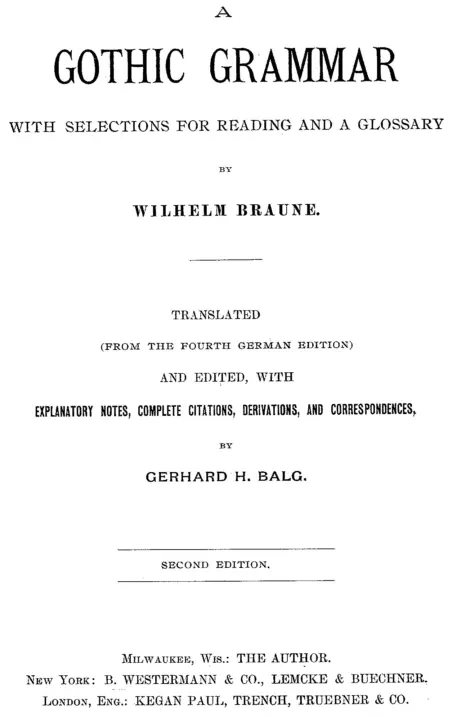
"A Gothic Grammar" by Wilhelm Braune is an academic textbook written in the late 19th century. The work serves as both a comprehensive introduction and an instructional guide for students seeking to learn the Gothic language, emphasizing phonology and inflectional grammar while providing reading selections and a glossary for practical application. The opening of this grammar provides insight into its structure and intended use in an academic context. It first outlines the purpose of the book, which is to aid students in gaining a practical understanding of Gothic, enabling them to follow lectures on historical and comparative grammar. Braune emphasizes that the focus will be on phonology and inflection without relying heavily on comparative grammar. Additionally, it advises beginners on how to approach the chapters, indicating that initial focus should be on phonology before progressing to inflections and reading texts, along with guidance on supplemental resources for deeper study. This sets the stage for a systematic exploration of the intricacies of the Gothic language.
Introduction adapted from the source catalogue; source summaries may be automatically generated.
Free to read · English · 99,757 words · No account needed
MAKE TIME FOR A GOOD BOOK
On by default. Untick to stop anonymous reading totals. Each page counts after 10 seconds in view. How this works.
Anonymous counting is on unless you have switched it off.
§ 69. Gothic =t= corresponds to Greek τ, and stands frequently both initially and medially. E. g. (a) +initially+: =tunþus=, tooth; =triu=, tree; =tuggô=, tung; =tagr=, tear; =taíhun=, ten; =twai=, two; =tamjan=, to tame; =trauan=, to trust. =st=: =steigan=, to mount. (b) +medially+: =watô=, water; =haírtô=, hart; =baitrs=, bitter; =itan=, to eat; =giutan=, to pour; =sitan=, to sit; =witan=, to know.
Final =t= remains unchanged; as, =wait=, I know; =at=, at; =wit=,
we two.
NOTE 1. =t= is dubld in =atta=, father; =skatts=, muney.
NOTE 2. =t= before =t= in derivativ and inflected words becums =s= (§ 81); as, =ushaista=, very poor (cp. =haitan=); =blôstreis=, wurshipper (cp. =blôtan=, to wurship); 2nd pers. sg. prt. =waist= (1st =wait=), =haíhaist= (inf. =haitan=, to be calld); weak prt. =gamôsta= (1st pers. =gamôt=); =kaupasta= (inf. =kaupatjan=, to cuf); =wissa= (< =wista=, 1st =wait=).
§ 70. Gothic =þ= corresponds to Gr. θ (as, =Þômas=, Θωμᾶς; =Naþan=, Ναθάν); its sound-value was that of a voiceless dental spirant = the NE. surd th in thin. Also the Greek θ denoted at that time, as it stil does in New Greek, a similar sound.
NOTE 1. Greek authors represent the Goth. =þ= by θ; as, Θευδέριχος. Latin writers express Goth. =þ= mostly by th; as, =Theodoricus=, =Theodomirus=, but also often by t. Cp. Wrede, 'Wand.', 104; 'Ostg.', 170 et seq.--In like manner sum later prints hav =th= for =þ= (s. § 1, n. 3).
NOTE 2. Latin authors often uze d beside th for medial =þ= in proper nouns, from which a later softening may be inferd. Cp. Wrede, 'Ostg.', 171.
NOTE 3. Concerning the sound-value of Germanic-Goth. =þ=, cp. IF. 4, 341 et seq.; for the relation between Goth. =þ= and Gr. θ, s. Wimmer, 'Die Runenschrift', 268.
§ 71. =þ= in Gothic words is very frequent. E. g. (a) +initially+: =þulan=, to suffer; =þanjan=, to strech; =ga-þaírsan=, to wither; =þaúrsus=, witherd; =þaúrstei=, thirst; =þata= (prn.), that; =þu=, thou; =þreis=, three; =þliuhan=, flee; =ga-þláihan=, to cumfort, console; =þwahan=, to wash. (b) +medially+: =brôþar=, brother; =tunþus=, tooth; =wiþrus=, lam; =fraþi=, n., understanding; =fraþjan=, to understand; =anþar=, other; =ƕaþar=, 'uter'; =waírþan=, to becum; =qiþan=, to say. (c) Also +final+ =þ= remains unchanged; as, =þiuþ=, n., good (gen. =þiuþis=); =qaþ=, prt. of =qiþan=; =aiþs=, acc. =aiþ=, oath.
NOTE 1. =þþ= occurs in =aiþþau=, or (§ 20), and, by assimilation, for =h-þ=: =niþþan=, etc.; s. § 62, n. 3.
NOTE 2. =þ= finally and before the =s= of the nom. very often stands for =d=, and must be kept apart from the =þ= mentiond under (c) which remain =þ= +medially+ also; s. § 74.
NOTE 3. =þ= becums =s= before =t= (§ 81); e. g., 2nd pers. sg. prt. =qast= (inf. =qiþan=), =warst= (inf. =waírþan=), =snaist= (inf. =sneiþan=, to cut).
Your reading position is saved on this browser. Take it to another device with a library code. Reading pages adapt to text, rather than matching a printed edition.
BEHIND THE BOOK
This eBook is for the use of anyone anywhere in the United States and most other parts of the world at no cost and with almost no restrictions whatsoever. You may copy it, give it away or re-use it under the terms of the Project Gutenberg License included with this eBook or online at www.gutenberg.org. If you are not located in the United States, you will have to check the laws of the country where you are located before using this eBook. Read the source licence.
The original source file, including credits and licence, is retained by this library. Request an original-format copy at no charge. Please include the book title and Project Gutenberg identifier #50336.
KEEP YOUR CURIOSITY GOING
Charles Dickens
Violet Hunt
Marjorie Bowen

Edward Lucas White
James Mooney
May Agnes Fleming