THE CLASSIC COLLECTION✦A Christmas Carol The original manuscriptCLASSIC FREE BOOKS
A Christmas Carol The original manuscript
Charles Dickens
THE CLASSIC COLLECTION · 1895
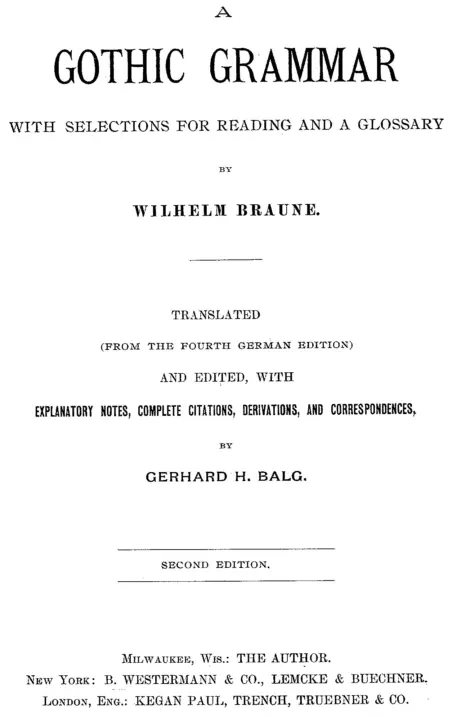
"A Gothic Grammar" by Wilhelm Braune is an academic textbook written in the late 19th century. The work serves as both a comprehensive introduction and an instructional guide for students seeking to learn the Gothic language, emphasizing phonology and inflectional grammar while providing reading selections and a glossary for practical application. The opening of this grammar provides insight into its structure and intended use in an academic context. It first outlines the purpose of the book, which is to aid students in gaining a practical understanding of Gothic, enabling them to follow lectures on historical and comparative grammar. Braune emphasizes that the focus will be on phonology and inflection without relying heavily on comparative grammar. Additionally, it advises beginners on how to approach the chapters, indicating that initial focus should be on phonology before progressing to inflections and reading texts, along with guidance on supplemental resources for deeper study. This sets the stage for a systematic exploration of the intricacies of the Gothic language.
Introduction adapted from the source catalogue; source summaries may be automatically generated.
Free to read · English · 99,757 words · No account needed
MAKE TIME FOR A GOOD BOOK
On by default. Untick to stop anonymous reading totals. Each page counts after 10 seconds in view. How this works.
Anonymous counting is on unless you have switched it off.
Chap. II. 1. =warþ...urrann=; asyndetic constructions with =warþ= ar quite common in Gothic.--=in dagans jainans=; for the acc. we should rather hav expected the dat. of the Grk. text. 2. =at raginôndin Kyreinaiau=; abl. abs. introduced by =at= (S., 120).--=Saúrim=; dat. (pl.) guvernd by =raginôndin= (S., 38; 52, 3, n.). 3. =ei mêlidai= (pp. Gr., 134) =wêseina=; a final clause for the inf. in Grk.--=ƕarjizuh in seinai baúrg= (dat. Gr., 116); belongs to =mêlidai=: every one (of all that went) in his own city. 4. =Galeilaia...Nazaraíþ= (indecl.); both stand for the dat. (Gr., 120 and notes).--=sei=; for =si-ei= (Gr., 157, n. 3). 5. =anamêljan= (for the inf. pass. in Grk.) to enrol (himself).--=sei was imma qeins= (for =qêns=, Gr., 7, n. 2), who was to him a wife, i. e. who was his wife (S., 35, (1)); the rel. clause stands for the Grk. art. with a ptc.--=wisandein inkilþôn= (w. adj. uzed as sb. in the predicate); in apposition with =Mariin=. 6. =warþ ...usfullnôdêdun=; see verse 1.--=þô=; nom. pl. n. of =sa=, referring to two persons of different gender (Joseph and Mary. S., 8).--=du baíran= (for τοῦ τεκεῖν. Cp. the Latin: tempus est abire, for the gen. of the gerund).--=izai=; dat. of advantage after =usfullnôdêdun= (S. 47). 7. =uzêtin=; dat. after =galagida in=; see Mt. V, 20.--=im=; dat. of possession after =was= (S., 35).--=rûmis=; gen. as subj.: of room, i. e. room (S., 25, n. 2). 8. =wahtwôm=; dir. obj. after =witandans= (S., 40).--=nahts= (Gr., 116), adv. gen. (S., 30), by night. 9. =agisa mikilamma=; see Mk. V, 42. 10. =waírþiþ=; for ἔσται.--=allai managein=; poss. dat., as in verse 7. 11. =himma daga=; adv. frase (S., 53, (2)), this day. 12. =þata=; subj. prns. are not subject to agreement with pred. sbs. (S., 7).--=bigitid= (=d= for =þ= is very common in this gospel. Gr., 74, 1); for the Grk. fut. (S., 86, (3)).--=biwundan.. galagid= (=d= for =þ=, as abuv); acc. sg. n. of the pp. (Gr., 134). 13. =warþ=, was, lit. became, appeard: it is the pred. (in the sing.) of the collectiv noun =managei= (S., 5. Cp. Mk. V, 32).--=harjis h.=; gen. after =managei=.--=hazjandanê..qiþandanê= (Gr., 133); attributiv ptcs. agreeing w. =harjis= in gender and number (in sense. S., 5 and 9, n. 1). 14. =in háuhistjam=, in the highest, for ἐν ὑψίστοις.--=guþa= (sc. =sijai=); dat. of possession (S., 35). 15. =himin=; dat. guvernd by =galiþun in=; see Mk. V, 20.--=þai haírdjôs=; in apposition (S., 11) with =mans= (Gr., 117).--=þaírhgaggaima ...saíƕaima=; 1st pers. pl. of the hort. opt., for the more common 1st pers. pl. imper. (S., 91, n. 1). 18. =im=; refers to =allai= (S., 61). 19. =þagkjandei=; prsp. fem. (in =-ei=. Gr., 133): pondering (sc. them). 20. =in allaizê þizêei=, because of all that which, the rel. prn. (Gr., 157) being assimilated to the case of its antecedent (S., 71). verse 6. 21. =jah biþê...= and when--=du bimaitan ina=; cp. verse 6.--=....jah=; introduces the principal clause, and remains untranslated. We might rather expect =þan= which is uzually found after temporal clauses introduced by =biþê=.--=namô is=; subj. =...Iêsus=; pred. nom. with =haitan was= (S., 13, b, β).--=þata qiþanô=; refers to =namô=.--=wêsi=; opt. in a temporal clause (S., 100); so always with =faúrþizei= (S., 100, n.). 22. =atsatjan=; sc. =ina=. 23. =ƕazuh= (Gr., 164); uzed substantivly, and followd by the partitiv gen.--=weihs=; predicate adj. with =haitada= (cp. 21, abuv).--=fraujins=; guvernd by =weihs= (S., 22). 24. =ei gêbeina=; prt. opt. in a final clause (S., 96, b), while the coordinate =atsatjan= (in verse 22) is an 'inf.' of purpose (S., 114).--=fram imma=, on his behalf (cp. Mk. I, 44; II Cor. V, 12).--=juggôns=; adj. uzed as sb., followd by a partitiv gen. (S., 21). 25. =þaruh=; for καὶ ἰδοῦ, and behold.--=sa=; dem. prn. =laþônais=; obj. gen. after =beidands= (S., 26). 27. =alh=; dat. (Gr., 116) guvernd by =qam in=; see Mt. V, 20.--=ina=; refers to the natural gender of =barn=, as in verse 28, and elsewhere. 28. =guþa=; dat. guvernd by =þiuþida= (S., 45). 29. =fraleitais= (=ei= for =ê=. Gr., 7, n. 2); opt. proper (S., 91, (1)). 32. =þiudôm= (for ἐθνῶν); dat. of advantage after =andhuleinai=, like =managein= (for λαοῦ) =þeinai= after =wulþu= (S., 34).--=Israêla=; in apposition with =managein= (S., 11). 33. =sildaleikjandôna=; nom. pl. n., referring to two living beings of different gender (S., 9, n. 3). 34. =ina=; the Grk. text has αὐτούς.--=sa=; dem. prn. 35. =þeina saiwala=; the obj. of =þaírhgaggiþ=.--=silbôns= (always weak. Gr., 156); intensiv (like the Lt. 'ipsius' preceded by a poss. prn. and followd by the sb.), its gender being that of the noun or prn. to which it refers (here =Mariin=). 36. =sôh= (for =sô-uh=); a compd. dem. (Gr., 154), for αὕτη.--=dagê managaizê=; emfatic gen. w. =framaldra= (S., 22).--=jêra sibun=; acc. of extent of time (S., 15, n. 2, β). 37. =sôh þan=, and this, and she (sc. was).--=ahtáutêhund jah fidwôr=; uninflected (Gr., 143) attribute to =jêrê=.--=sôh=; here for ἥ.--=fastubnjam...bidôm=; instr. dat. of manner (S., 52, (6)).--=blôtandê= (=ê= for =ei=, fem. ending of the prsp. Gr., 17, n. 1, and 133).--=nahtam jah dagam=; loc. dat. of time (S., 53, (2)), like =þizai ƕeilai= in the next verse. 38. =andhaíhait= with the dat. (=fraujin=), to giv thanks to (S., 45).--=in allaim= (=in= being added by Wulfila), among all (without =in=, =allaim= would be the indir. obj. after =rôdida=); =allaim= is attribute to the ptc. =usbeidandam=, which is uzed substantivly, but with a dir. obj. (S., 15, n. 2), =laþôn=, redemption. 40. =ahmins..handugeins=; instr. genitivs guvernd by =fullnands=, becuming fild with spirit and wisdom (S., 27). 41. =jêra ƕammêh= (Gr., 164, a); loc. dat. of time (S., 53, (2)): every year.--=at dulþ= (acc. Gr., 116) =paska= (indecl. attribute), at the feast of the passover; =at= with the acc. always denotes time. 42. 43. =usgaggandam þan im...jah ustiuhandam=; dat. abs. (S., 119), when they then (=þan= referring to the preceding clause) went up ... and when they had fulfild.--=miþþanê= (=ê= for =ei=, as in 37) =gawandidêdun sik aftra=, as they returnd, lit.: as they turnd themselvs back.--=wissêdun=; here the pl. occurs in an abridged compound sentence (S. 1, n.), sumtimes the sing. (S., 5, n. 1). 44. =hugjandôna=; n. pl., as in verse 33.--=ina wisan=; acc. and inf. guvernd by =hugjandôna= (S., 112).--=dagis= (adnominal gen. S., 20) =wig= (acc. of extent of space. S., 15, n. 2, β), a day's way, a day's jurney.--=kunþam=; weak dat. of =kunþs= (uzed as sb. Gr., 132). 46. =warþ=; see verse 1.--=in midjaim laisarjaim=, in the midst of the teachers (cp. the Lt. 'in media urbe').--=im=; dat. guvernd by =hausjandan=, hearing, i. e. listening to (S., 45). 47. =is=, him, lit. of him; obj. gen. guvernd by =hausjandans= (S., 26).--=ana frôdein=; depends on =usgeisnôdêdun=. 48. =magau=; voc. for =magu= (Gr., 105, n. 2).--=ƕa=; acc. of specification (S., 15, 2, b, n. 2, α): why?--=uns=; dat. of the indir. obj. (S., 37).--=sôkidêdum=; here and in verse 49 we should rather hav expected the dual (S., 5, n. 4). The subj. being of different persons, the first person is preferd (S., 5, n. 2). 49. =in þaim attins meinis=; so-calld elliptic expressions like this ar also common in Grk., a noun signifying 'things' or the like being understood with the art.: in, or about, the things of my father. As a matter of fact, however, =attins meinis= shows the orig. adj. force of the gen. which is here uzed substantivly (S., 19, and 68, (3)). 50. =ija=; nom. pl. n. (Gr., 152), referring to Joseph and Mary; see verse 6.--=þamma waúrda=; loc. dat. guvernd by =frôþun= (S., 53, (1), p. 254; and cp. n. 2, p. 255), prt. of =fraþjan= (Gr., 177, n. 2). 51. =im=; dat. after =ufhausjands= (S., 38). 52. =frôdein..wahstau..anstai=; loc. dats. of specification (S., 53, 1, c).
Your reading position is saved on this browser. Take it to another device with a library code. Reading pages adapt to text, rather than matching a printed edition.
BEHIND THE BOOK
This eBook is for the use of anyone anywhere in the United States and most other parts of the world at no cost and with almost no restrictions whatsoever. You may copy it, give it away or re-use it under the terms of the Project Gutenberg License included with this eBook or online at www.gutenberg.org. If you are not located in the United States, you will have to check the laws of the country where you are located before using this eBook. Read the source licence.
The original source file, including credits and licence, is retained by this library. Request an original-format copy at no charge. Please include the book title and Project Gutenberg identifier #50336.
KEEP YOUR CURIOSITY GOING
Charles Dickens
Violet Hunt
Marjorie Bowen

Edward Lucas White
James Mooney
May Agnes Fleming