THE CLASSIC COLLECTION✦A Christmas Carol The original manuscriptCLASSIC FREE BOOKS
A Christmas Carol The original manuscript
Charles Dickens
THE CLASSIC COLLECTION · 1895
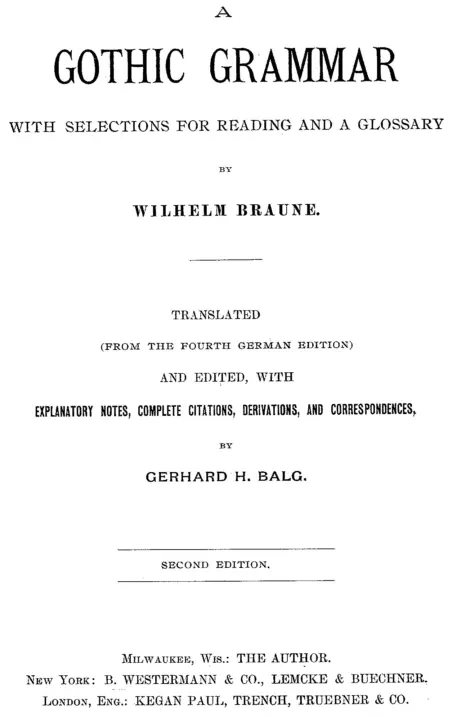
"A Gothic Grammar" by Wilhelm Braune is an academic textbook written in the late 19th century. The work serves as both a comprehensive introduction and an instructional guide for students seeking to learn the Gothic language, emphasizing phonology and inflectional grammar while providing reading selections and a glossary for practical application. The opening of this grammar provides insight into its structure and intended use in an academic context. It first outlines the purpose of the book, which is to aid students in gaining a practical understanding of Gothic, enabling them to follow lectures on historical and comparative grammar. Braune emphasizes that the focus will be on phonology and inflection without relying heavily on comparative grammar. Additionally, it advises beginners on how to approach the chapters, indicating that initial focus should be on phonology before progressing to inflections and reading texts, along with guidance on supplemental resources for deeper study. This sets the stage for a systematic exploration of the intricacies of the Gothic language.
Introduction adapted from the source catalogue; source summaries may be automatically generated.
Free to read · English · 99,757 words · No account needed
MAKE TIME FOR A GOOD BOOK
On by default. Untick to stop anonymous reading totals. Each page counts after 10 seconds in view. How this works.
Anonymous counting is on unless you have switched it off.
Chap. VI. 1. =taujan=; complimentary inf. after =atsaíƕiþ= (2nd pers. pl. imper.).--=du saíƕan im= prop. a gerundiv construction, to be seen by them, lit. 'for them to see'. The activ inf. in Gothic often has a passiv force (S., 106, n. 3, end).--=aiþþau=, or else, otherwise. 2. =þan=, when.--=taujais=; opt. in a temporal clause (S., 100).--=haúrnjais=; hort. opt. (S., 91, (2)).--=þai liutans=; the art. denotes a class of peple (S., 68, (6), n.).--=háuhjaindau=; prs. opt. pass. in a final clause (S., 96, a, α).--=fram=, by.--=qiþa=; without =ik=; see V, 22, abuv.--=andnêmun=; pret. expressing completion (= our prs. perf.): they hav receivd (Cp. 5, below). 3. =þuk taujandan armaiôn ni witi hleidumei þeina, ƕa taujiþ taíhswô þeina=; a puzling construction, indeed! (Cp. O. Luecke, 'Absolute Participia im Gotischen, etc.'; and E. Bernhardt, 'Gotische Grammatik', p. 116). Sum Latin manuscripts hav 'te facientem'. But =þuk taujandan= probably depends on =witi=: Let not thy left hand know thee doing alms, what thy right hand doeth (= when thou doest alms, let not thy left hand know what thy right hand doeth.) 4. =sijai=; prs. opt. in a final clause (S., 96, a).--=saíƕiþ=; ind. in a rel. clause expressing a fact (S., 99).--=usgibiþ=; prs. ind. for the Grk. fut. (S., 86, (3)). 5. =ei gaumjaindau mannam=; dat. after =gaumjan= in the pass. ('to be seen by' = 'to appear' or 'show one's self to').--=þatei haband=, etc.; cp. =andnêmun=, etc., in 2, abuv. 6. =haúrdai þeinai=; instr. dativ after =galûkands= (S., 52, (4), note). 7. =bidjandansuþ=; =s= before the enclitic =-uh= (=-uþ=; Gr., 62, n. 3) generally becums =z= (Gr., 78, c).--=þai þiudô=; gen. after the art. in the nom.; see V, 46.--=im=; dat. (of the pers. prn. =is=) after the impers. =þugkeiþ= (S., 42, n.).--=andhausjaindau=; prs. opt. pass. expressing probability (S., 91, (3)). 8. =þaim= (dem. prn. S., 63); instr. dat. after =galeikôþ= (S., 51 and 52).--=þizei jus þaúrbuþ=, of what you ar in need; =þizei= is gen. of attraction (= =þata þizei=; S., 70, n. 1; 72); for the inflection of =þaúrbuþ=, s. Gr., 196.--=bidjaiþ=; opt. in a temporal clause. 9. =bidjaiþ=; hort. opt. (S., 91, (2)).--=atta unsar þu=; voc. accumpanied by =þu= (for the Greek art. S., 14, ns. 1 and 2).--(9 ... 13) =weihnai.. qimai..waírþai.....briggais=; opts. expressing a wish, while the imperativs =gif....aflêt.....lausei= imply what the speaker desires to be done now (S., 91, n. 1). 11. =hlaif unsarana þana sinteinan=, our bred, the daily = our daily bred; =sinteins=, continual (= daily) is undoutedly ment to express the 'cotidianum' of the Itala, for the Grk. τὸν ἐπιούσιον means the following [ἡ ἐπιοῦσα (whense ἐπιούσιος), sc. ἡμέρα, the following day].--=himma daga=; loc. dat. (S., 53, (2)): to day. (For the dem. =himma=, s. Gr., 155). 12. =uns=; dat. of the indir. object, as in 14, below.--=þatei=; acc. after =skulans sijaima= (S., 15, n. 5). 13. =in fraistubnjai=; dat. after =in=, where we should expect the acc., as in V, 20.--=þeina ist=; the predicate is in the sg., altho it belongs to three coordinate subjects (S., 5, n. 1), the gender of =þeina= being that of the first subject (S., 9, n. 3).--=in aiwins= (acc. pl. of the =i=-declension; see Gr., 91, n. 5), for ages, for ever. 14. =aflêtiþ= (2nd pers. pl. prs. ind.) =...aflêtiþ= (3d pers. sing. prs. ind., for the Grk. future); the ind. in both clauses regarded as statements implying facts (S., 102).--=izê=, of them = their (S., 60). 15. =þau=; adv.; see V, 20.--=missadêdins=; acc. pl. of =-dêþs= (=-dêds=; s. Gr., 74, n. 2). 18. =mannam=; dat., as in 5, abuv.--=usgibiþ þus=; cp. verse 6, end. 19. =frawardeiþ=; sg., altho belonging to two subjects connected by =jah= (S., 5, n. 1). 21. =ist=; for the Grk. future.--=jah=, also. 22. =lukarn leikis ist augô=; the subject is =augô=; in the Grk. text the art. occurs with each noun.--=waírþiþ=; for ἔσται. 23. =ƕan filu=; supply =ist= from the protasis. 24. =twaim fraujam=; dat. of the relation of one person towards another (S., 37 and 45); so after the following vbs., =ufhauseiþ= and =frakunnan= (S., 41).--=jabai=; as if for εἰ, but the Grk. text has ἤ; hense the follg. =jah= means also. 25. =duþþê=; for =du-h-þê= (see 'Vocabulary').--=saiwalai...leika=; dats. of the thing towards which the action of the vb., =maúrnaiþ=, is directed (S., 40): for your life.--=matjaiþ ..drigkaiþ..wasjaiþ=; opt. in indir. questions (S., 95).--=ƕê=; instr. case (Gr., 153 and 159; S., 52, (2)).--=fôdeinai..wastjôm=; abl. dats. after =mais= (S., 54, (3)). 26. =þei ni saiand=, etc.; an object clause depending on =insaíƕiþ=; =þei= is conj. (Gr., 218).--=mais wulþrizans=; a pleonastic use of the compar. degree (S., 57. n.).--=þaim=; abl. dat., as =fôdeinai= in 25. 29. =qiþuh=; for =qiþa-uh= (Gr., 4, n. 1). 30. =himma daga=; s. verse 11.--=gistradagis=, to-morrow; the corresponding word of the cognate dialects means yesterday. See 'Vocabulary'.--=wisandô=; prs. ptc. n. (weak infl.; Gr., 133) =...galagiþ=; pp. n. (strong infl.; Gr., 134).--=guþ=; subject. 31. =matjam..drigkam=; ind.: what shal we eat ... drink [now] =..wasjaima= [sc. uns]; opt. (for the Grk. fut.): wherewith shal [= may (S., 91, (3))] we clothe ourselvs [hereafter]? 32. =waituh=; for =wait-uh=.
Your reading position is saved on this browser. Take it to another device with a library code. Reading pages adapt to text, rather than matching a printed edition.
BEHIND THE BOOK
This eBook is for the use of anyone anywhere in the United States and most other parts of the world at no cost and with almost no restrictions whatsoever. You may copy it, give it away or re-use it under the terms of the Project Gutenberg License included with this eBook or online at www.gutenberg.org. If you are not located in the United States, you will have to check the laws of the country where you are located before using this eBook. Read the source licence.
The original source file, including credits and licence, is retained by this library. Request an original-format copy at no charge. Please include the book title and Project Gutenberg identifier #50336.
KEEP YOUR CURIOSITY GOING
Charles Dickens
Violet Hunt
Marjorie Bowen

Edward Lucas White
James Mooney
May Agnes Fleming