THE CLASSIC COLLECTION✦Artists Past and Present; Random StudiesCLASSIC FREE BOOKS
Artists Past and Present; Random Studies
Elisabeth Luther Cary
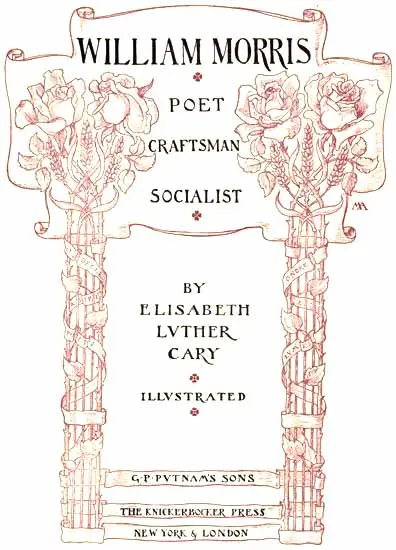
THE CLASSIC COLLECTION · 1902
"William Morris: Poet, Craftsman, Socialist" by Elisabeth Luther Cary is a biographical account written in the early 20th century. This work explores the life and contributions of William Morris, a significant figure in the arts, literature, and socialism of the 19th century. The book likely focuses on Morris's artistic vision, creative endeavors, and his commitment to social reform, woven together with glimpses of his personal experiences and relationships. The opening of the book sets the stage by emphasizing Morris's holistic approach to life, where his artistic and social pursuits were deeply interconnected. It outlines his early life, starting with his childhood in Essex, England, highlighting how the beauty of the landscape and the rich history of the region influenced his lifelong fascination with the Middle Ages and the desire to improve the world around him. Morris's struggles with formal education and his passionate interests emerge early, demonstrating how his artistic inclinations shaped his identity and paved the way for a career dedicated to craftsmanship, poetry, and socialist ideals. This initial portrayal reveals a man driven by dreams and an idealistic vision of a better society, inviting readers to explore further into his remarkable life.
Introduction adapted from the source catalogue; source summaries may be automatically generated.
Free to read · English · 79,457 words · No account needed
MAKE TIME FOR A GOOD BOOK
On by default. Untick to stop anonymous reading totals. Each page counts after 10 seconds in view. How this works.
Anonymous counting is on unless you have switched it off.
His work with silks and with wools was naturally greatly enriched by his use of his own full, soft and brilliant colours, and his personal attention to the art of dyeing counted for so much that one of his most accomplished pupils in embroidery is quoted by Mr. Mackail as saying that she promptly felt the difference when Morris ceased to dye with his own hands, that the colours became more monotonous and prosy and the very lustre of the silk was less beautiful. It is, however, difficult to impress yourself upon the public precisely as you are, whatever vigour your personality may have. Morris, with his intense love of bright full hues, has come down as the promoter of the so-called "aesthetic" dulness of colour, and his name has been especially associated with the peacock blue and the "sage-green" to which he had an especial aversion. It was one of his doctrines that a room should be kept cheerful in tone, and how happily he could carry out this doctrine is seen in more than one of the rooms decorated by the firm. A visitor to Stanmore Hall, for example, has noted the delicate tones of the painted ceilings as looking like embroidery on old white silk, giving a bright yet light and aerial effect, and forming with the woodwork of untouched oak an impression of delightful gayety.
That Morris made himself a master of so many crafts and grappled even so successfully as he did with the technical difficulties involved would be somewhat remarkable had he attempted none of the other undertakings in which he gained for himself a name to be remembered. His eagerness to express his ideals in a practical form led him on indefinitely. To the very last a new world to conquer roused his spirit and made him tingle to be off. For a man with the trace of the plodder in him such a career would have been an impossible one, but Morris went blithely from craft to craft by a series of leaps and bounds. He stayed with each just long enough to understand its working principles and to make himself efficient to teach others its peculiar virtues and demands, and he then passed on. "Each separate enterprise on which he entered," says one of his biographers, "seems for a time to have moved him to extraordinary energy. He thought it out, installed it, set it going, designed for it, trained men and women in the work to be done, and then by degrees, as the work began to run smoothly and could be trusted to go on without him, his interest became less active: a new idea generated in his mind, or an old one burst into bud, and his energies burst out afresh in some new doing." As time went on he had less and less practically to do with the firm of which he was the head and of which he continued to the end to be the consulting adviser. He gathered about him cooeperators who not only were sympathetic with his methods but absorbed his style. His distinction as a designer was neither so great nor so personal that it could not to a considerable degree be communicated, and this accounts for the enduring quality of his influence which has been handed down to us through others without too much subtracted from it, with many of the characteristics most to be cherished still present. Greater decorators have existed, indeed, but it may be questioned if anyone has been quite so inspiriting; has had the matter quite so much at heart. He persuaded the multitude from the intensity of his own conviction, and he persuaded them on the whole toward good things and toward beauty. He made other men's ideas his own but he adopted them body and soul. He followed his own fashion, inveighing with vigour and frequently with logic against nearly all the fashions of his time. It is not surprising that he himself became the great fashion of the nineteenth century in matters of decoration. And this certainly was what he wanted, in the sense of wanting everyone in England to see as he did the possibilities of household art and to share in furthering them by turning their backs upon the sham art with which the commercial world was largely occupied. But he made no effort toward gaining the patronage of those unwilling to admit that what he disliked was intolerable. His was never a conciliatory policy. The following passage from his lecture on The Lesser Arts reveals his attitude in his own phrasing:
Your reading position is saved on this browser. Take it to another device with a library code. Reading pages adapt to text, rather than matching a printed edition.
BEHIND THE BOOK
This eBook is for the use of anyone anywhere in the United States and most other parts of the world at no cost and with almost no restrictions whatsoever. You may copy it, give it away or re-use it under the terms of the Project Gutenberg License included with this eBook or online at www.gutenberg.org. If you are not located in the United States, you will have to check the laws of the country where you are located before using this eBook. Read the source licence.
The original source file, including credits and licence, is retained by this library. Request an original-format copy at no charge. Please include the book title and Project Gutenberg identifier #39725.
KEEP YOUR CURIOSITY GOING
Cécile Tormay

Moritz Busch
John L. Ransom
Frances Wright
Cécile Tormay

Mabel Potter Daggett