READ · DISCOVER · ENJOYClassic literature · Always free
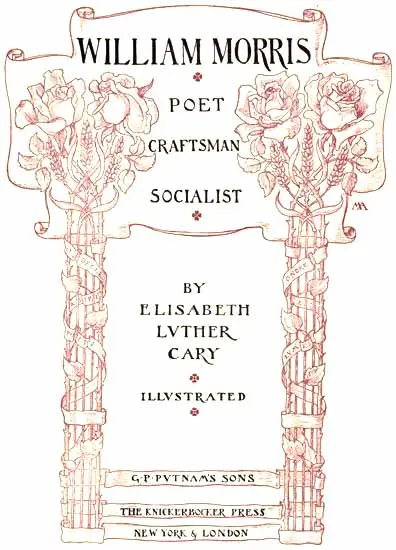
William Morris: Poet, Craftsman, Socialist — digital edition cover

THE CLASSIC COLLECTION · 1902

William Morris: Poet, Craftsman, Socialist

"William Morris: Poet, Craftsman, Socialist" by Elisabeth Luther Cary is a biographical account written in the early 20th century. This work explores the life and contributions of William Morris, a significant figure in the arts, literature, and socialism of the 19th century. The book likely focuses on Morris's artistic vision, creative endeavors, and his commitment to social reform, woven together with glimpses of his personal experiences and relationships. The opening of the book sets the stage by emphasizing Morris's holistic approach to life, where his artistic and social pursuits were deeply interconnected. It outlines his early life, starting with his childhood in Essex, England, highlighting how the beauty of the landscape and the rich history of the region influenced his lifelong fascination with the Middle Ages and the desire to improve the world around him. Morris's struggles with formal education and his passionate interests emerge early, demonstrating how his artistic inclinations shaped his identity and paved the way for a career dedicated to craftsmanship, poetry, and socialist ideals. This initial portrayal reveals a man driven by dreams and an idealistic vision of a better society, inviting readers to explore further into his remarkable life.

Introduction adapted from the source catalogue; source summaries may be automatically generated.

Start reading ↓

Free to read · English · 79,457 words · No account needed

MAKE TIME FOR A GOOD BOOK

William Morris: Poet, Craftsman, Socialist

On by default. Untick to stop anonymous reading totals. Each page counts after 10 seconds in view. How this works.

Anonymous counting is on unless you have switched it off.

William Morris: Poet, Craftsman, Socialist

While Morris was developing the industries of the firm with essential steadiness, despite the rapid transitions from one pursuit to another, he was going through a variety of personal experiences, some of which involved his disappointment in deeply cherished plans. For one thing, and this perhaps the most grievous, he was obliged to give up the Red House upon which so much joyous labour had been spent. Several causes contributed to the unhappy necessity, chief among them an attack of rheumatic fever that made him sensitive to the bleak winds which the exposed situation of the building invited. The distance between London and Upton became also a serious matter after his illness, as he found it almost impossible to make the daily journeys required by his attention to the business. Several compromises were thought of, the most enticing being the removal of the works from Red Lion Square to Upton, and the addition of a wing to the Red House for Burne-Jones and his family; but in the end the beautiful house was sold, Morris, after leaving it, never again setting eyes upon it.

The first move was to Queen Square, London, where Morris and the business became house-mates in the autumn of 1865, remaining together there, with more or less interruption, for seven years. Queen Square is in Bloomsbury, not far from the British Museum, and a part of the ugly London middle-class region for which Morris had so little liking, but as a place to carry on the rapidly increasing work of the firm it possessed great advantages. The number of the house was 26, and adjacent buildings and grounds were used for the workshops. At this time Mr. George Warrington Taylor was made business manager for the company, and Morris gained by his accession much valuable time, not only for designing and experimenting, but for the literary work that again began to claim his attention. He was still, however, a familiar figure in "the shop," acting as salesman, showman, designer, or manual labourer. His aspect as he strode along the streets of the dull neighbourhood must have been refreshing. Those who knew him have repeatedly described him as the image of a sea-captain in general appearance. He wore habitually a suit of navy-blue serge cut in nautical fashion, and his manner was bluff and hearty as that of the proverbial seaman. Mr. Mackail gives a breezy picture of him in his workman's blouse, hatless, with his ruddy complexion and rocking walk, bound for the Faulkners' house where once upon a time a new maid took him for the butcher. To have seen him in these days was to have seen one of his own ideal workmen out of News from Nowhere. As a master of men he seems to have been singularly successful, despite the temper which led him at times to commit acts of positive violence. His splendid zest for work must have been stimulating and to a degree contagious. Merely to be in the company of one who thought hearty manual labour so interesting and so pleasant and so heartily to be desired by everyone, must have had its vivifying effect. He was stating the simple truth when he said that he should die of despair and weariness if his daily work were taken from him unless he could at once make something else his daily work, and he is constantly drawing persuasive pictures of the charm of the various handicrafts--that of weaving for example, his description of which would invite the most discontented mind. He does not call the weaver's craft a dull one: "If he be set to doing things which are worth doing--to watch the web growing day by day almost magically, in anticipation of the time when it is to be taken out and one can see it on the right side in all its well-schemed beauty--to make something beautiful that will last out of a few threads of silk and wool, seems to me not an unpleasant way of earning one's livelihood, so long only as one lives and works in a pleasant place, with work-day not too long, and a book or two to be got at." His own weavers were some of them boys trained in the shop from a condition of absolute ignorance of drawing and of the craft to such an efficiency as enabled them to weave the Stanmore tapestry, one panel of which took two years to the making, and which was of the utmost elaboration and magnificence of design. The exigencies of the business presently made it necessary to devote the whole of the premises in Queen Square to the work going on there, and the Morris family removed in 1872 to a small house between Hammersmith and Turnham Green, near Chiswick Lane, Morris retaining a couple of rooms in the Queen Square house for his use when busy there. Even the extended quarters soon proved insufficient, however, and in 1877 rooms were taken in Oxford Street for showing and selling the work of the firm, the manufacturing departments being still ensconced in Queen Square. In 1881 these also were transferred to more suitable premises. The dyeing and cotton-printing demanded workshops by the side of some stream of clear water "fit to dye with," and after much search Morris found an ideal situation on the banks of the little Wandle River, near Wimbledon. There were the ruins of Merton Abbey where the Barons once gave their famous answer "Nolumus leges Angliae mutari," and there manufactures had been carried on for centuries. In the long low-roofed worksheds on the river's bank his workmen could move about in ample space, practising ancient methods of dyeing, printing, and weaving, seven miles from Charing Cross. It is anything but a typical manufactory that has been depicted by visitors to the Merton Abbey works. We read of an old walled garden gay with old-fashioned flowers and shrubs, of the swift little Wandle River rushing along between the buildings, its trout leaping under the windows, a water-wheel revolving at ease, hanks of yarn, fresh from the vats, drying in the pure air, calico lying "clearing" on the meadow grass in an enclosure made by young poplar trees, a sunlit picture of peaceful work carried on by unharried workers among surroundings of fresh and wholesome charm. Women and men were both employed, some of them old and not all of them competent, but none of them overworked or underpaid. Though Morris had somewhat scant courtesy of manner toward those who worked for and with him, he had at least the undeviating desire to promote their welfare. If he expected work of his work-people, as certainly he did, he expected it only under the most healthful and agreeable conditions. Judging others by himself, he could not conceive anyone as happy in idleness, but neither did he expect anyone to be happy without leisure. In his own business he proved what the nineteenth century found hard to believe, that honest, thorough, and artistic workmanship, accomplished under reasonable exactions by people enjoying their occupation, could be combined with commercial prosperity. That the products of such labour could not be bought by the poorer classes was due, he argued, to a social order wrong at the root. The time when art could be made "by the people and for the people, as a happiness to the maker and the user," was a far-off dream.

Your reading position is saved on this browser. Take it to another device with a library code. Reading pages adapt to text, rather than matching a printed edition.

More from this author

BEHIND THE WORDS

About Elisabeth Luther Cary

Elisabeth Luther Cary (1867–1936). Explore William Morris: Poet, Craftsman, Socialist, Artists Past and Present; Random Studies in this collection. These books span biography & memoir, history, poetry.

Explore this author’s books →

THE READERS’ VERDICT

How did this story stay with you?

Not rated yet
Your rating for William Morris: Poet, Craftsman, Socialist

Be the first to share your verdict.

One rating per browser, which you can change or remove. A necessary browser identifier remembers your vote. How ratings work

A GOOD STORY DESERVES COMPANY

Pass this book along.

A great read is even better when it’s shared.

SEND A LITTLE INSPIRATION

Share this book

BEHIND THE BOOK

Edition & source details.

Title
William Morris: Poet, Craftsman, Socialist
Author
Elisabeth Luther Cary
Publication year
1902
Digital edition publisher
Project Gutenberg
Gutenberg release date
2012-05-18
Language
English
Source edition imprint
Not stated in source catalogue
Source identifier
Project Gutenberg #39725
Contributors
No additional named contributors in source metadata

Public-domain source & licence

This eBook is for the use of anyone anywhere in the United States and most other parts of the world at no cost and with almost no restrictions whatsoever. You may copy it, give it away or re-use it under the terms of the Project Gutenberg License included with this eBook or online at www.gutenberg.org. If you are not located in the United States, you will have to check the laws of the country where you are located before using this eBook. Read the source licence.

Full source licence and obtaining an original copy

The original source file, including credits and licence, is retained by this library. Request an original-format copy at no charge. Please include the book title and Project Gutenberg identifier #39725.

the full Project Gutenberg License must appear
prominently whenever any copy of a Project Gutenberg work (any work
on which the phrase “Project Gutenberg” appears, or with which the
phrase “Project Gutenberg” is associated) is accessed, displayed,
performed, viewed, copied or distributed:

This eBook is for the use of anyone anywhere in the United States and most
other parts of the world at no cost and with almost no restrictions
whatsoever. You may copy it, give it away or re-use it under the terms
of the Project Gutenberg™ License included with this eBook or online
at www.gutenberg.org. If you
are not located in the United States, you will have to check the laws
of the country where you are located before using this eBook.

1.E.2. If an individual Project Gutenberg electronic work is
derived from texts not protected by U.S. copyright law (does not
contain a notice indicating that it is posted with permission of the
copyright holder), the work can be copied and distributed to anyone in
the United States without paying any fees or charges. If you are
redistributing or providing access to a work with the phrase “Project
Gutenberg” associated with or appearing on the work, you must comply
either with the requirements of paragraphs 1.E.1 through 1.E.7 or
obtain permission for the use of the work and the Project Gutenberg
trademark as set forth in paragraphs 1.E.8 or 1.E.9.

1.E.3. If an individual Project Gutenberg electronic work is posted
with the permission of the copyright holder, your use and distribution
must comply with both paragraphs 1.E.1 through 1.E.7 and any
additional terms imposed by the copyright holder. Additional terms
will be linked to the Project Gutenberg License for all works
posted with the permission of the copyright holder found at the
beginning of this work.

1.E.4. Do not unlink or detach or remove the full Project Gutenberg
License terms from this work, or any files containing a part of this
work or any other work associated with Project Gutenberg.

1.E.5. Do not copy, display, perform, distribute or redistribute this
electronic work, or any part of this electronic work, without
prominently displaying the sentence set forth in paragraph 1.E.1 with
active links or immediate access to the full terms of the Project
Gutenberg License.

1.E.6. You may convert to and distribute this work in any binary,
compressed, marked up, nonproprietary or proprietary form, including
any word processing or hypertext form. However, if you provide access
to or distribute copies of a Project Gutenberg work in a format
other than “Plain Vanilla ASCII” or other format used in the official
version posted on the official Project Gutenberg website
(www.gutenberg.org), you must, at no additional cost, fee or expense
to the user, provide a copy, a means of exporting a copy, or a means
of obtaining a copy upon request, of the work in its original “Plain
Vanilla ASCII” or other form. Any alternate format must include the
full Project Gutenberg License as specified in paragraph 1.E.1.

1.E.7. Do not charge a fee for access to, viewing, displaying,
performing, copying or distributing any Project Gutenberg works
unless you comply with paragraph 1.E.8 or 1.E.9.

1.E.8. You may charge a reasonable fee for copies of or providing
access to or distributing Project Gutenberg electronic works
provided that:

• You pay a royalty fee of 20% of the gross profits you derive from
the use of Project Gutenberg works calculated using the method
you already use to calculate your applicable taxes. The fee is owed
to the owner of the Project Gutenberg trademark, but he has
agreed to donate royalties under this paragraph to the Project
Gutenberg Literary Archive Foundation. Royalty payments must be paid
within 60 days following each date on which you prepare (or are
legally required to prepare) your periodic tax returns. Royalty
payments should be clearly marked as such and sent to the Project
Gutenberg Literary Archive Foundation at the address specified in
Section 4, “Information about donations to the Project Gutenberg
Literary Archive Foundation.”

• You provide a full refund of any money paid by a user who notifies
you in writing (or by e-mail) within 30 days of receipt that s/he
does not agree to the terms of the full Project Gutenberg™
License. You must require such a user to return or destroy all
copies of the works possessed in a physical medium and discontinue
all use of and all access to other copies of Project Gutenberg™
works.

• You provide, in accordance with paragraph 1.F.3, a full refund of
any money paid for a work or a replacement copy, if a defect in the
electronic work is discovered and reported to you within 90 days of
receipt of the work.

• You comply with all other terms of this agreement for free
distribution of Project Gutenberg™ works.


1.E.9. If you wish to charge a fee or distribute a Project
Gutenberg™ electronic work or group of works on different terms than
are set forth in this agreement, you must obtain permission in writing
from the Project Gutenberg Literary Archive Foundation, the manager of
the Project Gutenberg™ trademark. Contact the Foundation as set
forth in Section 3 below.

1.F.

1.F.1. Project Gutenberg volunteers and employees expend considerable
effort to identify, do copyright research on, transcribe and proofread
works not protected by U.S. copyright law in creating the Project
Gutenberg™ collection. Despite these efforts, Project Gutenberg™
electronic works, and the medium on which they may be stored, may
contain “Defects,” such as, but not limited to, incomplete, inaccurate
or corrupt data, transcription errors, a copyright or other
intellectual property infringement, a defective or damaged disk or
other medium, a computer virus, or computer codes that damage or
cannot be read by your equipment.

1.F.2. LIMITED WARRANTY, DISCLAIMER OF DAMAGES - Except for the “Right
of Replacement or Refund” described in paragraph 1.F.3, the Project
Gutenberg Literary Archive Foundation, the owner of the Project
Gutenberg™ trademark, and any other party distributing a Project
Gutenberg™ electronic work under this agreement, disclaim all
liability to you for damages, costs and expenses, including legal
fees. YOU AGREE THAT YOU HAVE NO REMEDIES FOR NEGLIGENCE, STRICT
LIABILITY, BREACH OF WARRANTY OR BREACH OF CONTRACT EXCEPT THOSE
PROVIDED IN PARAGRAPH 1.F.3. YOU AGREE THAT THE FOUNDATION, THE
TRADEMARK OWNER, AND ANY DISTRIBUTOR UNDER THIS AGREEMENT WILL NOT BE
LIABLE TO YOU FOR ACTUAL, DIRECT, INDIRECT, CONSEQUENTIAL, PUNITIVE OR
INCIDENTAL DAMAGES EVEN IF YOU GIVE NOTICE OF THE POSSIBILITY OF SUCH
DAMAGE.

1.F.3. LIMITED RIGHT OF REPLACEMENT OR REFUND - If you discover a
defect in this electronic work within 90 days of receiving it, you can
receive a refund of the money (if any) you paid for it by sending a
written explanation to the person you received the work from. If you
received the work on a physical medium, you must return the medium
with your written explanation. The person or entity that provided you
with the defective work may elect to provide a replacement copy in
lieu of a refund. If you received the work electronically, the person
or entity providing it to you may choose to give you a second
opportunity to receive the work electronically in lieu of a refund. If
the second copy is also defective, you may demand a refund in writing
without further opportunities to fix the problem.

1.F.4. Except for the limited right of replacement or refund set forth
in paragraph 1.F.3, this work is provided to you ‘AS-IS’, WITH NO
OTHER WARRANTIES OF ANY KIND, EXPRESS OR IMPLIED, INCLUDING BUT NOT
LIMITED TO WARRANTIES OF MERCHANTABILITY OR FITNESS FOR ANY PURPOSE.

1.F.5. Some states do not allow disclaimers of certain implied
warranties or the exclusion or limitation of certain types of
damages. If any disclaimer or limitation set forth in this agreement
violates the law of the state applicable to this agreement, the
agreement shall be interpreted to make the maximum disclaimer or
limitation permitted by the applicable state law. The invalidity or
unenforceability of any provision of this agreement shall not void the
remaining provisions.

1.F.6. INDEMNITY - You agree to indemnify and hold the Foundation, the
trademark owner, any agent or employee of the Foundation, anyone
providing copies of Project Gutenberg™ electronic works in
accordance with this agreement, and any volunteers associated with the
production, promotion and distribution of Project Gutenberg™
electronic works, harmless from all liability, costs and expenses,
including legal fees, that arise directly or indirectly from any of
the following which you do or cause to occur: (a) distribution of this
or any Project Gutenberg work, (b) alteration, modification, or
additions or deletions to any Project Gutenberg work, and (c) any
Defect you cause.

Section 2. Information about the Mission of Project Gutenberg

Project Gutenberg is synonymous with the free distribution of
electronic works in formats readable by the widest variety of
computers including obsolete, old, middle-aged and new computers. It
exists because of the efforts of hundreds of volunteers and donations
from people in all walks of life.

Volunteers and financial support to provide volunteers with the
assistance they need are critical to reaching Project Gutenberg’s
goals and ensuring that the Project Gutenberg collection will
remain freely available for generations to come. In 2001, the Project
Gutenberg Literary Archive Foundation was created to provide a secure
and permanent future for Project Gutenberg and future
generations. To learn more about the Project Gutenberg Literary
Archive Foundation and how your efforts and donations can help, see
Sections 3 and 4 and the Foundation information page at www.gutenberg.org.

Section 3. Information about the Project Gutenberg Literary Archive Foundation

The Project Gutenberg Literary Archive Foundation is a non-profit
501(c)(3) educational corporation organized under the laws of the
state of Mississippi and granted tax exempt status by the Internal
Revenue Service. The Foundation’s EIN or federal tax identification
number is 64-6221541. Contributions to the Project Gutenberg Literary
Archive Foundation are tax deductible to the full extent permitted by
U.S. federal laws and your state’s laws.

The Foundation’s business office is located at 41 Watchung Plaza #516,
Montclair NJ 07042, USA, +1 (862) 621-9288. Email contact links and up
to date contact information can be found at the Foundation’s website
and official page at www.gutenberg.org/contact

Section 4. Information about Donations to the Project Gutenberg
Literary Archive Foundation

Project Gutenberg™ depends upon and cannot survive without widespread
public support and donations to carry out its mission of
increasing the number of public domain and licensed works that can be
freely distributed in machine-readable form accessible by the widest
array of equipment including outdated equipment. Many small donations
($1 to $5,000) are particularly important to maintaining tax exempt
status with the IRS.

The Foundation is committed to complying with the laws regulating
charities and charitable donations in all 50 states of the United
States. Compliance requirements are not uniform and it takes a
considerable effort, much paperwork and many fees to meet and keep up
with these requirements. We do not solicit donations in locations
where we have not received written confirmation of compliance. To SEND
DONATIONS or determine the status of compliance for any particular state
visit www.gutenberg.org/donate.

While we cannot and do not solicit contributions from states where we
have not met the solicitation requirements, we know of no prohibition
against accepting unsolicited donations from donors in such states who
approach us with offers to donate.

International donations are gratefully accepted, but we cannot make
any statements concerning tax treatment of donations received from
outside the United States. U.S. laws alone swamp our small staff.

Please check the Project Gutenberg web pages for current donation
methods and addresses. Donations are accepted in a number of other
ways including checks, online payments and credit card donations. To
donate, please visit: www.gutenberg.org/donate.

Section 5. General Information About Project Gutenberg electronic works

Professor Michael S. Hart was the originator of the Project
Gutenberg concept of a library of electronic works that could be
freely shared with anyone. For forty years, he produced and
distributed Project Gutenberg eBooks with only a loose network of
volunteer support.

Project Gutenberg eBooks are often created from several printed
editions, all of which are confirmed as not protected by copyright in
the U.S. unless a copyright notice is included. Thus, we do not
necessarily keep eBooks in compliance with any particular paper
edition.

Most people start at our website which has the main PG search
facility: www.gutenberg.org.

This website includes information about Project Gutenberg,
including how to make donations to the Project Gutenberg Literary
Archive Foundation, how to help produce our new eBooks, and how to
subscribe to our email newsletter to hear about new eBooks.


KEEP YOUR CURIOSITY GOING

Your next chapter awaits.