THE CLASSIC COLLECTION✦Artists Past and Present; Random StudiesCLASSIC FREE BOOKS
Artists Past and Present; Random Studies
Elisabeth Luther Cary
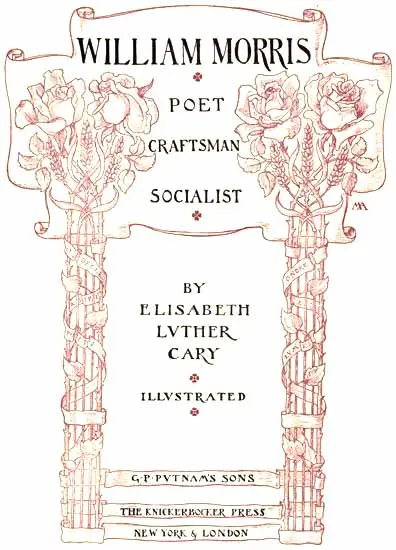
THE CLASSIC COLLECTION · 1902
"William Morris: Poet, Craftsman, Socialist" by Elisabeth Luther Cary is a biographical account written in the early 20th century. This work explores the life and contributions of William Morris, a significant figure in the arts, literature, and socialism of the 19th century. The book likely focuses on Morris's artistic vision, creative endeavors, and his commitment to social reform, woven together with glimpses of his personal experiences and relationships. The opening of the book sets the stage by emphasizing Morris's holistic approach to life, where his artistic and social pursuits were deeply interconnected. It outlines his early life, starting with his childhood in Essex, England, highlighting how the beauty of the landscape and the rich history of the region influenced his lifelong fascination with the Middle Ages and the desire to improve the world around him. Morris's struggles with formal education and his passionate interests emerge early, demonstrating how his artistic inclinations shaped his identity and paved the way for a career dedicated to craftsmanship, poetry, and socialist ideals. This initial portrayal reveals a man driven by dreams and an idealistic vision of a better society, inviting readers to explore further into his remarkable life.
Introduction adapted from the source catalogue; source summaries may be automatically generated.
Free to read · English · 79,457 words · No account needed
MAKE TIME FOR A GOOD BOOK
On by default. Untick to stop anonymous reading totals. Each page counts after 10 seconds in view. How this works.
Anonymous counting is on unless you have switched it off.
"Meantime, I cannot allow that it is good for any hour of the day to be wholly stripped of life and beauty, therefore we must provide ourselves with lesser (I will not say worse) art with which to surround our common work-a-day or restful times; and for those times I think it will be enough for us to clothe our daily and domestic walls with ornament that reminds us of the outward face of the earth, of the innocent love of animals, or man passing his days between work and rest as he does. I say with ornament that reminds us of these things and sets our minds and memories at work easily creating them; because scientific representation of them would again involve us in the problems of hard fact and the troubles of life, and so once more destroy our rest for us."
Was ever a craftsman of the ancient guilds so at pains to make clear the propriety and usefulness of his wood-carving or enamelling or niello! Like the early workman, however, he moved with marvellous facility from one branch of his art to another. From wall-papers it was but a step to cotton prints which in a way were the playthings of a mind at leisure. They might be as gay as one chose to make them, and "could not well go wrong so long as they avoided commonplace and kept somewhat on the daylight side of nightmare." From the weaving of hangings to the weaving of carpets was a step as easily taken, and when the impulse seized him to carry on the great but dying art of Persia in this direction, Morris so effectively applied himself to mastering the conditions under which the beautiful Eastern carpets were brought to their perfection as to produce at least one example--that called The Buller's Wood Carpet--that fairly competes with the splendour of its prototypes. Stained glass for a time baffled him. "His was not the temperament," says one of his critics, "patiently to study the chemistry of glass colour; or to prove by long experiment the dependence to be placed upon a flux." Although many windows were made by the firm, the larger number of them designed by Burne-Jones, Morris being responsible for the colour, he never seemed to forget that he had come near to being worsted in his fight with the technical difficulties of this most difficult art, and economised his enthusiasm for it accordingly. Hand-painted tiles, however, which he was the first to introduce into England, were favourites with him, and in them he perpetuated some of his attempts at drawing the human figure. Furniture, though an important feature of the work undertaken by the firm, did not appeal to him, and he left it to his associates. His experiments in vegetable dyes produced interesting results, although here also his technical knowledge was not entirely adequate to his task. In connection with his textile work he early felt the imperative necessity of having finer colours than the market offered. To get them as he wanted them he was obliged to go back as far as Pliny, but this was a small matter to one whose mind was always ready to provide him with an Aladdin's carpet. Back to Pliny he went to learn old methods, and in addition he called to his aid ancient herbals and French books of the sixteenth and seventeenth centuries, finally setting up his own vats and becks and very literally plunging in. At first he complained of "looking such a beast," but his enthusiasm soon overcame this rather remarkable display of concern for his personal appearance, and he wrote most joyously of working in sabots and blouse in the dye-house "pretty much all day long." Out of his vats came the blue of his indigo, the red of his madder, the yellow of weld or Persian berry, the rich brown of walnut juice, making beautiful combinations, which, when they faded, changed into paler tints of the same colour and were not unpleasant to look upon. The aniline dyes, which in 1860 were the latest wonder of science, and in a very crude stage of their development, called out his most picturesque invective. Each colour was hideous in itself, crude, livid, cheap, and loathed by every person of taste, the "foul blot of the capitalist dyer." In brief, the invention supposed to be for the benefit of an art "the very existence of which depends upon its producing beauty" was "on the road; and very far advanced on it, towards destroying all beauty in the art." The only thing to do was to turn one's back on the chemical dyes, relegate them to a museum of scientific curiosities, and go back "if not to the days of the Pharaohs yet at least to those of Tintoret." It was highly characteristic of him that he chose the remedy of "going back" in place of progressing with the new material as far as possible.
Your reading position is saved on this browser. Take it to another device with a library code. Reading pages adapt to text, rather than matching a printed edition.
BEHIND THE BOOK
This eBook is for the use of anyone anywhere in the United States and most other parts of the world at no cost and with almost no restrictions whatsoever. You may copy it, give it away or re-use it under the terms of the Project Gutenberg License included with this eBook or online at www.gutenberg.org. If you are not located in the United States, you will have to check the laws of the country where you are located before using this eBook. Read the source licence.
The original source file, including credits and licence, is retained by this library. Request an original-format copy at no charge. Please include the book title and Project Gutenberg identifier #39725.
KEEP YOUR CURIOSITY GOING
Cécile Tormay

Moritz Busch
John L. Ransom
Frances Wright
Cécile Tormay

Mabel Potter Daggett