THE CLASSIC COLLECTION✦Artists Past and Present; Random StudiesCLASSIC FREE BOOKS
Artists Past and Present; Random Studies
Elisabeth Luther Cary
THE CLASSIC COLLECTION · 1902
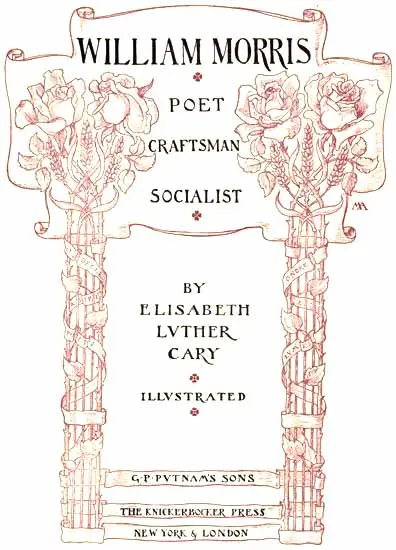
"William Morris: Poet, Craftsman, Socialist" by Elisabeth Luther Cary is a biographical account written in the early 20th century. This work explores the life and contributions of William Morris, a significant figure in the arts, literature, and socialism of the 19th century. The book likely focuses on Morris's artistic vision, creative endeavors, and his commitment to social reform, woven together with glimpses of his personal experiences and relationships. The opening of the book sets the stage by emphasizing Morris's holistic approach to life, where his artistic and social pursuits were deeply interconnected. It outlines his early life, starting with his childhood in Essex, England, highlighting how the beauty of the landscape and the rich history of the region influenced his lifelong fascination with the Middle Ages and the desire to improve the world around him. Morris's struggles with formal education and his passionate interests emerge early, demonstrating how his artistic inclinations shaped his identity and paved the way for a career dedicated to craftsmanship, poetry, and socialist ideals. This initial portrayal reveals a man driven by dreams and an idealistic vision of a better society, inviting readers to explore further into his remarkable life.
Introduction adapted from the source catalogue; source summaries may be automatically generated.
Free to read · English · 79,457 words · No account needed
MAKE TIME FOR A GOOD BOOK
On by default. Untick to stop anonymous reading totals. Each page counts after 10 seconds in view. How this works.
Anonymous counting is on unless you have switched it off.
Although a blight of discouragement seems to have fallen upon Morris under Rossetti's tuition, there were some blithe compensations. Not the least of these was the fitting up of the rooms at 17 Red Lion Square where he and Burne-Jones took quarters. "Topsy and I live together," wrote Burne-Jones, "in the quaintest room in all London, hung with brasses of old knights and drawings of Albert Duerer." For the furniture, Morris, who, Rossetti said, was "bent on doing the magnificent," made designs to be carried out in deal by a carpenter of the neighbourhood. Everything was very large and heavy, intensely mediaeval, and doubtless rather ugly in an honest fashion, but in the end it was furniture to be coveted, for it offered great spaces for decoration, and Rossetti as well as Morris and Burne-Jones painted on it subjects from Chaucer and Dante and the Arthurian stories. The panels of a cupboard glowed with Rossetti's beautiful pictures representing Dante and Beatrice meeting in Florence and meeting in Paradise, and on the wide backs of the chairs he painted scenes from some of the poems Morris had written. The wardrobe was decorated by Burne-Jones with paintings from The Prioress's Tale. On the walls of the room were hung, no doubt, the several water-colours bought from Rossetti, to the lovely names of which Morris promptly wrote ballads. An owl was co-tenant with the young artists, and they were served and also criticised by a housemaid of literary ambitions. In this highly individual apartment, where, curiously enough, Rossetti and his friend Deverell had had their studio together five or six years before, life was not all labour and striving. There were, moreover, holidays spent at the Zooelogical Gardens, evenings at the theatre, night-long sessions in Rossetti's rooms, and excursions on the Thames. One of the latter is vividly described in Dr. Birkbeck Hill's Letters of Gabriel Rossetti to William Allingham, giving a joyous picture of Morris at the mercy of his ungovernable temper. The party, consisting of Hill, Morris, and Faulkner, had started out to row down the Thames from Oxford to a London suburb. By the time they had reached Henley they had spent all their money except enough for Faulkner's return ticket to Oxford, where he was to attend a college meeting. For this he departed, promising to bring back a supply of money in the evening. "The weather was unusually hot," writes Dr. Hill, "Morris and I sauntered along the river-side. I have not forgotten the longing glances he cast on a large basket of strawberries. He had always been so plentifully supplied with money that he bore with far greater impatience than I did this privation. At last the shadows had grown long and the heat was more bearable. We went with light hearts to the railway station to meet our comrade. 'Well, Faulkner,' cried out Morris, cheerfully, 'how much money have you brought?' Our friend gave a start. 'Good heavens,' he replied, 'I forgot all about it.' Morris thrust both his hands into his long dark curly hair, tugged at it wildly, ground his teeth, swore like a trooper, and stamped up and down the platform--in fact, behaved just like Sinbad's captain when he found that his ship was driving upon the rocks. His outbursts of rage, I hasten to say, were always harmless. They left no sullenness behind, and as each rapidly passed away he was ready to join in a hearty laugh at it. Faulkner, who was not the most patient of men, noticed that passengers, station-master, porters, engine-driver, and stoker were all gazing in astonishment. He, too, lost his temper, and, though in a far lower key, stormed back. Morris soon quieted down, and a council of war was held. He fortunately had a gold watch-chain on which he raised enough to pay all needful expenses. I remember well how the rest of our journey we rowed by many a tavern on the bank as effectually constrained as ever was Ulysses not to listen to its siren call. It was through no earthly paradise that the young poet and artist passed on the afternoon of our last day." When they landed they had just a penny among them, and were still some six or seven miles from their destination, so they were obliged to hire a cab and trust to good fortune for not coming to a turnpike gate before arriving at Red Lion Square.
Your reading position is saved on this browser. Take it to another device with a library code. Reading pages adapt to text, rather than matching a printed edition.
BEHIND THE BOOK
This eBook is for the use of anyone anywhere in the United States and most other parts of the world at no cost and with almost no restrictions whatsoever. You may copy it, give it away or re-use it under the terms of the Project Gutenberg License included with this eBook or online at www.gutenberg.org. If you are not located in the United States, you will have to check the laws of the country where you are located before using this eBook. Read the source licence.
The original source file, including credits and licence, is retained by this library. Request an original-format copy at no charge. Please include the book title and Project Gutenberg identifier #39725.
KEEP YOUR CURIOSITY GOING
Cécile Tormay

Moritz Busch
John L. Ransom
Frances Wright
Cécile Tormay

Mabel Potter Daggett