THE CLASSIC COLLECTION✦Artists Past and Present; Random StudiesCLASSIC FREE BOOKS
Artists Past and Present; Random Studies
Elisabeth Luther Cary
THE CLASSIC COLLECTION · 1902
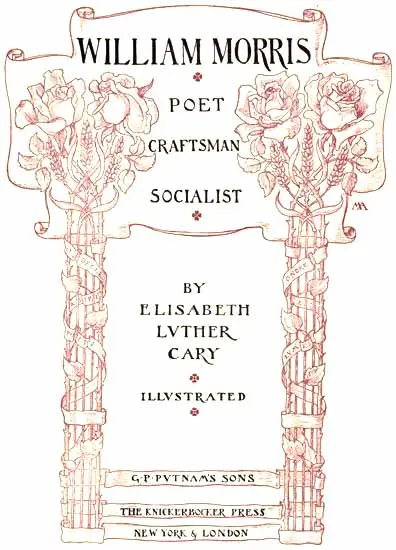
"William Morris: Poet, Craftsman, Socialist" by Elisabeth Luther Cary is a biographical account written in the early 20th century. This work explores the life and contributions of William Morris, a significant figure in the arts, literature, and socialism of the 19th century. The book likely focuses on Morris's artistic vision, creative endeavors, and his commitment to social reform, woven together with glimpses of his personal experiences and relationships. The opening of the book sets the stage by emphasizing Morris's holistic approach to life, where his artistic and social pursuits were deeply interconnected. It outlines his early life, starting with his childhood in Essex, England, highlighting how the beauty of the landscape and the rich history of the region influenced his lifelong fascination with the Middle Ages and the desire to improve the world around him. Morris's struggles with formal education and his passionate interests emerge early, demonstrating how his artistic inclinations shaped his identity and paved the way for a career dedicated to craftsmanship, poetry, and socialist ideals. This initial portrayal reveals a man driven by dreams and an idealistic vision of a better society, inviting readers to explore further into his remarkable life.
Introduction adapted from the source catalogue; source summaries may be automatically generated.
Free to read · English · 79,457 words · No account needed
MAKE TIME FOR A GOOD BOOK
On by default. Untick to stop anonymous reading totals. Each page counts after 10 seconds in view. How this works.
Anonymous counting is on unless you have switched it off.
Van Eyck, his motto chosen by Morris, 68
Velasquez, 261
Verona, 61
Viollet-le-Duc, 31
Virgil, 122-124, 262
Volsunga Saga, The, 125
Voyage Round the World, 263
Wagner, Richard, 135, 141
Wake, London Lads! ballad by Morris, 148
Walker, Emery, 22, 205, 209
Wall-papers, 81-83
Wallace, Alfred, his suggestion that Epping Forest be planted with North American trees, 11
Walthamstow, 3, 10
Wardrop, Oliver, 230
Warren, Sir Charles, 179
Water of the Wondrous Isles, The, 233, 240, 245, 248-251
Watts-Dunton, Theodore, 69
Waverley Novels, the, Morris's early fondness for, 3
Weaving, 85, 86
Webb, Philip, architect of the Red House, 61, 70, 75, 82, 111
Well at the World's End, The, 232, 245, 248
Westminster Abbey, 154, 181
White Horse, The, 30
Whitney, Miss Anne, 229
Whittingham, Charles, 33
Wilde, Lady, 228
Women and Roses, Browning's, 39
Wood beyond the World, The, Morris's, 7, 230, 242, 252
Woodford Hall, home of the Morrises, 3
Working Men's College, Burne-Jones's visit to, 40
Wyatt, A. J., 230
Yonge, Miss, 24
Zainer, Gunther, 223
Messrs. MORRIS & COMPANY have appointed as their general agent Mr. A. E. Bulkley of 42 East 14th St., New York City, and he will be pleased to give all information respecting the various fabrics, etc., designed by the late Mr. Morris and sold by MORRIS & COMPANY. These may also be obtained of Mr. A. H. Davenport, 96-98 Washington St., Boston.
[1] When the Utopia appeared with this introduction an Eton master who had ordered forty copies in advance, intending the books to be used as prizes for the boys in his school, withdrew his order, Young England not being allowed at that time to keep such Socialistic company.
[2] The trustees are now publishing the remainder of Morris's own works in the type of the Kelmscott Press, though without the ornaments, that a uniform edition may be had.
[3] The reader here is expected to note the correspondence between the names of the ladies and the titles of their lovers, and the same correspondence is carried out in the colour of the ladies' garments and the armour of the knights.
[4] Lewis F. Day.
[5] This bibliography is reprinted, with certain slight additions, from the bibliography prepared by S. C. Cockerell for the monograph entitled, "A Note by William Morris on his Aims in Founding the Kelmscott Press."
[6] At the Ellis Sale (1901) a presentation vellum copy brought L114.
[7] The first sheet was printed on the 2d of March, the last on the 4th of
April.
[8] At the Ellis Sale a presentation vellum copy brought L60.
[9] In this line as it originally stood, "dawn" was the rhyme provided for "corn." In the new line the rhyme for corn is "daylight new-born;" but Mr. Buxton Forman writes that Morris was wont to declare that "No South Englishman makes any difference in ordinary talk between dawn and morn for instance."
[10] "When Adam dalf and Eve span, who was thanne the gentleman."
Your reading position is saved on this browser. Take it to another device with a library code. Reading pages adapt to text, rather than matching a printed edition.
BEHIND THE BOOK
This eBook is for the use of anyone anywhere in the United States and most other parts of the world at no cost and with almost no restrictions whatsoever. You may copy it, give it away or re-use it under the terms of the Project Gutenberg License included with this eBook or online at www.gutenberg.org. If you are not located in the United States, you will have to check the laws of the country where you are located before using this eBook. Read the source licence.
The original source file, including credits and licence, is retained by this library. Request an original-format copy at no charge. Please include the book title and Project Gutenberg identifier #39725.
KEEP YOUR CURIOSITY GOING
Cécile Tormay

Moritz Busch
John L. Ransom
Frances Wright
Cécile Tormay

Mabel Potter Daggett