THE CLASSIC COLLECTION✦Artists Past and Present; Random StudiesCLASSIC FREE BOOKS
Artists Past and Present; Random Studies
Elisabeth Luther Cary
THE CLASSIC COLLECTION · 1902
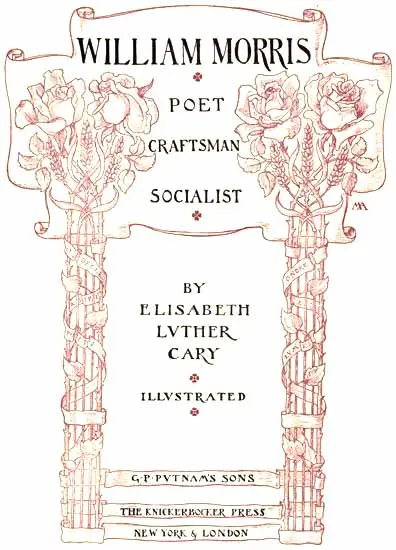
"William Morris: Poet, Craftsman, Socialist" by Elisabeth Luther Cary is a biographical account written in the early 20th century. This work explores the life and contributions of William Morris, a significant figure in the arts, literature, and socialism of the 19th century. The book likely focuses on Morris's artistic vision, creative endeavors, and his commitment to social reform, woven together with glimpses of his personal experiences and relationships. The opening of the book sets the stage by emphasizing Morris's holistic approach to life, where his artistic and social pursuits were deeply interconnected. It outlines his early life, starting with his childhood in Essex, England, highlighting how the beauty of the landscape and the rich history of the region influenced his lifelong fascination with the Middle Ages and the desire to improve the world around him. Morris's struggles with formal education and his passionate interests emerge early, demonstrating how his artistic inclinations shaped his identity and paved the way for a career dedicated to craftsmanship, poetry, and socialist ideals. This initial portrayal reveals a man driven by dreams and an idealistic vision of a better society, inviting readers to explore further into his remarkable life.
Introduction adapted from the source catalogue; source summaries may be automatically generated.
Free to read · English · 79,457 words · No account needed
MAKE TIME FOR A GOOD BOOK
On by default. Untick to stop anonymous reading totals. Each page counts after 10 seconds in view. How this works.
Anonymous counting is on unless you have switched it off.
Like the majority of the students who went up to Oxford in the fifties, Morris matriculated with the definite intention of taking holy orders. Unlike the majority, he was impelled not only by the sensuous beauty of ritualistic worship, to which, however, no one could have been more keenly alive than he, but by a genuine enthusiasm for a life devoted to high purposes. A fine buoyant desire to better existing conditions and sweep as much evil as possible off the face of the earth early inspired him. His mind turned toward the conventual life as that which combined the mediaeval suggestions always alluring to him with the moral beauty of holiness. He planned a "Crusade and Holy Warfare against the Age," sang plain song at daily morning service, read masses of mediaeval chronicles and ecclesiastical Latin poetry, and hovered just this side of the Roman Communion. Had the ecclesiology of the University been supported at that time by an inward and spiritual grace sufficient to hold the heart of youth to a sustained allegiance, there is little doubt that Morris would have thrown himself ardently into the religious path. But Oxford had become an indolent and indifferent mother to her children. The storm of feeling aroused by the Tractarian movement had died down and the reaction from it was evident. At Balliol Jowett's energy had made its mark, but at Exeter, where Morris was, the educational system deserved (and received) the contempt of an ambitious boy with an unusually large supply of stored-up intellectual force seeking outlet and guidance. Nor was the social life more stimulating to moral activity. The abuses recorded in 1852 by the University Commission were in essence so shameful that in the light of that famous report "the sweet city with her dreaming spires" seems to have only the beauty of the daughter of Helios, under whose enchantments men were turned to swine for loving her. The clean mind and honest nature of Morris revolted from the excesses that went on about him. He wrote to his mother two years after his matriculation, defending the proposition that his Oxford education had not been thrown away: "If by living here and seeing evil and sin in its foulest and coarsest forms, as one does day by day, I have learned to hate any form of sin and to wish to fight against it, is not this well too?" It is proof of his purity of taste and strength of will that, despite his ample means, the wanton extravagance of the typical undergraduate had for him no allurement. It is certain that he was never seen at those dinners which were pronounced by an official censor "a curse and a disgrace to a place of Christian education," and as certainly he played no part in the mad carnivals at which novices were initiated into a curriculum of vice. Yet he could not indeed say with any truth what Gibbon had said a hundred years before, that the time he spent at Oxford was the most idle and unprofitable of his whole life. If he felt, as Gibbon did, that his formal studies were "equally devoid of profit and pleasure," and if he found nothing ridiculous in Ruskin's bitter complaint that Oxford taught him all the Latin and Greek that he would learn, but did not teach him that fritillaries grew in Iffley meadow, he did find a little band of helpful associates. With these he realised the priceless advantages which Mr. Bagehot says cannot be got outside a college and which he sums up as found "in the books that all read because all like; in what all talk of because all are interested; in the argumentative walk or disputatious lounge; in the impact of fresh thought on fresh thought, of hot thought on hot thought; in mirth and refutation, in ridicule and laughter." The first of the few strong personal attachments in the life of Morris dates from his first day at Oxford. At the end of January, 1853, he went up for his matriculation, and beside him at the examination in the Hall sat Burne-Jones, who within a week of their formal entrance to the college became his intimate. The friendship thus spontaneously formed on the verge of manhood lasted until Morris died. In their studies, in their truant reading, in their later aims and work, the two, diametrically as they differed in aspect and in temperament and in quality of mind, were sympathetic and dear companions. Together they joined a group of other happily gifted men--Fulford, Faulkner, Dixon, Cormell Price, and Macdonald--who met in one another's rooms for the disputatious lounge over the exuberant ideals by which they were in common inspired. Tennyson, Keats, and Shelley, Shakespeare, Ruskin, Carlyle, Kingsley, Thackeray, Dickens, and Miss Yonge were the gods and half gods of their young and passionate enthusiasm. The last, curiously enough, was an influence as potent as any. The hero of her novel of 1853, The Heir of Redclyffe, was the pattern chosen by Morris, according to Mr. Mackail's account, to build himself upon. Singular as it seems to-day that any marked impression should have been made upon an even fairly well-trained mind by a writer of such slight literary quality, it is true that the author of The Daisy Chain counted among her devoted readers men of brilliant and dominant intellectual power. She had the lucky touch to kindle in young minds that fire of sympathy with which they greet whatever shows them their own world, their age, themselves as they best like to see them. To Morris in particular the young heir of Redclyffe made the appeal of a congenial temperament in a position similar to his own. Like Morris, he was headstrong and passionate, given to excessive bursts of rage and to repentances not less excessive; like Morris, he united to his natural pride an unnatural and slightly obtrusive humility; like Morris, he was rich and beautiful, generous and lovable. It was no great wonder that Morris, poring with his characteristic absorption over the pleasant pages on which Guy Morville's chivalrous life is portrayed, said as Dromio to Dromio, "Methinks you are my glass and not my brother; I see by you I am a sweet-faced youth."
Your reading position is saved on this browser. Take it to another device with a library code. Reading pages adapt to text, rather than matching a printed edition.
BEHIND THE BOOK
This eBook is for the use of anyone anywhere in the United States and most other parts of the world at no cost and with almost no restrictions whatsoever. You may copy it, give it away or re-use it under the terms of the Project Gutenberg License included with this eBook or online at www.gutenberg.org. If you are not located in the United States, you will have to check the laws of the country where you are located before using this eBook. Read the source licence.
The original source file, including credits and licence, is retained by this library. Request an original-format copy at no charge. Please include the book title and Project Gutenberg identifier #39725.
KEEP YOUR CURIOSITY GOING
Cécile Tormay

Moritz Busch
John L. Ransom
Frances Wright
Cécile Tormay

Mabel Potter Daggett