
Last letters from the living dead man
David Patterson (Spirit) Hatch
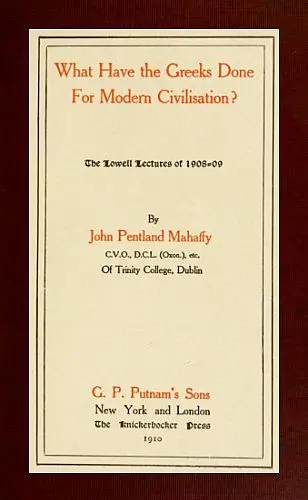
THE CLASSIC COLLECTION · 1909
"What Have the Greeks Done for Modern Civilisation?" by J. P. Mahaffy is a series of lectures written in the early 20th century. The work explores the profound influence of ancient Greek culture on contemporary society, particularly focusing on the arts, philosophy, science, and education. Its purpose is to reevaluate the significance of Greek studies in modern education and society. The opening of the text introduces Mahaffy as a seasoned scholar delivering a series of lectures that aim to highlight the contributions of the Greeks to modern civilization. He expresses his initial doubts about the diminishing interest in Greek studies, particularly in America, and outlines the various domains—literature, art, politics, and science—through which Greek thought has indelibly shaped contemporary understanding. He emphasizes that understanding the Greek legacy is essential for appreciating the foundations upon which modern culture is built and suggests that reforming the teaching of Greek is vital to reviving its significance in educational curricula.
Introduction adapted from the source catalogue; source summaries may be automatically generated.
Free to read · English · 58,758 words · No account needed
MAKE TIME FOR A GOOD BOOK
On by default. Untick to stop anonymous reading totals. Each page counts after 10 seconds in view. How this works.
Anonymous counting is on unless you have switched it off.
Let us turn to a widely different kind of explanation, which is wont to be set forth at the opening of most modern histories of Greece, as a vera causa to account for a wonderful and exceptional result. This theory is the echo of the famous opening of Buckle’s great book on Civilisation, wherein it is asserted that man is the creature of external circumstances and that these determine not only his physical, but his intellectual increase. In particular, the greatness of Egypt and its early victory over the obstacles of nature are attributed to the heat and moisture of the climate; and so we are told that the temperate airs of the Ægean, the multitude of its islands, its indented coast, its fiords, its broken outlines, and varied scenery--these are such that the people living among them would naturally develop the qualities which have given the primacy in its turn to Greece. Such conclusions are based upon very superficial and inaccurate observation. It was assumed that Egypt had been necessarily an unity, owing to the isolation of its land from neighbours, and to the fact that its great high-road, the Nile, traversed the whole country. We now know this to be false, and that the reduction of Egypt first to two, and then to one state was not accomplished till after ages of separation among its nomes, and was accomplished not by natural necessity but by the genius of a conqueror. As regards the physical peculiarities of that country, they are all to be found again on the Indus, with its affluents from far inland Alps bringing down a periodical inundation, with its great delta spreading from Hyderabad, with its long course through a desert which affords it not a rivulet of increase: yet the peoples of the Indus have never thriven and waxed great like the Egyptians. So far as our evidence leads us, we may assert that had the Egyptians been settled on the Indus, and the population of the Indus on the Nile, the respective parts played by these rivers in civilisation would have been reversed. I am equally convinced that had the Greek race been settled on the Adriatic, with many fiords and islands, and over against Italy, instead of Asia Minor, or on the west coast of Italy, with its headlands and bays, its great and fruitful islands within sight,--these circumstances would have been equally favourable to their genius, whereas they were not sufficient to raise the Corsicans and Sardinians, perhaps the best situated of all, from a very low level among nations. I will not cite Sicily, drawn from its obscurity by the Greeks, for they were already great in the scale of nations when they transformed that splendid island, long undistinguished under Sikels, Sicans, Phœnicians, into a brilliant province of Hellenedom. It may perhaps occur to some of you that the special qualities of the race came from its being a purer branch of the great Aryan stock than its brethren; that it was pre-eminently Japhet dwelling in the tents of Shem, unalloyed with the dross of lower races, whose animalism has survived in the defects of other Aryan stocks that dwelt among them. But the very opposite seems to be the case. The more we study the Greek language, the more we are impressed with the number of strange roots, which point to a non-Aryan origin. Many of the words in commonest use, such as βασιλεὑς and τὑραννος, are not to be explained from Aryan roots, and anyone who has studied such place-names as Tiryns, Assos, and their congeners will fairly conclude that the Greeks were not purer from admixture than the Slavs or the Celts.[1] After all that has been adduced, therefore, to account for the intellectual supremacy of the Greeks, we are compelled to fall back on the ultimate fact--which has not been explained--that they possessed a national genius denied to their brethren and their neighbours. It is as yet an ultimate fact that the human race is not promoted, except in numbers, by heat and moisture. Some have been higher from the earliest moment that we can observe, or infer, their conditions. Others have remained lower in spite of the most favourable circumstances. This is a riddle which no historian has yet solved. But is it stranger, I ask, than the sporadic and unaccountable appearance, in a settled and known society, of individual genius? This is the parallel case wherewith I cannot explain, but only vindicate my position. Is it stranger that one nation should emerge into history with exceptional gifts than that there emerges into life, according to no law that we know, individual genius? If you look back at the family history of those that have made or upset empires, that have added new domains to science, that have created the poetry of the world, you will find no law or reason to explain their sporadic appearance, like that of brilliant meteors across the orderly stars of the sky. They generally come from undistinguished parents; they have undistinguished brothers and sisters; they do not transmit their great qualities, save in some rare occasions, as if to show that there is even here no prohibitive law. They may be single, or eldest, or youngest, children, or in the middle of a large family. They need not be noted for physical health. There was once a posthumous and yet prematurely born infant, so puny and wretched that, but for the sorrows of the widowed mother, little pains would have been taken to keep it alive, for it was her first born. Charitable neighbours nursed it with amazing care, and so saved its miserable spark of life from extinction. After a delicate and monotonous youth, the child went to Cambridge; he was known in later years as Sir Isaac Newton.
Your reading position is saved on this browser. Take it to another device with a library code. Reading pages adapt to text, rather than matching a printed edition.
BEHIND THE BOOK
This eBook is for the use of anyone anywhere in the United States and most other parts of the world at no cost and with almost no restrictions whatsoever. You may copy it, give it away or re-use it under the terms of the Project Gutenberg License included with this eBook or online at www.gutenberg.org. If you are not located in the United States, you will have to check the laws of the country where you are located before using this eBook. Read the source licence.
The original source file, including credits and licence, is retained by this library. Request an original-format copy at no charge. Please include the book title and Project Gutenberg identifier #59132.
KEEP YOUR CURIOSITY GOING
David Patterson (Spirit) Hatch
Cécile Tormay

Moritz Busch
Coulson Kernahan
John L. Ransom

Ralph Waldo Emerson