THE CLASSIC COLLECTION✦My diaries, being a personal narrative of events 1888-1914, Part 2 (1900-1914)CLASSIC FREE BOOKS
My diaries, being a personal narrative of events 1888-1914, Part 2 (1900-1914)
Wilfrid Scawen Blunt
THE CLASSIC COLLECTION · 1791
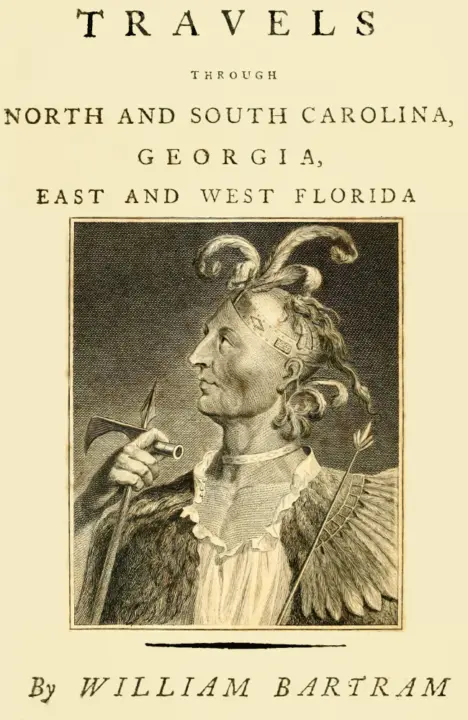
"Travels Through North and South Carolina, Georgia, East and West Florida, the Cherokee Country..." by William Bartram is a naturalist's account published in 1791. The work chronicles Bartram's four-year journey through the American South between 1773 and 1777, documenting encounters with Creek, Seminole, Cherokee, and Choctaw peoples, discoveries of plant species, and observations of unexplored territories. His sympathetic portrayal of Native Americans challenged prevailing assumptions, while his vivid descriptions influenced Romantic poets including Coleridge and Wordsworth. The book stands as both scientific documentation and literary achievement.
Introduction adapted from the source catalogue; source summaries may be automatically generated.
Free to read · English · 153,055 words · No account needed
MAKE TIME FOR A GOOD BOOK
On by default. Untick to stop anonymous reading totals. Each page counts after 10 seconds in view. How this works.
Anonymous counting is on unless you have switched it off.
The vessel, in which I was to embark for East Florida, being now ready to pursue her voyage, we sat sail with a fair wind and tide. Our course was south, through the sound, betwixt a chain of sea-coast-islands, and the main. In the evening we came to, at the south end of St. Simons, having been hindred by the flood tide making against us. The Captain and myself, with one of our crew, went on shore, with a view of getting some venison and sea fowl. We had not the good fortune to see any deer, yet we were not altogether unsuccessful, having taken three young racoons (Ursus cauda elongata) which are excellent meat: we had them for supper, served up in a pillo. Next morning early, we again got under way, running by Jekyl and Cumberland Islands, large, beautiful, and fertile, yet thinly inhabited, and consequently excellent haunts for deer, bears, and other game.
As we ran by Cumberland Isle, keeping the channel through the sound, we saw a sail a head coming up towards us. Our Captain knew it to be the trading schooner from the stores on St. John’s, and immediately predicted bad news, as she was not to sail until our arrival there. As she approached us, his apprehensions were more and more confirmed, from the appearance of a number of passengers on deck. We laid to, until she came up, when we hailed her, “What news?” “Bad; the Indians have plundered the upper store, and the traders have escaped, only with their lives.” Upon this both vessels came to anchor very near each other, when, learning the particulars, it appeared, that a large party of Indians had surprised and plundered two trading houses, in the istmus, beyond the river St. John’s, and a third being timely apprised of their hostile intentions, by a faithful runner, had time to carry off part of the effects, which they secreted in a swamp at some distance from it, covering them with skins. The upper store had saved their goods in like manner, and the lower store, to which we were bound, had removed the chief of theirs, and deposited them on a small island, in the river, about five miles below the store. With these effects was my chest, which I had forwarded in this vessel, from Savanna, not being at that time determined whether to make this journey by land or water. The Captain of our vessel resolved to put about and return to Frederica, for fresh instructions how to proceed; but for my part, I was determined to proceed for the island up St. John’s, where my chest was lodged, there being some valuable books and papers in it, which I could not do well without. I accordingly desired our Captain to put me on shore, on Little St. Simon’s, which was not far distant, intending to walk a few miles to a fort, at the south end of that island, where some fishermen resided, who, as I expected, would set me over on Amelia Island, where was a large plantation, the property of Lord Egmont, a British nobleman, whose agent, while I was at Frederica, gave me an invitation to call on him, as I passed toward East Florida; and here I had expectations of getting a boat to carry me to St. John’s. Agreeably to my desire, the captain put me on shore, with a young man, a passenger, for East Florida, who promised to continue with me, and share my adventures. We landed safely; the captain wishing us a prosperous journey, returned on board his vessel, and we proceeded for the fort, encountering some harsh treatment from thorny thickets, and prickly vines. However we reached the fort in the evening. The commander was out in the forest, hunting. My companion being tired, or indolent, betook himself to rest, while I made a tour round the south point of the island, walking the shelly paved sea beach, and picking up novelties. I had not gone above a mile, before I came up to a roebuck, lying slain on the sands; and hearing the report of a gun, not far off, and supposing it to be from the captain of the fort, whom I expected soon to return to take up his game, I retired to a little distance, mounted the sand hills, and sat down, enjoying a fine prospect of the rolling billows and foaming breakers, beating on the bar, and north promontory of Amelia Isle, opposite to me. The captain of the fort soon came up, with a slain buck on his shoulders. We hailed each other, and returned together to the fort, where we were well treated, and next morning, at my request, the captain obligingly sat us over, landing us safely on Amelia. After walking through a spacious forest of Live Oaks and Palms, and crossing a creek, that ran through a narrow salt marsh, I and my fellow traveller arrived safe at the plantation, where the agent, Mr. Egan, received us very politely and hospitably. This gentleman is a very intelligent and able planter, having already greatly improved the estate, particularly in the cultivation of indigo. Great part of this island consists of excellent hommocky land, which is the soil this plant delights in, as well as cotton, corn, batatas, and almost every other esculent vegetable. Mr. Egan politely rode with me, over great part of the island. On Egmont estate, are several very large Indian tumuli, which are called Ogeeche mounts, so named from that nation of Indians, who took shelter here, after being driven from their native settlements on the main near Ogeeche river. Here they were constantly harrassed by the Carolinians and Creeks, and at length slain by their conquerors, and their bones entombed in these heaps of earth and shells. I observed here the ravages of the common grey caterpillar (Phalena periodica), so destructive to forest and fruit trees, in Pennsylvania, and through the northern states, by stripping them of their leaves, in the spring, while young and tender.
Your reading position is saved on this browser. Take it to another device with a library code. Reading pages adapt to text, rather than matching a printed edition.
BEHIND THE BOOK
This eBook is for the use of anyone anywhere in the United States and most other parts of the world at no cost and with almost no restrictions whatsoever. You may copy it, give it away or re-use it under the terms of the Project Gutenberg License included with this eBook or online at www.gutenberg.org. If you are not located in the United States, you will have to check the laws of the country where you are located before using this eBook. Read the source licence.
The original source file, including credits and licence, is retained by this library. Request an original-format copy at no charge. Please include the book title and Project Gutenberg identifier #63678.
KEEP YOUR CURIOSITY GOING
Wilfrid Scawen Blunt
Wilfrid Scawen Blunt

E. W. (Edgar Watson) Howe
Cécile Tormay

Moritz Busch
John L. Ransom