THE CLASSIC COLLECTION✦My diaries, being a personal narrative of events 1888-1914, Part 2 (1900-1914)CLASSIC FREE BOOKS
My diaries, being a personal narrative of events 1888-1914, Part 2 (1900-1914)
Wilfrid Scawen Blunt
THE CLASSIC COLLECTION · 1791
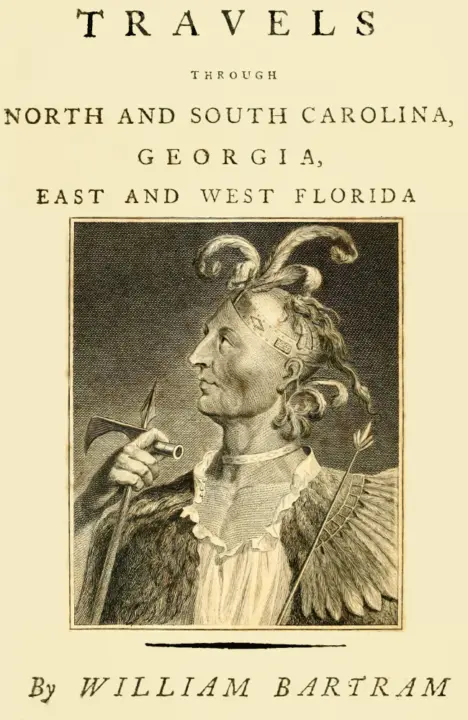
"Travels Through North and South Carolina, Georgia, East and West Florida, the Cherokee Country..." by William Bartram is a naturalist's account published in 1791. The work chronicles Bartram's four-year journey through the American South between 1773 and 1777, documenting encounters with Creek, Seminole, Cherokee, and Choctaw peoples, discoveries of plant species, and observations of unexplored territories. His sympathetic portrayal of Native Americans challenged prevailing assumptions, while his vivid descriptions influenced Romantic poets including Coleridge and Wordsworth. The book stands as both scientific documentation and literary achievement.
Introduction adapted from the source catalogue; source summaries may be automatically generated.
Free to read · English · 153,055 words · No account needed
MAKE TIME FOR A GOOD BOOK
On by default. Untick to stop anonymous reading totals. Each page counts after 10 seconds in view. How this works.
Anonymous counting is on unless you have switched it off.
The Muscogulge language is spoken throughout the confederacy (although consisting of many nations, who have a speech peculiar to themselves), as also by their friends and allies, the Natches. The Chicasaw and Chactaw, the Muscogulges say is a dialect of theirs.
This language is very agreeable to the ear, courteous, gentle and musical: the letter R is not sounded in one word of their language: the women in particular speak so fine and musical, as to represent the singing of birds; and when heard and not seen, one might imagine it to be the prattling of young children. The men’s speech is indeed more strong and sonorous, but not harsh, and in no instance guttural, and I believe the letter R is not used to express any word, in any language of the confederacy.
The Cherokee tongue, on the contrary, is very loud, somewhat rough and very sonorous, sounding the letter R frequently, yet very agreeable and pleasant to the ear. All the Indian languages are truly rhetorical, or figurative, assisting their speech by tropes; their hands, flexure of the head, the brow, in short, every member, naturally associate, and give their assistance to render their harrangues eloquent, persuasive and effectual.
The pyramidal hills or artificial mounts, and highways, or avenues, leading from them to artificial lakes or ponds, vast tetragon terraces, chunk yards,[64] and obelisks or pillars of wood, are the only monuments of labour, ingenuity and magnificence that I have seen worthy of notice, or remark. The region lying between Savanna river and Oakmulge, east and west, and from the sea coast to the Cherokee or Apalachian mountains, North and South, is the most remarkable for these high conical hills, tetragon terraces and chunk yards. This region was last possessed by the Cherokees, since the arrival of the Europeans, but they were afterwards dispossessed by the Muscogulges, and all that country was probably many ages preceding the Cherokee invasion, inhabited by one nation or confederacy, who were ruled by the same system of laws, customs and language, but so ancient that the Cherokees, Creeks, or the nation they conquered, could render no account for what purpose these monuments were raised. The mounts and cubical yards adjoining them, seem to have been raised in part for ornament and recreation, and likewise to serve some other public purpose, since they are always so situated as to command the most extensive prospect over the town and country adjacent. The tetragon terraces seem to be the foundation of a fortress, and perhaps the great pyramidal mounts, served the purpose of ook-out towers, and high places for sacrifice. The sunken area, called by white traders the chunk yard, very likely served the same conveniency that it has been appropriated to, by the more modern and even present nations of Indians, that is, the place where they burnt and otherwise tortured the unhappy captives that were condemned to die, as the area is surrounded by a bank, and sometimes two of them, one behind and above the other, as seats, to accommodate the spectators at such tragical scenes, as well as the exhibition of games, shows, and dances. From the river St. Juans, Southerly, to the point of the peninsula of Florida, are to be seen high pyramidal mounts with spacious and extensive avenues, leading from them out of the town, to an artificial lake or pond of water; these were evidently dignified in part, for ornament or monuments of magnificence, to perpetuate the power and grandeur of the nation, and not inconsiderable neither, for they exhibit scenes of power and grandeur, and must have been public edifices.
Your reading position is saved on this browser. Take it to another device with a library code. Reading pages adapt to text, rather than matching a printed edition.
BEHIND THE BOOK
This eBook is for the use of anyone anywhere in the United States and most other parts of the world at no cost and with almost no restrictions whatsoever. You may copy it, give it away or re-use it under the terms of the Project Gutenberg License included with this eBook or online at www.gutenberg.org. If you are not located in the United States, you will have to check the laws of the country where you are located before using this eBook. Read the source licence.
The original source file, including credits and licence, is retained by this library. Request an original-format copy at no charge. Please include the book title and Project Gutenberg identifier #63678.
KEEP YOUR CURIOSITY GOING
Wilfrid Scawen Blunt
Wilfrid Scawen Blunt

E. W. (Edgar Watson) Howe
Cécile Tormay

Moritz Busch
John L. Ransom