THE CLASSIC COLLECTION✦My diaries, being a personal narrative of events 1888-1914, Part 2 (1900-1914)CLASSIC FREE BOOKS
My diaries, being a personal narrative of events 1888-1914, Part 2 (1900-1914)
Wilfrid Scawen Blunt
THE CLASSIC COLLECTION · 1791
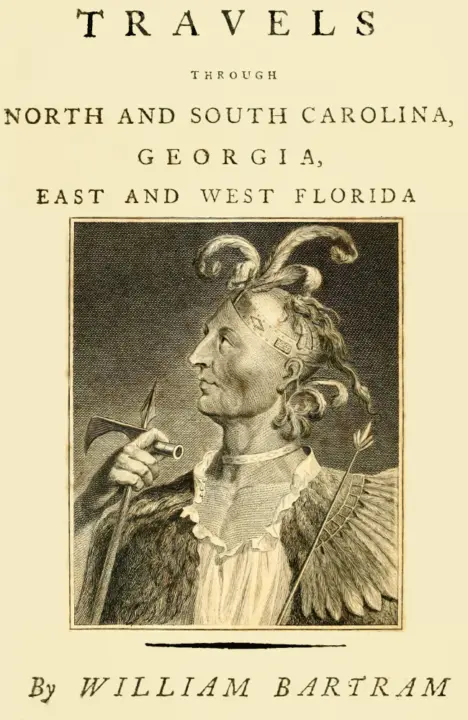
"Travels Through North and South Carolina, Georgia, East and West Florida, the Cherokee Country..." by William Bartram is a naturalist's account published in 1791. The work chronicles Bartram's four-year journey through the American South between 1773 and 1777, documenting encounters with Creek, Seminole, Cherokee, and Choctaw peoples, discoveries of plant species, and observations of unexplored territories. His sympathetic portrayal of Native Americans challenged prevailing assumptions, while his vivid descriptions influenced Romantic poets including Coleridge and Wordsworth. The book stands as both scientific documentation and literary achievement.
Introduction adapted from the source catalogue; source summaries may be automatically generated.
Free to read · English · 153,055 words · No account needed
MAKE TIME FOR A GOOD BOOK
On by default. Untick to stop anonymous reading totals. Each page counts after 10 seconds in view. How this works.
Anonymous counting is on unless you have switched it off.
Arriving in Carolina very early in the spring vegetation was not sufficiently advanced to invite me into the western parts of this state; from which circumstance, I concluded to make an excursion into Georgia; accordingly, I embarked on board a coasting vessel, and in twenty-four hours arrived in Savanna, the capital, where, acquainting the governor, Sir J. Wright, with my business, his excellency received me with great politeness, showed me every mark of esteem and regard, and furnished me with letters to the principal inhabitants of the state, which were of great service to me. Another circumstance very opportunely occurred on my arrival: the assembly was then sitting in Savanna, and several members lodging in the same house where I took up my quarters, I became acquainted with several worthy characters, who invited me to call at their seats occasionally, as I passed through the country; particularly the hon. B. Andrews, esq. a distinguished, patriotic and liberal character. This gentleman’s seat, and well cultivated plantations, are situated near the south high road, which I often travelled; and I seldom passed his house without calling to see him, for it was the seat of virtue, where hospitality, piety, and philosophy, formed the happy family; where the weary traveller and stranger found a hearty welcome, and from whence it must be his own fault, if he departed without being greatly benefited.
After resting, and a little recreation for a few days in Savanna, and having in the mean time purchased a good horse, and equipped myself for a journey southward, I sat off early in the morning for Sunbury, a sea-port town, beautifully situated on the main, between Medway and Newport rivers, about fifteen miles south of great Ogeeche river. The town and harbour are defended from the fury of the seas by the north and south points of St. Helena and South Catherine’s islands; between which is the bar and entrance into the sound: the harbour is capacious and safe, and has water enough for ships of great burthen. I arrived here in the evening, in company with a gentleman, one of the inhabitants, who politely introduced me to one of the principal families, where I supped and spent the evening in a circle of genteel and polite ladies and gentlemen. Next day, being desirous of visiting the islands, I forded a narrow shoal, part of the sound, and landed on one of them, which employed me the whole day to explore. The surface and vegetable mould here is generally a loose sand, not very fertile, except some spots bordering on the sound and inlets, where are found heaps or mounds of sea-shell, either formerly brought there, by the Indians, who inhabited the island, or which were perhaps thrown up in ridges, by the beating surface of the sea: possibly both these circumstances may have contributed to their formation. These sea-shells, through length of time, and the subtle penetrating effects of the air, which dissolve them to earth, render these ridges very fertile, and, when clear of their trees, and cultivated, they become profusely productive of almost every kind of vegetable. Here are also large plantations of indigo, corn, and potatoes,[5] with many other sorts of esculent plants. I observed, amongst the shells of the conical mounds, fragments of earthen vessels, and of other utensils, the manufacture of the ancients: about the centre of one of them, the rim of an earthen pot appeared amongst the shells and earth, which I carefully removed, and drew it out, almost whole: this pot was curiously wrought all over the outside, representing basket work, and was undoubtedly esteemed a very ingenious performance, by the people, at the age of its construction. The natural produce of these testaceous ridges, besides many of less note, are, the great Laurel Tree, (Magnolia grandiflora) Pinus tæda, Laurus Borbonia, Quercus sempervirens, or Live Oak, Prunus, Lauro-cerasus, Ilex aquifolium, Corypha palma, Juniperus Americana. The general surface of the island being low, and generally level, produces a very great variety of trees, shrubs and herbaceous plants; particularly the great long-leaved Pitch-Pine, or Broom-Pine, Pinus palustris, Pinus squamosa, Pinus lutea, Gordonia Lasianthus, Liquid Ambar (Styraciflua) Acer rubrum, Fraxinus excelcior; Fraxinus aquatica, Quercus aquatica, Quercus phillos, Quercus dentata, Quercus humila varietas, Vaccinium varietas, Andromeda varietas, Prinos varietas, Ilex varietas, Viburnum prunifolium, V. dentatum, Cornus florida, C. alba, C. sanguinea, Carpinus betula, C. ostrya, Itea Clethra alnifolia, Halesia tetraptera, H. diptera, Iva, Rhamnus frangula, Callicarpa, Morus rubra, Sapindus, Cassine, and of such as grow near water-courses, round about ponds and savannas, Fothergilla gardini, Myrica cerifera, Olea Americana, Cyrilla racemiflora, Magnolia glauca, Magnolia pyramidata, Cercis, Kalmia angustifolia, Kalmia ciliata, Chionanthus, Cephalanthos, Æsculus parva, and the intermediate spaces, surrounding and lying between the ridges and savannas, are intersected with plains of the dwarf prickly fan-leaved Palmetto, and lawns of grass variegated with stately trees of the great Broom-Pine, and the spreading ever-green Water-Oak, either disposed in clumps, or scatteringly planted by nature. The upper surface, or vegetative soil of the island, lies on a foundation, or stratum, of tenacious cinereous-coloured clay, which perhaps is the principal support of the vast growth of timber that arises from the surface, which is little more than a mixture of fine white sand and dissolved vegetables, serving as a nursery bed to hatch, or bring into existence, the infant plant, and to supply it with aliment and food, suitable to its delicacy and tender frame, until the roots, acquiring sufficient extent and solidity to lay hold of the clay, soon attain a magnitude and stability sufficient to maintain its station. Probably if this clay were dug out, and cast upon the surface, after being meliorated by the saline or nitrous qualities of the air, it would kindly incorporate with the loose sand, and become a productive and lasting manure.
Your reading position is saved on this browser. Take it to another device with a library code. Reading pages adapt to text, rather than matching a printed edition.
BEHIND THE BOOK
This eBook is for the use of anyone anywhere in the United States and most other parts of the world at no cost and with almost no restrictions whatsoever. You may copy it, give it away or re-use it under the terms of the Project Gutenberg License included with this eBook or online at www.gutenberg.org. If you are not located in the United States, you will have to check the laws of the country where you are located before using this eBook. Read the source licence.
The original source file, including credits and licence, is retained by this library. Request an original-format copy at no charge. Please include the book title and Project Gutenberg identifier #63678.
KEEP YOUR CURIOSITY GOING
Wilfrid Scawen Blunt
Wilfrid Scawen Blunt

E. W. (Edgar Watson) Howe
Cécile Tormay

Moritz Busch
John L. Ransom