THE CLASSIC COLLECTION✦My diaries, being a personal narrative of events 1888-1914, Part 2 (1900-1914)CLASSIC FREE BOOKS
My diaries, being a personal narrative of events 1888-1914, Part 2 (1900-1914)
Wilfrid Scawen Blunt
THE CLASSIC COLLECTION · 1791
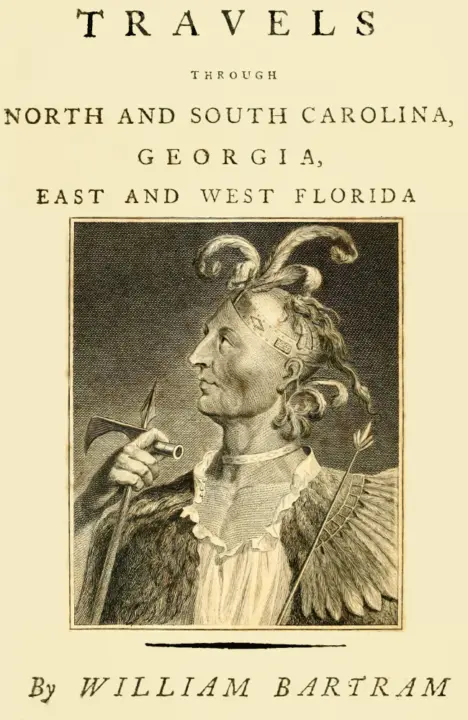
"Travels Through North and South Carolina, Georgia, East and West Florida, the Cherokee Country..." by William Bartram is a naturalist's account published in 1791. The work chronicles Bartram's four-year journey through the American South between 1773 and 1777, documenting encounters with Creek, Seminole, Cherokee, and Choctaw peoples, discoveries of plant species, and observations of unexplored territories. His sympathetic portrayal of Native Americans challenged prevailing assumptions, while his vivid descriptions influenced Romantic poets including Coleridge and Wordsworth. The book stands as both scientific documentation and literary achievement.
Introduction adapted from the source catalogue; source summaries may be automatically generated.
Free to read · English · 153,055 words · No account needed
MAKE TIME FOR A GOOD BOOK
On by default. Untick to stop anonymous reading totals. Each page counts after 10 seconds in view. How this works.
Anonymous counting is on unless you have switched it off.
When I approached the house, the good man, who was reclining on a bear-skin, spread under the shade of a Live Oak, smoking his pipe, rose and saluted me: “Welcome, stranger, I am indulging the rational dictates of nature, taking a little rest, having just come in from the chace and fishing.” After some conversation and rest, his servant brought a bowl of honey and water, a very refreshing and agreeable liquor, of which I drank. On rising to take my departure, he objected, and requested me to stay and dine with him; and on my pleading, for excuse, the necessity of my being at Frederica, “Yet, I pray you, stay a little, I will soon have some refreshment for you.” Presently was laid before us a plentiful repast of venison, &c. our drink being honey and water, strengthened by the addition of brandy. Our rural table was spread under the shadow of Oaks, Palms, and Sweet Bays, fanned by the lively salubrious breezes wafted from the spicy groves. Our music was the responsive love-lays of the painted nonpareil, and the alert and gay mock-bird; whilst the brilliant humming-bird darted through the flowery groves, suspended in air, and drank nectar from the flowers of the yellow Jasmine, Lonicera, Andromeda, and sweet Azalea.
But yet, how awfully great and sublime is the majestic scene eastward! the solemn sound of the beating surf strikes our ears; the dashing of yon liquid mountains, like mighty giants, in vain assail the skies; they are beaten back, and fall prostrate upon the shores of the trembling island.
Taking leave of my sylvan friend, I sat off on my return to the town, where I arrived before night, having observed, on the way, many curious vegetable productions, particularly Corypha Palma (or great Cabbage Palm) Corypha pumila, Corypha repens, frondibus expansis, flabelliformibus, plicatis, stipit. spinosis (Dwarf Saw Palmetto) Corypha) obliqua, caudice arboreo ascendente, frondibus expansis, flabelliformibus, plicatis, stipit. serratis, Cyrilla, Tillandsia monostachya, Till. lingulata, or Wild Pine; both these curious vegetables are parasites, living on the substance of others, particularly on the limbs of the Live Oak; the latter species is a very large flourishing plant, greatly resembling, at some distance, a well grown plant of the Bromelia Ananas: the large deep green leaves are placed in a imbricated order, and ascendant; but their extremities are reflex, their bases gibbous and hollowed, like a ladle, and capable of containing near a pint of water: heavy tempests of wind and rain tear these plants from the trees; yet they live and flourish on the earth, under the shadow of these great Live Oaks. A very large part of this island had formerly been cleared and planted by the English, as appeared evidently to me, by vestiges of plantations, ruins of costly buildings, highways, &c. but it is now overgrown with forests. Frederica was the first town built by the English in Georgia, and was founded by general Oglethorp, who began and established the colony. The fortress was regular and beautiful, constructed chiefly with brick, and was the largest, most regular, and perhaps most costly, of any in North America, of British construction: it is now in ruins, yet occupied by a small garrison; the ruins also of the town only remain; peach trees, figs, pomegranates, and other shrubs, grow out of the ruinous walls of former spacious and expensive buildings, not only in the town, but at a distance in various parts of the island; yet there are a few neat houses in good repair, and inhabited: it seems now recovering again, owing to the public and liberal spirit and exertions of J. Spalding, esq. who is president of the island, and engaged in very extensive mercantile concerns.
Your reading position is saved on this browser. Take it to another device with a library code. Reading pages adapt to text, rather than matching a printed edition.
BEHIND THE BOOK
This eBook is for the use of anyone anywhere in the United States and most other parts of the world at no cost and with almost no restrictions whatsoever. You may copy it, give it away or re-use it under the terms of the Project Gutenberg License included with this eBook or online at www.gutenberg.org. If you are not located in the United States, you will have to check the laws of the country where you are located before using this eBook. Read the source licence.
The original source file, including credits and licence, is retained by this library. Request an original-format copy at no charge. Please include the book title and Project Gutenberg identifier #63678.
KEEP YOUR CURIOSITY GOING
Wilfrid Scawen Blunt
Wilfrid Scawen Blunt

E. W. (Edgar Watson) Howe
Cécile Tormay

Moritz Busch
John L. Ransom