THE CLASSIC COLLECTION✦My diaries, being a personal narrative of events 1888-1914, Part 2 (1900-1914)CLASSIC FREE BOOKS
My diaries, being a personal narrative of events 1888-1914, Part 2 (1900-1914)
Wilfrid Scawen Blunt
THE CLASSIC COLLECTION · 1791
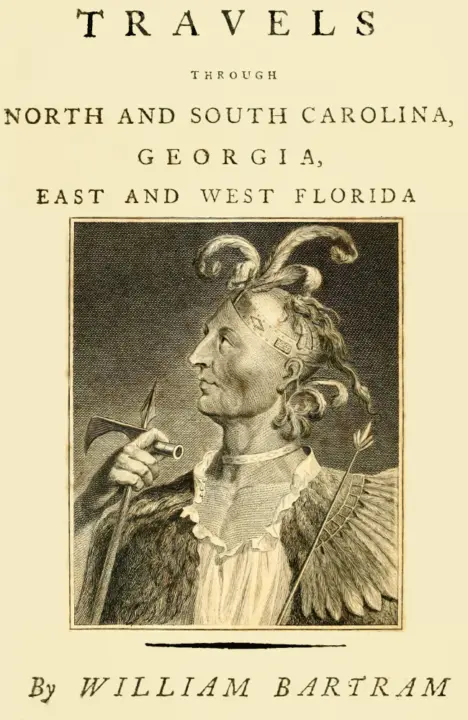
"Travels Through North and South Carolina, Georgia, East and West Florida, the Cherokee Country..." by William Bartram is a naturalist's account published in 1791. The work chronicles Bartram's four-year journey through the American South between 1773 and 1777, documenting encounters with Creek, Seminole, Cherokee, and Choctaw peoples, discoveries of plant species, and observations of unexplored territories. His sympathetic portrayal of Native Americans challenged prevailing assumptions, while his vivid descriptions influenced Romantic poets including Coleridge and Wordsworth. The book stands as both scientific documentation and literary achievement.
Introduction adapted from the source catalogue; source summaries may be automatically generated.
Free to read · English · 153,055 words · No account needed
MAKE TIME FOR A GOOD BOOK
On by default. Untick to stop anonymous reading totals. Each page counts after 10 seconds in view. How this works.
Anonymous counting is on unless you have switched it off.
Being now in readiness to prosecute our voyage to St. John’s, we sat sail in a handsome pleasure-boat, manned with four stout negro slaves, to row in case of necessity. After passing Amelia Narrows we had a pleasant run, across Fort George’s sound, where, observing the pelicans fishing, Mr. Egan shot one of them, which we took into the boat. I was greatly surprised on observing the pouch or sack, which hangs under the bill: it is capable of being expanded to a prodigious size. One of the people on board, said, that he had seen more than half a bushel of bran crammed into one of their pouches. The body is larger than that of a tame goose, the legs extremely short, the feet webbed, the bill of a great length, bent inwards like a scythe, the wings extend near seven feet from tip to tip, the tail is very short, the head, neck, and breast, nearly white, the body of a light bluish grey, except the quill feathers of the wings, which are black. They seem to be of the gull kind, both in form and structure, as well as manner of fishing. The evening following, we landed on the main. It was a promontory of high land, covered with orange-trees, and projecting into the sound, forming a convenient port. We pitched our tent under the shelter of a forest of Live Oaks, Palms and Sweet Bays; and having in the course of the day, procured plenty of sea fowl, such as curlews, willets, snipes, sand birds and others, we had them dressed for supper, and seasoned with excellent oysters, which lay in heaps in the water, close to our landing place. The shrub Capsicum growing here in abundance, afforded us a very good pepper: we drank of a well of fresh water just at hand, amidst a grove of Myrtles (Myrica carefera.) Our repose however was incomplete, from the stings of musquitoes, the roaring of crocodiles, and the continual noise and restlessness of the sea fowl, thousands of them having their roosting places very near us, particularly loons of various species, herons, pelicans, Spanish curlews, &c. all promiscuously lodging together, and in such incredible numbers, that the trees were entirely covered. They roost in inaccessible islets in the salt marshes, surrounded by lagoons, and shallow water. Just without the trees, betwixt them, the water and marshes, is a barricade of Palmetto royal (Yucca gloriosa) or Adam’s needle, which grows so thick together, that a rat or bird can scarcely pass through them; and the stiff leaves of this Sword plant, standing nearly horizontally, are as impenetrable to man, or any other animal, as if they were a regiment of grenadiers with their bayonets pointed at you. The Palmetto royal is, however, a very singular and beautiful production. It may be termed a tree, from its durability and magnitude, as likewise from the ligneous quality of its stem, or trunk, when old; yet from its form and texture, I should be inclined to rank it amongst the herbaceous plants, for even the glorious Palm, although it rises to the altitude of a tree, and even transcends most of them, yet it bears the characters of the herbaceous ones: and this, like the Palm tree, rises with a straight, erect stem, about ten or twelve feet high, crowned with a beautiful chaplet of sword or dagger-like leaves, of a perfect green colour, each terminated with a stiff, sharp spur, and their edges finely crenated. This thorny crown is crested with a pyramid of silver white flowers, each resembling a tulip or lily. These flowers are succeeded by a large fruit, nearly of the form and size of a slender cucumber, which, when ripe, is of a deep purple colour, the skin smooth and shining, its pulp soft, very juicy, and of an agreeable aromatic flavour but rather bitter to the taste; it is, however, frequently eaten, but if eaten to excess, proves violently purgative. The seeds are numerous, flat and lunated.
Your reading position is saved on this browser. Take it to another device with a library code. Reading pages adapt to text, rather than matching a printed edition.
BEHIND THE BOOK
This eBook is for the use of anyone anywhere in the United States and most other parts of the world at no cost and with almost no restrictions whatsoever. You may copy it, give it away or re-use it under the terms of the Project Gutenberg License included with this eBook or online at www.gutenberg.org. If you are not located in the United States, you will have to check the laws of the country where you are located before using this eBook. Read the source licence.
The original source file, including credits and licence, is retained by this library. Request an original-format copy at no charge. Please include the book title and Project Gutenberg identifier #63678.
KEEP YOUR CURIOSITY GOING
Wilfrid Scawen Blunt
Wilfrid Scawen Blunt

E. W. (Edgar Watson) Howe
Cécile Tormay

Moritz Busch
John L. Ransom