THE CLASSIC COLLECTION✦My diaries, being a personal narrative of events 1888-1914, Part 2 (1900-1914)CLASSIC FREE BOOKS
My diaries, being a personal narrative of events 1888-1914, Part 2 (1900-1914)
Wilfrid Scawen Blunt
THE CLASSIC COLLECTION · 1791
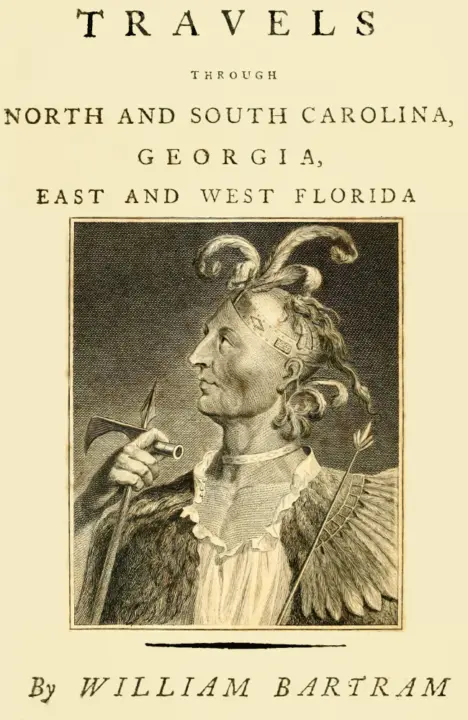
"Travels Through North and South Carolina, Georgia, East and West Florida, the Cherokee Country..." by William Bartram is a naturalist's account published in 1791. The work chronicles Bartram's four-year journey through the American South between 1773 and 1777, documenting encounters with Creek, Seminole, Cherokee, and Choctaw peoples, discoveries of plant species, and observations of unexplored territories. His sympathetic portrayal of Native Americans challenged prevailing assumptions, while his vivid descriptions influenced Romantic poets including Coleridge and Wordsworth. The book stands as both scientific documentation and literary achievement.
Introduction adapted from the source catalogue; source summaries may be automatically generated.
Free to read · English · 153,055 words · No account needed
MAKE TIME FOR A GOOD BOOK
On by default. Untick to stop anonymous reading totals. Each page counts after 10 seconds in view. How this works.
Anonymous counting is on unless you have switched it off.
The North West of Cape Fear, here at Ashwood, is near three hundred yards over (when the stream is low and within its banks), and is eighty or ninety miles above the capes. Observed growing hereabouts a great variety of very curious and beautiful flowering and sweet scented shrubs, particularly Callicarpa, Æsculus pavia, floribus coccineis, caule suffructicoso, Æsculus sylvatica, floribus ex albo et carneo eleganter variegatis, caule arboreo, Ptelea trifoliata, Styrax, Stewartia, Fothergilla, Amorpha, Myrica, Stillingia fructicosa, foliis lanciolatis, utrinque glabris, fructu tricocco, Olea Americana, foliis lanceolato-ellipticis, baccis atro-purpureis (Purple berried bay), Catesby. Ilex dahoon, Cassine Yapon, Azalea, varieties, Kalmia, Cyrilla, Liquidambar peregrinum, Sideroxylon, Andromeda lucida, &c.
Leaving Ashwood, and continuing up the west side of the river, about forty miles, in the banks of a creek, five or six feet below the sandy surface, are to be seen projecting out many feet in length, trunks of trees petrified to very hard stone; they lie between the upper sandy stratum and the common bed of blackish vitriolic earth; and these stone trees are to be seen in the same situation, sticking out of the perpendicular banks or bluffs of the river in this region: there are several trunks of large trees with their bark, stumps of their limbs and roots, lying petrified on the sand hills and Pine forests, near the road about this creek, not far from the saw-mills.
Crossed Rock-fish, a large branch of the North West, near its mouth or confluence, and at evening arrived at Cross-Creeks, another very considerable branch of the river, flowing in through its west banks. This creek gave name to a fine inland trading town, on some heights or swelling hills, from whence the creek descends precipitately, then gently meanders near a mile, through lower level lands, to its confluence with the river, affording most convenient mill-seats: these prospects induced active enterprising men to avail themselves of such advantages pointed out to them by nature; they built mills, which drew people to the place, and these observing eligible situations for other profitable improvements, bought lots and erected tenements, where they exercised mechanic arts, as smiths, wheelwrights, carpenters, coopers, tanners, &c. And at length merchants were encouraged to adventure and settle: in short, within eight or ten years from a grist-mill, saw-mill, smith-shop and a tavern, arose a flourishing commercial town, the seat of government of the county of Cumberland. The leading men of the county, seeing plainly the superior advantages of this situation, on the banks of a famous navigable river, petitioned the Assembly for a charter to empower them to purchase a district, sufficient for founding a large town, which being granted, they immediately proceeded to mark out its precincts, and named the new city Cambelton, a compliment to —— Cambel, Esq. a gentleman of merit, and a citizen of the county. When I was here about twenty years ago, this town was marking out its bounds, and there were then about twenty habitations, and now there are above a thousand houses, many wealthy merchants, and respectable public buildings, a vast resort of inhabitants and travellers, and continual brisk commerce by waggons, from the back settlements, with large trading boats, to and from Wilmington, the seaport and flourishing trading town on the Clarendon, about forty miles above the capes, which is about one hundred miles below this town. The Clarendon or Cape Fear river has its source in the Cherokee mountains, where its numerous confederate streams unite, after leaving the first ridges of the mountains, it assumes the name of Haw river, and coursing the hilly fertile country, above one hundred and fifty miles, receives through its west banks the west branch, called Deep River, and after this union, takes the name of the North-West of Cape Fear, from whence, down to Cambelton, about eighty miles it is navigable for perriauguas of considerable burthen.
Your reading position is saved on this browser. Take it to another device with a library code. Reading pages adapt to text, rather than matching a printed edition.
BEHIND THE BOOK
This eBook is for the use of anyone anywhere in the United States and most other parts of the world at no cost and with almost no restrictions whatsoever. You may copy it, give it away or re-use it under the terms of the Project Gutenberg License included with this eBook or online at www.gutenberg.org. If you are not located in the United States, you will have to check the laws of the country where you are located before using this eBook. Read the source licence.
The original source file, including credits and licence, is retained by this library. Request an original-format copy at no charge. Please include the book title and Project Gutenberg identifier #63678.
KEEP YOUR CURIOSITY GOING
Wilfrid Scawen Blunt
Wilfrid Scawen Blunt

E. W. (Edgar Watson) Howe
Cécile Tormay

Moritz Busch
John L. Ransom