THE CLASSIC COLLECTION✦My diaries, being a personal narrative of events 1888-1914, Part 2 (1900-1914)CLASSIC FREE BOOKS
My diaries, being a personal narrative of events 1888-1914, Part 2 (1900-1914)
Wilfrid Scawen Blunt
THE CLASSIC COLLECTION · 1791
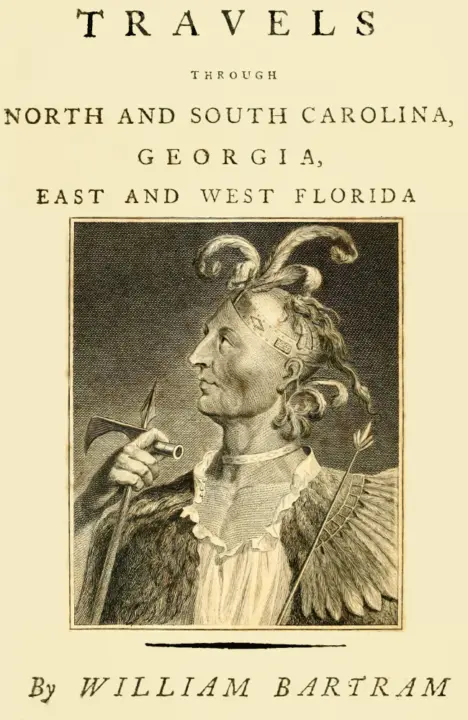
"Travels Through North and South Carolina, Georgia, East and West Florida, the Cherokee Country..." by William Bartram is a naturalist's account published in 1791. The work chronicles Bartram's four-year journey through the American South between 1773 and 1777, documenting encounters with Creek, Seminole, Cherokee, and Choctaw peoples, discoveries of plant species, and observations of unexplored territories. His sympathetic portrayal of Native Americans challenged prevailing assumptions, while his vivid descriptions influenced Romantic poets including Coleridge and Wordsworth. The book stands as both scientific documentation and literary achievement.
Introduction adapted from the source catalogue; source summaries may be automatically generated.
Free to read · English · 153,055 words · No account needed
MAKE TIME FOR A GOOD BOOK
On by default. Untick to stop anonymous reading totals. Each page counts after 10 seconds in view. How this works.
Anonymous counting is on unless you have switched it off.
This wonderful plant seems to be distinguished in the creation, by the Author of nature, with faculties eminently superior to every other vegetable production[59]; specimens of it were first communicated to the curious of the old world by John Bartram, the American botanist and traveller, who contributed as much if not more than any other man towards enriching the North American botanical nomenclature, as well as its natural history.
After traversing these ample savannas, I gradually ascended sand hills to open Pine forests; at evening got to Old town near Brunswick, where I lodged. Brunswick is a sea-port town on the Clarendon, or Cape Fear river, about thirty miles above the capes; it is about thirty years since this was the seat of government, when Arthur Dobbs, Esq. was governor and commander in chief of the province of North Carolina. Continued up the west side of North West of Cape Fear river, and rested two or three days at the seat of F. Lucas, Esq. a few miles above Livingston’s creek, a considerable branch of the North West. This creek heads in vast swamps, in the vicinity of the beautiful lake Wakamaw, which is the source of a fine river of that name, and runs a South course seventy or eighty miles, delivering its waters into Winyaw bay at George-town. The Wakamaw lake is twenty-six miles in circuit; the lands on its Eastern shores are fertile, and the situation delightful, gradually ascending from pleasing eminences; bounded on the North-West coast by vast rich swamps, fit for the production of Rice: the lake is twelve miles west from —— Moore’s, Esq. whose villa is on the banks of the North West.
Proceeding again up the North West, crossed Carver’s creek, and stopped at Ashwood, the ancient seat of Colonel William Bartram. The house stands on the high banks of the river, near seventy feet in height, above the surface of the water; this high bluff continues two or three miles on the river, and commands a magnificent prospect of the low lands opposite, when in their native state, presenting to the view grand forests and expansive Cane meadows: the trees which compose these forests are generally of the following tribes, Quercus tinctoria, Querc. alba, Querc. phillos, Querc. aquatica, Querc. hemispherica, Fraxinus excelsior, Platanus occidentalis, Liriodendron tulipifera, Liquidambar styraciflua, Ulmus, Telea, Juglans hickory, Juglans cinerea, Juglans nigra, Morus rubra, Gleditsia triacanthus, Hopea tinctoria, Nyssa aquatica, Nyssa sylvatica, Carpinus and many more; the Cupressus disticha as stately and beautiful as I have seen any where. When these lands are cleared of their timber and cultivated, they produce abundantly, particularly, Wheat, Zea, Cotton, Hemp, Flax, with variety of excellent vegetables. This perpendicular bank of the river, by which the waters swiftly glide along, discovers at once the various strata of the earth of this low maritime country. For the most part the upper stratum consists of a light, sandy, pale, yellowish mould or loam, for ten or twelve feet in depth (except the flat level land back from the rivers, where the clays or marle approach very near the surface, and the ridges of sand hills, where the clays lie much deeper): this sandy mould or loam lies upon a deep bed of black, or dark slate coloured saline and sulphureous earth, which is composed of horizontal thin flakes or laminæ, separable by means of very thin, almost imperceptible veins or strata of fine micaceous particles, which drain or percolate a clear water, continually exuding, or trickling down, and forming little rills and diminutive cataracts, being conducted by perpendicular chinks or fissures: in some places, a portion of this clear water or transparent vapour, seems to coagulate on the edges of the veins and fissures, leaving a reddish curd or jelly-like substance sticking to them, which I should suppose indicates it to spring from a ferruginous source, especially since it discovers a chalybeate scent and taste: in other places these fissures show evidently a crystallization of exceeding fine white salts, which have an alluminous or vitriolic scent: there are pyrites, marcasites, or sulphureous nodules, shining like brass, of various sizes and forms, some single and others conglomerated: other places present to view, strata of heterogenous matter, lying between the upper loamy stratum and the bed of black saline earth, consisting of various kinds of sea shells, some whole, others broken to pieces, and even pulverized, which fill up the cavities of the entire shells, and the interstices betwixt them: at other places we observe, two or three feet below the surface or virgin mould, a stratum of four, five or six feet in depth, of brownish marle, on a bed of testaceous rocks; a petrefaction composed apparently of various kinds of sea shells, belemnites, sand, &c. combined or united with a calcareous cement: these masses of rocks are in some places detached by veins and strata of a heterogenous earth, consisting of sea shells and other marine productions, as well as terrestrial, which seem to be fossile or in some degree of petrifaction, or otherwise transmuted, particularly those curious productions called birds bills or sharks teeth (dentes carchariæ) belemnites, &c. loosely mixed with a desiccated earth composed of sand, clay, particles of marle, vegetable rubbish, &c. And again we observe shells, marcasites, belemnites, dentes carchariæ, with pieces of wood transmuted, black and hard as sea coal, singly interspersed in the black vitriolic strata of earth: when this black earth is exposed to the sun and dry air, the little thin laminæ separate, and soon discover a fine, white crystallization, or alluminous powder; but this very soon disappears, being again incorporated with the general mass, which gradually dissolves or falls like quick-lime, and appears then a greyish, extremely fine, dry micaceous powder, which smells like gun-powder.
Your reading position is saved on this browser. Take it to another device with a library code. Reading pages adapt to text, rather than matching a printed edition.
BEHIND THE BOOK
This eBook is for the use of anyone anywhere in the United States and most other parts of the world at no cost and with almost no restrictions whatsoever. You may copy it, give it away or re-use it under the terms of the Project Gutenberg License included with this eBook or online at www.gutenberg.org. If you are not located in the United States, you will have to check the laws of the country where you are located before using this eBook. Read the source licence.
The original source file, including credits and licence, is retained by this library. Request an original-format copy at no charge. Please include the book title and Project Gutenberg identifier #63678.
KEEP YOUR CURIOSITY GOING
Wilfrid Scawen Blunt
Wilfrid Scawen Blunt

E. W. (Edgar Watson) Howe
Cécile Tormay

Moritz Busch
John L. Ransom