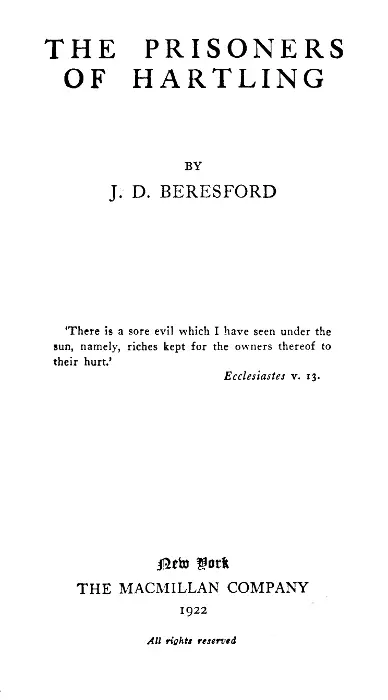
The Prisoners of Hartling
J. D. (John Davys) Beresford
THE CLASSIC COLLECTION · 1917
"The Wonder" by J. D. Beresford is a novel written in the early 20th century. The story explores themes of intelligence, abnormality, and the societal perceptions surrounding them, primarily through the lens of a remarkable child named Victor Stott. The narrative follows Ginger Stott, an ambitious cricketer whose life takes unexpected turns due to the extraordinary nature of his son. The opening of the book introduces us to a scene on a train where an unnamed narrator observes a woman with an unusual infant. The child's appearance captivates the attention of other passengers, leading to a mix of fascination and repulsion. As the narrator grapples with his own disdain for what he perceives as a “freak,” we learn that the child has not spoken or cried in his one year of life. The conversation touches on the mother’s protective behavior and the reactions of those around her, establishing the tension between normalcy and the extraordinary. This encounter hints at the complexity of Victor Stott's character and sets the stage for the exploration of his unique childhood and the challenges faced by his family.
Introduction adapted from the source catalogue; source summaries may be automatically generated.
Free to read · English · 60,640 words · No account needed
MAKE TIME FOR A GOOD BOOK
On by default. Untick to stop anonymous reading totals. Each page counts after 10 seconds in view. How this works.
Anonymous counting is on unless you have switched it off.
The boy took no notice of the question.
Challis was piqued. If this extraordinary child really had an intelligence, surely it must be possible to appeal to that intelligence in some way. He made another effort, addressing Mrs. Stott.
"I think we must forgive Mr. Crashaw, you know, Mrs. Stott. As I understand it, your boy at the age of four years and a half has defied--his cloth, if I may say so." He paused, and as he received no answer, continued: "But I hope that matter may be easily arranged."
"Thank you, sir," said Mrs. Stott. "It's very kind of you. I'm sure, I'm greatly obliged to you, sir."
"That's only one reason of my visit to you, however," Challis hesitated. "I've been wondering whether I might not be able to help you and your son in some other way. I understand that he has unusual power of--of intelligence."
"Indeed 'e 'as, sir," responded Mrs. Stott.
"And he can read, can't he?"
"I've learned 'im what I could, sir: it isn't much."
"Well, perhaps I could lend him a few books."
Challis made a significant pause, and again he looked at the boy; but as there was no response, he continued: "Tell me what he has read."
"We've no books, sir, and we never 'ardly see a paper now. All we 'ave in the 'ouse is a Bible and two copies of Lillywhite's cricket annual as my 'usband left be'ind."
Challis smiled. "Has he read those?" he asked.
"The Bible 'e 'as, I believe," replied Mrs. Stott.
It was a conversation curious in its impersonality. Challis was conscious of the anomaly that he was speaking in the boy's presence, crediting him with a remarkable intelligence, and yet addressing a frankly ignorant woman as though the boy was not in the room. Yet how could he break that deliberate silence? It seemed to him as though there must, after all, be some mistake; yet how account for Crashaw's story if the boy were indeed an idiot?
With a slight show of temper he turned to the Wonder.
"Do you want to read?" he asked. "I have between forty and fifty thousand books in my library. I think it possible that you might find one or two which would interest you."
The Wonder lifted his hand as though to ask for silence. For a minute, perhaps, no one spoke. All waited, expectant; Challis and Lewes with intent eyes fixed on the detached expression of the child's face, Ellen Mary with bent head. It was a strange, yet very logical question that came at last:
Your reading position is saved on this browser. Take it to another device with a library code. Reading pages adapt to text, rather than matching a printed edition.
J. D. (John Davys) Beresford
BEHIND THE BOOK
This eBook is for the use of anyone anywhere in the United States and most other parts of the world at no cost and with almost no restrictions whatsoever. You may copy it, give it away or re-use it under the terms of the Project Gutenberg License included with this eBook or online at www.gutenberg.org. If you are not located in the United States, you will have to check the laws of the country where you are located before using this eBook. Read the source licence.
The original source file, including credits and licence, is retained by this library. Request an original-format copy at no charge. Please include the book title and Project Gutenberg identifier #27188.
KEEP YOUR CURIOSITY GOING
Coulson Kernahan

Maurice Baring
Frances Wright
Cécile Tormay

Frederic Jesup Stimson

W. H. P. (William Henry Pope) Jarvis