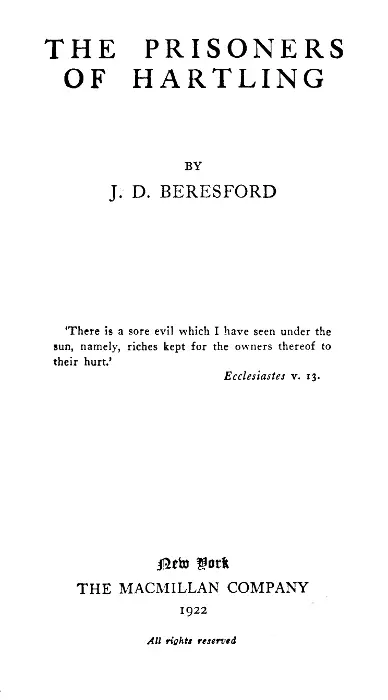
The Prisoners of Hartling
J. D. (John Davys) Beresford
THE CLASSIC COLLECTION · 1917
"The Wonder" by J. D. Beresford is a novel written in the early 20th century. The story explores themes of intelligence, abnormality, and the societal perceptions surrounding them, primarily through the lens of a remarkable child named Victor Stott. The narrative follows Ginger Stott, an ambitious cricketer whose life takes unexpected turns due to the extraordinary nature of his son. The opening of the book introduces us to a scene on a train where an unnamed narrator observes a woman with an unusual infant. The child's appearance captivates the attention of other passengers, leading to a mix of fascination and repulsion. As the narrator grapples with his own disdain for what he perceives as a “freak,” we learn that the child has not spoken or cried in his one year of life. The conversation touches on the mother’s protective behavior and the reactions of those around her, establishing the tension between normalcy and the extraordinary. This encounter hints at the complexity of Victor Stott's character and sets the stage for the exploration of his unique childhood and the challenges faced by his family.
Introduction adapted from the source catalogue; source summaries may be automatically generated.
Free to read · English · 60,640 words · No account needed
MAKE TIME FOR A GOOD BOOK
On by default. Untick to stop anonymous reading totals. Each page counts after 10 seconds in view. How this works.
Anonymous counting is on unless you have switched it off.
It was in the furthest of these three rooms that Challis and his secretary worked, and it was from here that they saw the gloomy figure of the Rev. Percy Crashaw coming up the drive.
This was the third time he had called. His two former visits had been unrewarded, but that morning a letter had come from him, couched in careful phrases, the purport of which had been a request for an interview on a "matter of some moment."
Challis frowned, and rose from among an ordered litter of manuscripts.
"I shall have to see this man," he said to Lewes, and strode hastily out
of the library.
Crashaw was perfunctorily apologetic, and Challis, looking somewhat out of place, smoking a heavy wooden pipe in the disused, bleak drawing-room, waited, almost silent, until his visitor should come to the point.
"... and the--er--matter of some moment, I mentioned," Crashaw mumbled on, "is, I should say, not altogether irrelevant to the work you are at present engaged upon."
"Indeed!" commented Challis, with a lift of his thick eyebrows, "no Polynesians come to settle in Stoke, I trust?"
"On broad lines, relevant on broad, anthropological lines, I mean," said
Crashaw.
Challis grunted. "Go on!" he said.
"You may remember that curious--er--abnormal child of the Stotts?" asked
Crashaw.
"Stotts? Wait a minute. Yes! Curious infant with an abnormally intelligent expression and the head of a hydrocephalic?"
Crashaw nodded. "Its development has upset me in a most unusual way," he continued. "I must confess that I am entirely at a loss, and I really believe that you are the only person who can give me any intelligent assistance in the matter."
"Very good of you," murmured Challis.
"You see," said Crashaw, warming to his subject and interlacing his fingers, "I happen, by the merest accident, I may say, to be the child's godfather."
"Ah! you have responsibilities!" commented Challis, with the first glint of amusement in his eyes.
"I have," said Crashaw, "undoubtedly I have." He leaned forward with his hands still clasped together, and rested his forearms on his thighs. As he talked he worked his hands up and down from the wrists, by way of emphasis. "I am aware," he went on, "that on one point I can expect little sympathy from you, but I make an appeal to you, nevertheless, as a man of science and--and a magistrate; for ... for assistance."
He paused and looked up at Challis, received a nod of encouragement and
developed his grievance.
"I want to have the child certified as an idiot, and sent to an asylum."
"On what grounds?"
"He is undoubtedly lacking mentally," said Crashaw, "and his influence is, or may be, malignant."
Your reading position is saved on this browser. Take it to another device with a library code. Reading pages adapt to text, rather than matching a printed edition.
J. D. (John Davys) Beresford
BEHIND THE BOOK
This eBook is for the use of anyone anywhere in the United States and most other parts of the world at no cost and with almost no restrictions whatsoever. You may copy it, give it away or re-use it under the terms of the Project Gutenberg License included with this eBook or online at www.gutenberg.org. If you are not located in the United States, you will have to check the laws of the country where you are located before using this eBook. Read the source licence.
The original source file, including credits and licence, is retained by this library. Request an original-format copy at no charge. Please include the book title and Project Gutenberg identifier #27188.
KEEP YOUR CURIOSITY GOING
Coulson Kernahan

Maurice Baring
Frances Wright
Cécile Tormay

Frederic Jesup Stimson

W. H. P. (William Henry Pope) Jarvis